Hands
7 structured phenotype dimensions · drawn from peer-reviewed scales
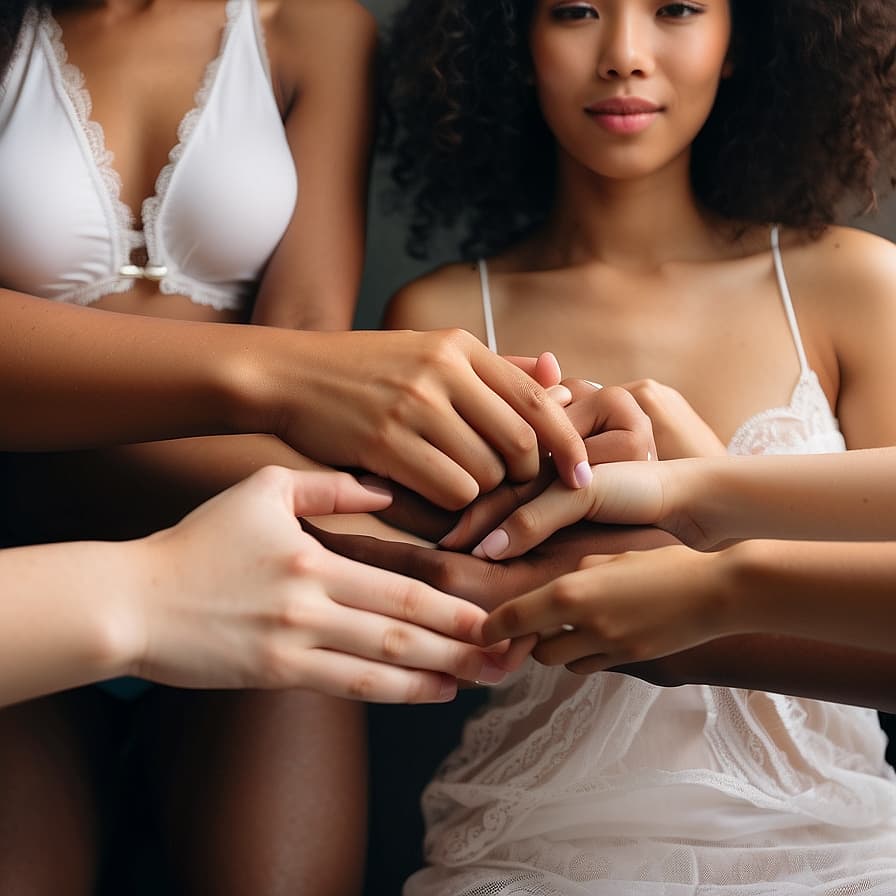
Hands
General Description: Hands are highly versatile and functional parts of the human body, used for grasping, feeling, and manipulating objects.
Ethnic Variations: While the basic structure of hands is similar across all humans, there can be variations in size and proportions among different ethnic groups.
Cultural Significance: Hands are often seen as symbols of skill and capability, and are central in many cultural gestures and expressions.
AI Character Design Considerations: Accurate representation of hands, including their movement and dexterity, is important in AI character design for realism and functionality.
Hands — taxonomy
7 dimensions · 7 photo-assessable · v1.0.0 · UBERON: UBERON:0002398
Hand morphology: hand size, palm shape, finger length proportions (digit ratio 2D:4D), finger morphology, nail morphology, knuckle prominence. The 2D:4D digit ratio is the most-cited individual hand-anthropometry dimension; Manning's prenatal-androgen-exposure hypothesis remains debated but the ratio itself is a well-established measurement with population-level variation.
Dimensions
Hand size (relative to body)
partly photo-observableordinal · hand_size_qualitative
Hand length relative to body height, captured qualitatively.
Aligned with anthropometric descriptors of hand-length proportional to height (typical ratio ~10.4-11.0%).
Valid values (3)
smallSmallaverageAveragelargeLarge
Palm shape
photo-observablecategorical · palm_shape_qualitative
Shape of the palm in proportional terms.
Aligned with descriptors used in chiromancy-adjacent hand-anthropometry literature.
Valid values (3)
squareSquare— Palm length approximately equal to palm width.rectangular_longRectangular / long— Palm length substantially exceeds width.wide_shortWide / short— Palm width approaches or exceeds length.
2D:4D digit ratio
partly photo-observablecategorical · manning_2D_4D
Ratio of index-finger length (2D) to ring-finger length (4D). Sex-dimorphic on average (males ~0.95-0.98, females ~0.97-1.00) with substantial individual variation.
Manning JT, Scutt D, Wilson J, Lewis-Jones DI (1998). The ratio of 2nd to 4th digit length: a predictor of sperm numbers and concentrations of testosterone, luteinizing hormone and oestrogen. Human Reproduction, 13(11): 3000-3004.
Valid values (3)
low_4D_dominantLow (ring finger longer)— 2D:4D ratio < ~0.95; ring finger clearly longer than index. More common in males.balancedBalanced— 2D:4D ratio ~0.95-1.00; subtle or no length difference.high_2D_dominantHigh (index finger longer)— 2D:4D ratio > ~1.00; index finger clearly longer than ring. Less common; more common in females.
Finger morphology
photo-observablecategorical · finger_thickness_qualitative
Overall thickness and shape of the fingers.
Aligned with hand-anthropometry descriptors used in glove-fitting and ergonomics literature.
Valid values (5)
slenderSlender— Long, thin fingers; narrow fingertips.balancedBalanced— Average finger thickness.thickThick— Substantial finger girth.taperedTapered— Wider at the base, narrower at the tips.spatulateSpatulate— Widening at the fingertips.
Knuckle prominence
photo-observableordinal · knuckle_prominence_qualitative
Visibility of the metacarpophalangeal joints as surface landmarks.
Aligned with surface-anatomy descriptors of metacarpophalangeal-joint visibility.
Valid values (3)
subtleSubtle— Knuckles barely visible; soft-tissue coverage smooth.moderateModerateprominentProminent— Clear knuckle landmarks even at rest.
Nail shape (when ungroomed)
photo-observablecategorical · nail_shape_qualitative
Native fingernail shape when not artificially shaped.
Aligned with descriptors used in dermatology and manicure literature.
Valid values (7)
squareSquareroundRoundovalOvalalmondAlmondstilettoStiletto / pointed— Often artificial; native nails rarely take this shape.groomed_artificialGroomed / artificial— Visible manicure or artificial nails; native shape not assessable.not_visibleNot visible
Wrist breadth (relative)
partly photo-observableordinal · wrist_breadth_qualitative
Wrist circumference relative to body proportions. Different from but related to body-shape.json's frame_size_estimate.
Aligned with frame-size literature; wrist circumference is the standard Frisancho frame-size proxy.
Valid values (3)
narrowNarrowaverageAveragewideWide
References (3)
- Manning JT, Scutt D, Wilson J, Lewis-Jones DI (1998). The ratio of 2nd to 4th digit length: a predictor of sperm numbers and concentrations of testosterone, luteinizing hormone and oestrogen. Human Reproduction, 13(11): 3000-3004.
- Frisancho AR (1984). New standards of weight and body composition by frame size and height. American Journal of Clinical Nutrition, 40(4): 808-819.
- Greiner TM, Gordon CC (1990). Anthropometry and Mass Distribution for Human Analogues. US Army Natick Laboratories Technical Report.
Top-coverage ethnic groups
Groups with the most image-grounded phenotype data — sorted by Data Depth score
- Soninken=39 · 85/100
- Tatarsn=70 · 85/100
- Uzbeksn=59 · 85/100
- Tuluvasn=52 · 84/100
- Irishn=49 · 84/100
- Iranunn=48 · 83/100
- Makassaresen=46 · 83/100
- Icelandersn=57 · 83/100
- Igbon=52 · 82/100
- Welshn=66 · 82/100
- Ibann=39 · 80/100
- Belarusiansn=62 · 80/100
- Ga-Adangben=35 · 79/100
- Estoniansn=73 · 79/100
- Javanesen=72 · 79/100
- Minangkabaun=51 · 79/100
- Mandinkan=54 · 79/100
- Tajiksn=37 · 79/100
- Ossetiansn=33 · 78/100
- Kadazan-Dusunn=33 · 78/100
- Kikuyun=34 · 78/100
- Garhwalisn=41 · 78/100
- Susun=26 · 77/100
- Tigrayansn=60 · 76/100