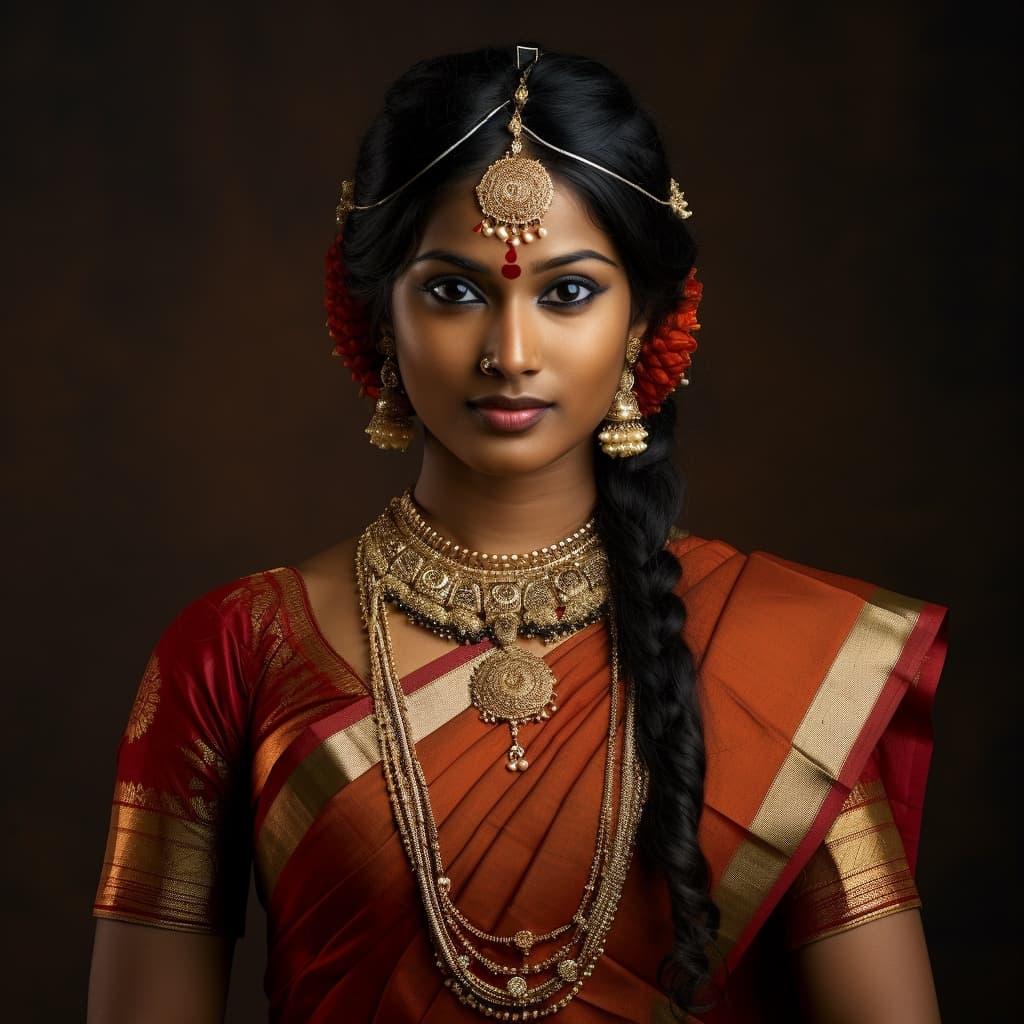
Tuluvas Erotic
Karnataka(India)
Tulu
Hinduism
Southern Asia
About Tuluvas People
The Tuluvas live along a narrow coastal strip of southwestern India — roughly the districts of Dakshina Kannada and Udupi in Karnataka, and Kasaragod across the border in Kerala — a region they themselves call Tulu Nadu. The geography matters: the Western Ghats rise sharply behind them and the Arabian Sea sits in front, so for centuries Tuluvas have been hemmed into a coastal world that faces outward by ship more easily than inland by road. This shaped a mercantile, port-town sensibility quite distinct from the agrarian Kannada-speaking interior.
Their language, Tulu, is Dravidian but not a dialect of Kannada — it branched off early and sits closer in some respects to the southern Dravidian cluster that includes Malayalam and Tamil. It is mostly unwritten in everyday use; Tuluvas typically read and write in Kannada or Malayalam, while Tulu itself thrives orally, in proverbs, oral epics, and the call-and-response of ritual performance. There is a distinctive Tulu script, historically used for religious manuscripts, but it has never been the workaday script of the community.
What sets the Tuluvas apart most clearly is matriliny. Inheritance, household identity, and lineage among many traditional Tuluva communities — particularly the Bunts and the Billavas — pass through the mother's line, under a system called aliyasantana. Property historically belonged to the joint matrilineal household rather than the individual, and a man's heirs were his sister's children rather than his own. Modern law has eroded the legal force of this, but the social texture persists: maternal uncles still carry weight, and women's status within the family is unusually robust by South Asian standards.
Religiously, Tuluvas are Hindu, but the practice on the ground is layered. Alongside mainstream temple worship sits Bhuta Kola — a spirit-veneration tradition in which costumed performers become possessed by local deities (bhutas), who then deliver judgments, settle disputes, and bless the year's harvest. These are not folk curiosities tacked onto Hinduism; in many villages they are the religion that actually governs daily life. Yakshagana, the all-night masked dance-drama drawn from the epics, is the other great performance tradition of the coast, and most Tuluvas have grown up with both. The cuisine — coconut-heavy, fish-forward, with a pronounced taste for tamarind sourness and roasted spice — tracks the same coastal logic: what the sea gives, and what grows in the strip between the Ghats and the shore.
Typical Tuluvas Phenotypes
Reference for AI generation — hair, eyes, skin, facial structure, build
Tuluvas are a Dravidian-speaking population from coastal Karnataka and northern Kerala — the Tulu Nadu belt — and their phenotype reflects long settlement on the Konkan coast rather than the inland Deccan. Skin tone runs from Fitzpatrick IV through deep V, with a warm bronze-to-coffee range that carries strong red-gold undertones rather than the ashier olive seen further north. Coastal sun exposure is intense year-round, so even lighter-skinned Tuluvas tend toward a tanned, sun-warmed complexion rather than fair.
Hair is near-uniformly black or very dark brown, with natural mahogany highlights surfacing in sun. Texture sits in the 2B–3A range — wavy to loosely curly, thick, and high-shine — coilier than typical North Indian hair but rarely tightly kinked. Premature graying is fairly common, often beginning in the thirties. Eyes are almost always dark brown to near-black, occasionally lighter hazel-brown in Bunt and Brahmin sub-groups; the eye is wide-set and almond-shaped with no epicanthic fold and characteristically heavy, dark lashes.
Facial structure is the more distinctive marker. Tuluvas tend toward broad, well-defined cheekbones, a relatively short midface, and a straight or slightly convex nose with a medium-to-wide alar base — narrower than Tamil or Malayali averages, broader than North Indian. Lips are medium-full and evenly proportioned; jawlines are square in men and softly rounded in women. The Bunt landowning community in particular is associated with taller stature and more angular features, while Mogaveera fishing communities skew shorter and more compactly built.
Average male stature sits around 167–170 cm, female around 154–157 cm — taller than the South Indian mean. Builds are generally lean-mesomorphic, with broad shoulders relative to hip width in men and an hourglass tendency in women. The combination of warm coastal skin, wavy 2B–3A hair, and sharply defined cheekbones — visible in figures like Devi Shetty and Shobha Karandlaje — is what most readily distinguishes Tuluva phenotype from neighboring Kannadiga and Malayali populations.
Data depth
84/100Coverage of image-grounded phenotype observations · drives AI generation diversity
- Sample size
- 40/40· 52 images
- Image quality
- 29/30· 58% high
- Confidence
- 15/20· mean 0.79
- Source diversity
- 0/10· wikipedia
- ·Wikipedia-only source — not population-representative
Observed Distribution — Image Sample
Empirical observations from analyzed photographs · supplementary signal, not population truth
Sample: 52 images analyzed (52 wikipedia). Quality: 30 high, 20 medium, 2 low, 0 very_low. Avg analyzer confidence: 0.79.
Skin tone (Fitzpatrick): IV (35%), V (62%), unclear (4%)
Hair color: gray/white (46%), black (46%), other (4%), unclear (4%)
Hair texture: straight (63%), wavy (19%), curly (2%), coily (6%), bald (6%), covered (2%), unclear (2%)
Eye color: dark brown (92%), unclear (8%)
Epicanthic fold: 0% present, 94% absent, 6% unclear
Caveats: Sample is 100% Wikipedia notable people — skews toward male, public-life, and modern figures, not population-representative.
Last aggregated: May 7, 2026
Explore phenotype categories
Structured taxonomy with peer-reviewed scales · 22 anatomical categories
Notable Tuluvas People
96 reference figures — sourced from Wikipedia
- Kayyar Kinhanna Rai — Indian independence activist and writer
- V. T. Rajshekar — founder and editor of the Dalit Voice
- K. K. Shetty — freedom fighter (was the editor of Navayuga for a short period)
- Mumthaaz Nelliadka — News anchor in TV Vikrama
- Jaya Prakash Shetty — News Anchor in Republic Kannada
- K. S. Hegde — former speaker of Lok Sabha; former judge of the Supreme Court of India
- N. Santosh Hegde — Karnataka Lokayuktha; former judge of the Supreme Court of India
- Rohini Salian — public prosecutor
- Kalmanje Jagannatha Shetty — 1926–2015), former judge, Supreme Court of India and former chief justice, Al…
- Kedambadi Jagannath Shetty — former judge of Karnataka High Court
- P. Gururaja Bhat — historian and writer of Tulunadu
- Bannanje Govindacharya — Vedic scholar
- Veerendra Heggade — philanthropist
- Padmanabh Jaini — Scholar of Buddhiam and Jainism
- M.K.Seetharam Kulal — Tulu-Kannada dramatist, poet; Karnataka State Tulu Sahithya Academy Award (2014)
- Madhvacharya — proponent of Dvaita (Dwaita) philosophy
- Venkataraja Puninchathaya — scholar
- Vadiraja Tirtha — Dvaita philosopher
- B. M. Hegde — educationist and surgeon
- Dinker Belle Rai — Indian American vascular surgeon, inventor, athlete and philosopher
- Devi Shetty — philanthropist and surgeon
- Shantharam Shetty — orthopaedic surgeon
- K. N. Udupa — Padma Shri recipient
- V. S. Acharya — former home minister, Karnataka state and former member of Karnataka legislat…
- A. Shanker Alva — former member of Parliament, Mangalore
- K. Nagappa Alva — former member of Parliament, Rajya Sabha (1970–1976) and health minister, Kar…
- Raghupati Bhat — former member of Karnataka Legislative Assembly (M.L.A.), elected from Udupi …
- D. V. Sadananda Gowda — former Minister of Chemicals and Fertilizers, former Minister of Law and Just…
- K. Jayaprakash Hegde — former member of Parliament
- Shobha Karandlaje — member of Parliament, Udupi Lok sabha constituency, Union Minister of State (…
- V. Dhananjay Kumar — former Union Minister
- Nalin Kumar Kateel — member of Parliament of Dakshina Kannada Lok Sabha constituency and former Pr…
- Manorama Madhwaraj — former member of Parliament, Udupi; former MLA Udupi
- Lalaji Mendon — MLA, Kaup Vidhansabha
- Veerappa Moily — former Chief Minister of Karnataka, member of the 16th Lok Sabha
- Janardhana Poojary — former Union Minister of State for Finance
- I. Rama Rai — former member of Parliament, Kasaragod
- Ramanath Rai — Minister for Forest, Environment and Ecology
- Kumble Sundara Rao — former MLA of Surathkal constituency
- Halady Srinivas Shetty — MLA 2013 assembly for Kundapura, Karnataka
- I. M. Jayarama Shetty — former member of Parliament, Udupi
- Suresh Shetty — MLA, Andheri (East), Maharashtra
- B. Nagaraja Shetty — former Minister and MLA of Bantwal constituency, Karnataka
- K. K. Hebbar — painter
- Kudroli Ganesh — Magician
- Prakash Shetty — cartoonist
- Sudarshan Shetty — born 1961) – artist
- R. Verman — art director
- Ranjith Bajpe — film director and screenwriter, known for his work in Tulu cinema
- Anup Bhandari — film director, music director, lyricist and playback singer
- Ramchandra P. N. — filmmaker
- Manmohan Shetty — founder of Adlabs Films
- Rohit Shetty — film director and producer
- B. Vittalacharya — film director of Kannada, Telugu-language cinema
- Vishal Kotian — Indian film and television actor
- M. B. Shetty — 1970s Bollywood actor
- Rakshit Shetty — Kannada actor, director
- Srinidhi Shetty — Miss Supranational 2016
- Sandeep Chowta — music director
- Kadri Gopalnath — saxophonist
- Gurukiran — music director
- Ganesh Hegde — singer, performer, video director and Bollywood choreographer
- Manikanth Kadri — film score and soundtrack composer and singer
- V. Manohar — music director, lyricist, film director and actor
- Vittal Ramamurthy — violinist
- Shweta Shetty — pop singer
- Vittal Rai — scientist
- Rajini Rao — physiologist
- Udupi Ramachandra Rao — scientist
- Kalidas Shetty — food scientist
- H. V. K. Udupa — electrochemical scientist
- Ashwini Akkunji — national-level athlete
- Ashish Ballal — former captain of the Indian Field Hockey team and Arjuna awardee
- Budhi Kunderan — cricketer
- Mamatha Poojary — kabadi player
- Nikhil Poojary — footballer
- Satheesha Rai — weightlifter, Olympian and Arjuna awardee
- Tanush Kotian — cricketer
- Shodhan Rai — international bodybuilder and Ekalavya Award winner
- Vandana Rao — national sprinter, 1990s
- Chirag Shetty — badminton player
- Pooja Shri Shetty — karateka
- Vikrant Shetty — United Arab Emirates cricketer
- Gundibail Sunderam — cricketer
- Siddhanth Thingalaya — national sprinter
- Shreyas Iyer — Indian Cricketer
- U. R. Bhat — director of Karnataka Bank
- A. B. Shetty — founder of Vijaya Bank and politician
- Mulki Sunder Ram Shetty — chairman of Vijaya Bank
- V. P. Shetty — chairman of JM Financial Asset Reconstruction Co. Pvt. Ltd., JM Financial Ass…
- Muthappa Rai — businessman
- Ajit Shetty — Belgian businessman; former chairman of the board of directors of Janssen Pha…
- B. R. Shetty — CMD New Medical Centre, billionaire; Padma Shri recipient
- R. N. Shetty — CMD RNS Infrastructure and hereditary administrator of Murudeshwara Shiva Temple
- Raj Shetty — founder of Ramee Hotels: a billionaire hotelier from Dubai
- Dinesh Chandra Bhandary — Vir Chakra recipient






Generate Tuluvas AI Content
Use this ethnicity's phenotype data to create AI-generated content with accurate physical traits and cultural context.
Open Creator Studio