Awadhis Erotic
Awadh (India)
Indo-European / Indo-Aryan / Hindustani / Awadhi
Hinduism
Barhai
Southern Asia
About Awadhis People
The Awadhis are the people of Awadh, the wedge of fertile Gangetic plain in what is now central Uttar Pradesh — roughly Lucknow, Faizabad, Sitapur, Bahraich, and the country in between. The land is flat, river-fed, and densely farmed, and Awadhi identity is bound up with that geography in a way that survives even after generations in Mumbai, Surat, or Mauritius. To call someone an Awadhi is to place them on that plain, in its courtyards and mango groves, with a particular cadence of speech and a particular set of manners around food, hospitality, and elders.
Their language, Awadhi, sits in the Indo-Aryan family alongside Hindi, Urdu, and Bhojpuri, but it is not simply a dialect of Hindi — it is older as a literary tongue than the standardized Hindi taught in schools. Tulsidas wrote the Ramcharitmanas in Awadhi in the sixteenth century, and Malik Muhammad Jayasi wrote Padmavat in it before him. That literary weight gives the language a status its modern speakers don't always claim out loud, since under census categories most Awadhis return their language as Hindi. The everyday register has a softer, more rounded sound than Khari Boli Hindi, with verb endings and pronouns that mark it instantly to a Hindi speaker as not quite the language of Delhi.
Most Awadhis are Hindu, with the usual caste stratification of the Gangetic belt — Brahmins, Thakurs, the trading and artisan jatis, and the large agricultural and Dalit populations who do most of the actual farming. The Barhai, a carpentry caste, are one such sub-group, traditionally responsible for plows, cart-wheels, doors, and the wooden frames of village houses; like other artisan jatis, they have moved heavily into urban trades over the last two generations. Awadh's Hindu life is shaped strongly by Ram-bhakti devotion, since Ayodhya — the mythological birthplace of Rama — sits in the middle of it, and that has made the region a flashpoint in modern Indian politics in ways outsiders sometimes underestimate.
Layered over the Hindu majority is a long Indo-Islamic history, the Nawabi court at Lucknow having set the region's standards for poetry, cuisine, and etiquette for two centuries. The famously slow-cooked dum biryani, the kebab traditions, the elaborate tehzeeb of greetings and forms of address — these are Awadhi as much as they are Muslim, and Hindu and Muslim Awadhis share them as common cultural property even when politics is doing its best to pull them apart.
Typical Awadhis Phenotypes
Reference for AI generation — hair, eyes, skin, facial structure, build
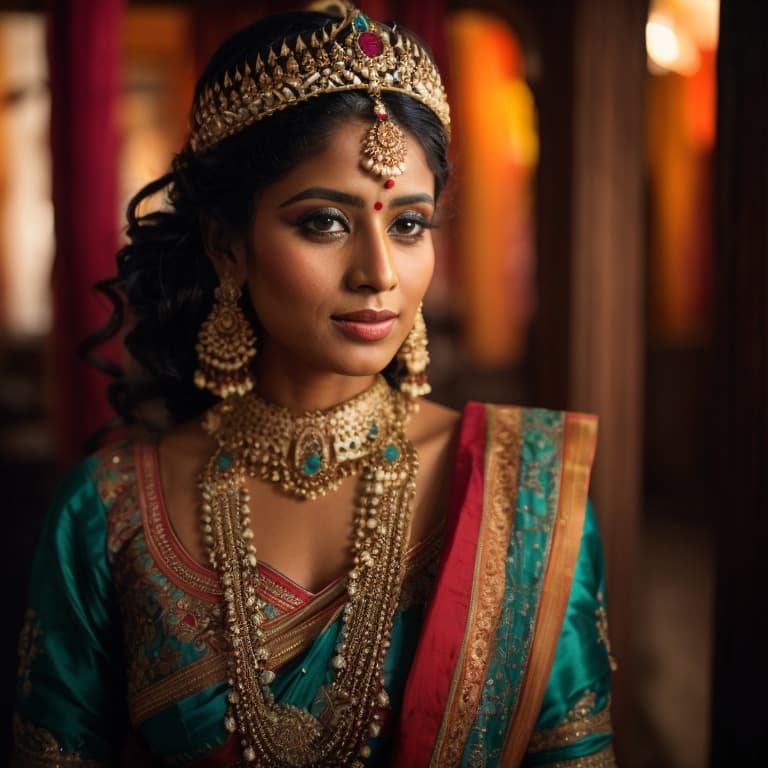
Awadhis are an Indo-Aryan population of the central Gangetic plain — the historic Awadh region around Lucknow, Faizabad, and Sitapur — and their phenotype sits squarely in the north-central Indian range, generally lighter and less Dravidian-featured than peninsular South Indian groups, but distinctly browner and rounder-faced than Punjabis or Kashmiris to the northwest.
Hair is almost uniformly black or very dark brown, with chestnut and dark-auburn highlights surfacing under sun. Texture runs straight to gently wavy; tight curls are uncommon, and the loose 2A–2B wave pattern dominates. Greying often begins early, by the late twenties in a visible minority. Body and facial hair on men is moderate to heavy — full beards grow in densely, and chest and forearm hair is typical rather than sparse.
Eye color is overwhelmingly dark brown to near-black, with a small fraction shading to lighter honey-brown or hazel, particularly in older Kayastha and Brahmin lineages. The epicanthic fold is absent; eyes are almond-shaped, often large, with thick lashes and pronounced upper-lid crease. Brows tend to be heavy and well-defined.
Skin tone covers a broad band of Fitzpatrick III to V — wheatish to medium-brown is the modal range, with warm yellow-olive or golden undertones rather than the cooler red-brown common further south. Rural sun-exposure pushes many darker; urban and upper-caste populations skew lighter.
Facial structure shows a straight or slightly aquiline nose with a medium bridge and moderate alar width — narrower than typical Bengali noses, broader than Kashmiri. Lips are medium-full, often with a defined cupid's bow. Cheekbones are softly rounded rather than sharply angular, and jawlines tend to be oval rather than square. Foreheads are broad.
Build is medium-framed; men average roughly 165–172 cm, women 152–158 cm. Body composition leans toward soft-muscular with a tendency to central adiposity in middle age. The Barhai (carpenter caste) sub-group shows no consistent visible phenotype distinction from the broader Awadhi population — variation is occupational and class-linked rather than morphological.
Data depth
0/100Coverage of image-grounded phenotype observations · drives AI generation diversity
- Sample size
- 0/40· 0 images
- Image quality
- 0/30· 0% high
- Confidence
- 0/20
- Source diversity
- 0/10
- ·No image observations yet
Explore phenotype categories
Structured taxonomy with peer-reviewed scales · 22 anatomical categories




Generate Awadhis AI Content
Use this ethnicity's phenotype data to create AI-generated content with accurate physical traits and cultural context.
Open Creator Studio