Eyes
12 structured phenotype dimensions · drawn from peer-reviewed scales
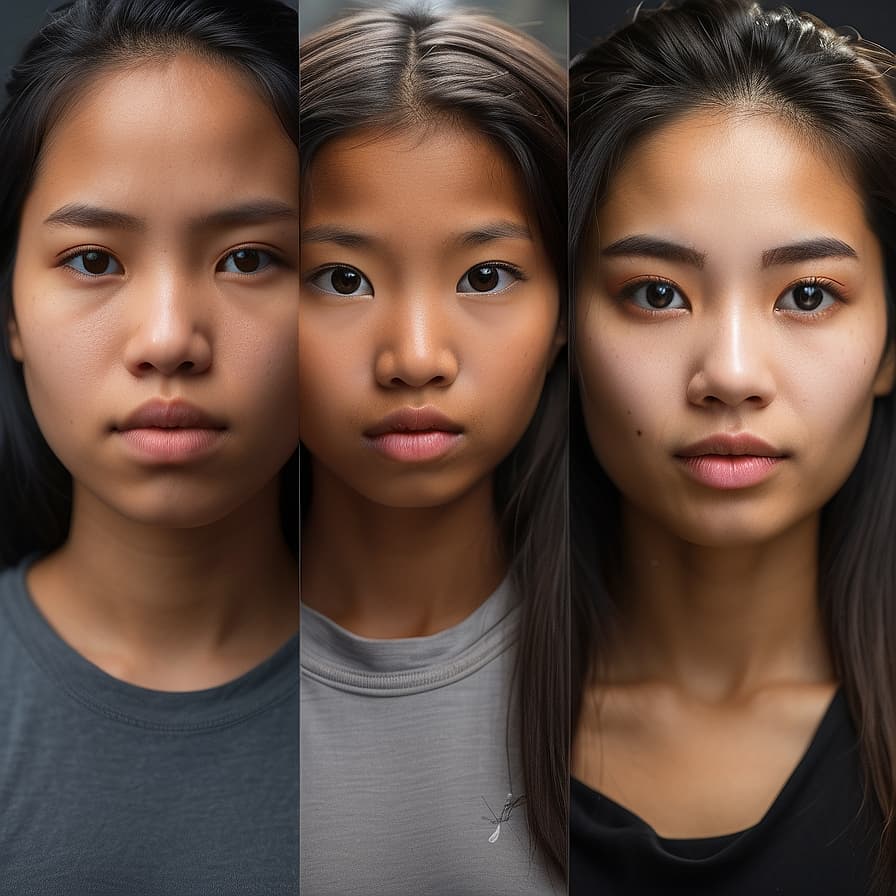
Eyes
General Description: The eyes are sensory organs that enable vision, one of the primary senses. They are capable of perceiving light and converting it into electrochemical signals that can be interpreted by the brain.
Ethnic Variations: Eye shape, size, and color can vary significantly across different ethnic groups. For instance, East Asian populations often have a characteristic epicanthic fold, while Caucasian eyes may have a larger variety of colors ranging from blue to green to brown. African and Hispanic populations typically have darker eye colors. The distribution of fat and connective tissues around the eyes also varies, influencing eye shape and eyelid appearance.
Cultural Significance: In many cultures, eyes are considered expressive features that convey emotion. Some societies may have historical or cultural preferences for certain eye shapes or colors, though such preferences are highly subjective and vary widely.
AI Character Design Considerations: When designing AI characters, incorporating these variations can enhance the authenticity and relatability of characters. It's important to offer a range of options that reflect the diversity of human eyes, including variations in color, shape, and size, to cater to a global audience.
Eyes — taxonomy
12 dimensions · 12 photo-assessable · v1.0.0 · UBERON: UBERON:0000970
Periocular phenotype: eye globe, eyelid morphology, palpebral fissure metrics, epicanthic fold, brow ridge, eyebrow morphology, and tear-trough region. Absorbs the original Eyelids and Eye Color atlas categories per the granularity decision (eye color is a single dimension, eyelid morphology is tightly coupled to eye morphology, brow region is the soft-tissue continuation of orbital anatomy). Dimensions are drawn from craniofacial anthropometry (Farkas), oculoplastic surgery (Putterman, McCord), Asian-eyelid-surgery classification literature (McCurdy, Liu, Chen), and dermatology / aging-face literature for the brow and tear-trough dimensions.
Dimensions
Iris color
photo-observablecategorical · iris_color_qualitative
Predominant color of the iris. Heterochromia is captured as its own value; mixed colors (e.g. hazel, blue-green) get distinct buckets.
Sturm RA, Larsson M (2009). Genetics of human iris colour and patterns. Pigment Cell & Melanoma Research, 22(5). Categorical descriptors aligned with the OCA2/HERC2 phenotype literature.
Valid values (12)
very_dark_brownVery dark brown / black-appearing— Iris appears nearly black under typical lighting; high melanin content. Common in East Asian, South Asian, Sub-Saharan African, and indigenous populations.brownBrown— Medium to dark brown iris; visible iris detail.light_brownLight brown— Lighter brown with visible warmth; sometimes called amber when more golden.amberAmber / honey— Golden-yellow to copper iris; relatively rare. Distinct from light brown by the warmth of the hue.hazelHazel— Mixed brown and green/gold; central iris differs in color from peripheral iris (central heterochromia).greenGreen— True green; uncommon globally, concentrated in Northern and Eastern European populations.blue_greenBlue-green— Mixed blue and green with neither dominant.blueBlue— True blue; highest frequency in Northern European populations, decreases southward.grayGray— Gray to gray-blue iris; lower stromal melanin than blue.violetViolet— Rare; very low melanin with red light scattering combined with blue stroma.heterochromiaHeterochromia— Two different iris colors — either between eyes (heterochromia iridis) or within one iris (sectoral heterochromia).unclearUnclear— Lighting, image quality, or angle prevents reliable iris-color assessment.
Eye shape
photo-observablecategorical · eye_shape_qualitative
Overall shape of the visible eye, considering the silhouette of the upper and lower lid margins together. Independent dimension from eyelid_crease_type and epicanthic_fold, which capture finer morphological variation.
Aligned with oculoplastic-surgery descriptors and aesthetic-anatomy literature (McCord CD Jr, Codner MA — Eyelid and Periorbital Surgery, 2nd Edition, 2016).
Valid values (9)
almondAlmond— Slightly elongated horizontal axis; mild taper at lateral and medial canthi. Considered the aesthetic reference shape.roundRound— Vertical and horizontal axes approximately equal; minimal canthal taper. Visible sclera above and below the iris.hoodedHooded— Upper lid skin descends over the lid crease, partially or fully covering the upper lid platform. Often associated with periorbital aging but can be constitutional.monolidMonolid (no visible crease)— Smooth upper lid with no visible supratarsal crease. Common in East Asian populations; associated with single eyelid morphology.deep_setDeep-set— Eye sits deep within the orbital socket; pronounced shadow above the upper lid. Brow ridge typically prominent.protrudingProtruding— Eye sits forward of the orbital socket; sclera visible around the entire iris circumference. Constitutional or proptotic.downturnedDownturned— Lateral canthus sits below the medial canthus; outer corner droops downward.upturnedUpturned— Lateral canthus sits above the medial canthus; outer corner angles upward. Common in East Asian populations and as an aging-related lid laxity sign.asymmetricAsymmetric— Notable left-right shape difference as the dominant feature.
Upper eyelid crease type
photo-observablecategorical · mccurdy_chen_eyelid_crease
Morphology of the upper eyelid supratarsal crease. The single most ethnically-variant periocular dimension. The Asian-ophthalmology / Asian-blepharoplasty literature provides the canonical classification system, distinguishing several functional and aesthetic patterns.
McCurdy JA Jr (2005). Cosmetic surgery of the Asian face. Thieme. Chen WP (2007). Asian Blepharoplasty and the Eyelid Crease. Butterworth-Heinemann.
Valid values (7)
single_no_creaseSingle eyelid (monolid, no crease)— No visible supratarsal crease; smooth upper lid skin. Approximately 50% of East Asian populations.double_lowDouble, low (~3-5mm above lash line)— Crease present but sits low on the lid, close to the lash line. Common in East Asian populations with double lids.double_mediumDouble, medium (~6-9mm)— Mid-position crease; common reference range for European-population eyelids.double_highDouble, high (>9mm)— High crease position; substantial visible upper lid platform between lash line and crease.partial_incompletePartial / incomplete— Crease present medially but fades or disappears laterally — or vice versa.multiple_creaseMultiple creases— Two or more visible creases on the same lid; commonly age-related but can be constitutional.asymmetricAsymmetric (single one side, double other)— One eye is single and the other double — common variation, particularly in East Asian populations.
Epicanthic fold
photo-observablecategorical · duke_elder_epicanthus_classification
Presence and morphology of the epicanthic fold — the skin fold of the upper eyelid that may cover the medial canthus. Significant ethnic variation; high prevalence in East Asian, Central Asian, and indigenous American populations.
Duke-Elder S (1964). System of Ophthalmology, Volume III. CV Mosby. The classical four-type Duke-Elder classification (tarsalis, palpebralis, supraciliaris, inversus) remains the standard ophthalmologic vocabulary.
Valid values (6)
absentAbsent— No epicanthic fold; medial canthus clearly visible.epicanthus_tarsalisTarsalis— Fold begins at the upper lid skin and inserts on the lower lid, covering the medial canthus. The most common epicanthic-fold variant in East Asian populations.epicanthus_palpebralisPalpebralis— Fold extends from the upper to the lower lid, covering the medial canthus more symmetrically.epicanthus_supraciliarisSupraciliaris— Fold originates at the eyebrow region and continues down to the lacrimal region. Less common; more characteristic of some Inuit and indigenous American populations.epicanthus_inversusInversus— Fold begins at the lower lid and extends upward; partial coverage of the medial canthus from below. Often associated with telecanthus / blepharophimosis syndrome.partial_residualPartial / residual— Subtle fold residue; medial canthus partially obscured but not fully covered. Can be developmental remnant or post-blepharoplasty result.
Palpebral fissure slant
photo-observablecategorical · fissure_axis_qualitative
Angle of the palpebral fissure axis (line from medial to lateral canthus) relative to horizontal. Significant ethnic variation; East Asian populations average steeper upslant than European populations.
Farkas LG (1994). Anthropometry of the Head and Face, 2nd Edition. Reference: palpebral fissure axis approximately 10° upslant from horizontal in the European-population aesthetic norm.
Valid values (5)
horizontalHorizontal— Lateral canthus at the same level as medial canthus; axis approximately 0°.slight_upslantSlight upslant— Lateral canthus slightly higher than medial; ~5-10° above horizontal. Within the European aesthetic reference range.marked_upslantMarked upslant— Lateral canthus substantially higher than medial; >10° above horizontal. Common in East Asian populations.slight_downslantSlight downslant— Lateral canthus slightly below medial; visible fatigue or aging appearance.marked_downslantMarked downslant— Lateral canthus substantially below medial. Associated with genetic syndromes or significant lid laxity.
Palpebral fissure length
photo-observableordinal · palpebral_fissure_length_qualitative
Length of the palpebral fissure (medial canthus to lateral canthus), expressed proportionally relative to intercanthal distance.
Farkas LG (1994). Anthropometry of the Head and Face, 2nd Edition. Reference: en-ex (medial-canthus to lateral-canthus distance) approximately 28-32mm in adult European-population norms.
Valid values (3)
shortShort— Fissure length less than intercanthal distance; small visible eye.normalNormal— Fissure length approximately equal to intercanthal distance.longLong— Fissure length greater than intercanthal distance; large visible eye.
Intercanthal distance
photo-observableordinal · intercanthal_distance_qualitative
Distance between the medial canthi, expressed proportionally relative to palpebral fissure length. Captures telecanthus (wide-set eyes) at one extreme.
Farkas LG (1994). Anthropometry of the Head and Face, 2nd Edition. Reference: en-en (medial-to-medial canthus distance) approximately 30-34mm in adult European-population norms; relative reference is en-en ≈ palpebral fissure length.
Valid values (3)
narrowNarrow (close-set)— Intercanthal distance less than approximately 90% of palpebral fissure length.normalNormal— Intercanthal distance approximately equal to palpebral fissure length (Farkas European-population norm).wide_telecanthusWide (telecanthus)— Intercanthal distance substantially greater than palpebral fissure length. Constitutional in some populations; pathologic in genetic syndromes.
Brow ridge (supraorbital ridge) prominence
partly photo-observableordinal · supraorbital_ridge_qualitative
Prominence of the supraorbital bony ridge above the eyes. Sex-correlated and with population-level variation.
Aligned with craniofacial-anthropology descriptors of supraorbital torus development. Sex-correlated (more prominent in adult males) and with population-level variation.
Valid values (3)
flatFlat— No visible bony prominence above the orbital rim; smooth transition between orbit and forehead.moderateModerate— Visible but not pronounced supraorbital ridge.prominentProminent— Strongly visible supraorbital torus; deep-set appearance to the eyes.
Eyebrow density
photo-observableordinal · eyebrow_density_qualitative
Density of native eyebrow hair, untreated. Cosmetic shaping (waxing, threading, microblading, tattooing) affects observed density and should reduce confidence.
Aligned with cosmetic-and-dermatology descriptors of brow density; no single canonical scale.
Valid values (5)
sparseSparse— Few visible hairs; gaps within the brow body.thinThin— Brow visible but light density throughout.normalNormal— Average density.denseDense— Thick, full brow with little visible skin within the brow body.very_denseVery dense— Brow extends into bushy or unibrow territory; high terminal-hair count.
Eyebrow shape
photo-observablecategorical · eyebrow_shape_qualitative
Overall arch and shape of the eyebrow as visible in the photograph.
Cosmetic-industry shape vocabulary aligned with brow-aesthetics literature (Westmore brow-mapping, etc.).
Valid values (6)
straightStraight— Minimal arch; nearly horizontal brow line.soft_archSoft arch— Gentle, gradual arch; arch peak in the lateral two-thirds.high_archHigh arch— Pronounced arch with a clear peak; stronger lateral-tail descent.roundedRounded— Curved brow without a distinct arch peak; smooth crescent shape.flat_descendingFlat / descending— No arch; brow descends laterally toward the temple.asymmetricAsymmetric— Notable left-right brow shape difference.
Tear-trough / infraorbital darkness
photo-observableordinal · infraorbital_darkness_qualitative
Visible darkness or hollowness in the infraorbital region (under-eye). Constitutional in some ethnic groups (notably South Asian, Mediterranean populations); also age-related and lifestyle-related.
Aligned with the Hirmand classification of tear-trough deformity (Hirmand H — Plastic and Reconstructive Surgery, 2010, 125(2)) for visible severity.
Valid values (4)
absentAbsent— No discernible darkness or hollowness.mildMild— Subtle pigmentation or shallow tear-trough; not the dominant feature of the periorbital region.moderateModerate— Clearly visible darkness or hollowness; periorbital region appears tired.markedMarked— Pronounced infraorbital pigmentation or deep tear-trough; significant aesthetic concern in cosmetic-medicine context.
Eye protrusion (anteroposterior)
partly photo-observablecategorical · eye_protrusion_qualitative
Anteroposterior position of the globe relative to the orbital rim. Constitutional variation; pathologic at the extremes (proptosis / enophthalmos).
Aligned with ophthalmologic exophthalmometry descriptors (Hertel exophthalmometry); qualitative-bucket equivalent for visual assessment.
Valid values (3)
recessedRecessed (enophthalmic-leaning)— Globe sits posterior to the orbital rim; deep-set appearance.normalNormal— Globe at typical orbital rim position.prominentProminent (proptotic-leaning)— Globe sits anterior to the orbital rim; visible sclera around the iris circumference.
References (8)
- Farkas LG (1994). Anthropometry of the Head and Face, 2nd Edition. Raven Press.
- Duke-Elder S (1964). System of Ophthalmology, Volume III. CV Mosby.
- Sturm RA, Larsson M (2009). Genetics of human iris colour and patterns. Pigment Cell & Melanoma Research, 22(5).
- McCurdy JA Jr (2005). Cosmetic surgery of the Asian face. Thieme.
- Chen WP (2007). Asian Blepharoplasty and the Eyelid Crease. Butterworth-Heinemann.
- McCord CD Jr, Codner MA (2016). Eyelid and Periorbital Surgery, 2nd Edition. Quality Medical Publishing.
- Hirmand H (2010). Anatomy and nonsurgical correction of the tear trough deformity. Plastic and Reconstructive Surgery, 125(2).
- Putterman AM (1999). Cosmetic Oculoplastic Surgery, 3rd Edition. WB Saunders.
Top-coverage ethnic groups
Groups with the most image-grounded phenotype data — sorted by Data Depth score
- Soninken=39 · 85/100
- Tatarsn=70 · 85/100
- Uzbeksn=59 · 85/100
- Tuluvasn=52 · 84/100
- Irishn=49 · 84/100
- Iranunn=48 · 83/100
- Makassaresen=46 · 83/100
- Icelandersn=57 · 83/100
- Igbon=52 · 82/100
- Welshn=66 · 82/100
- Ibann=39 · 80/100
- Belarusiansn=62 · 80/100
- Ga-Adangben=35 · 79/100
- Estoniansn=73 · 79/100
- Javanesen=72 · 79/100
- Minangkabaun=51 · 79/100
- Mandinkan=54 · 79/100
- Tajiksn=37 · 79/100
- Ossetiansn=33 · 78/100
- Kadazan-Dusunn=33 · 78/100
- Kikuyun=34 · 78/100
- Garhwalisn=41 · 78/100
- Susun=26 · 77/100
- Tigrayansn=60 · 76/100