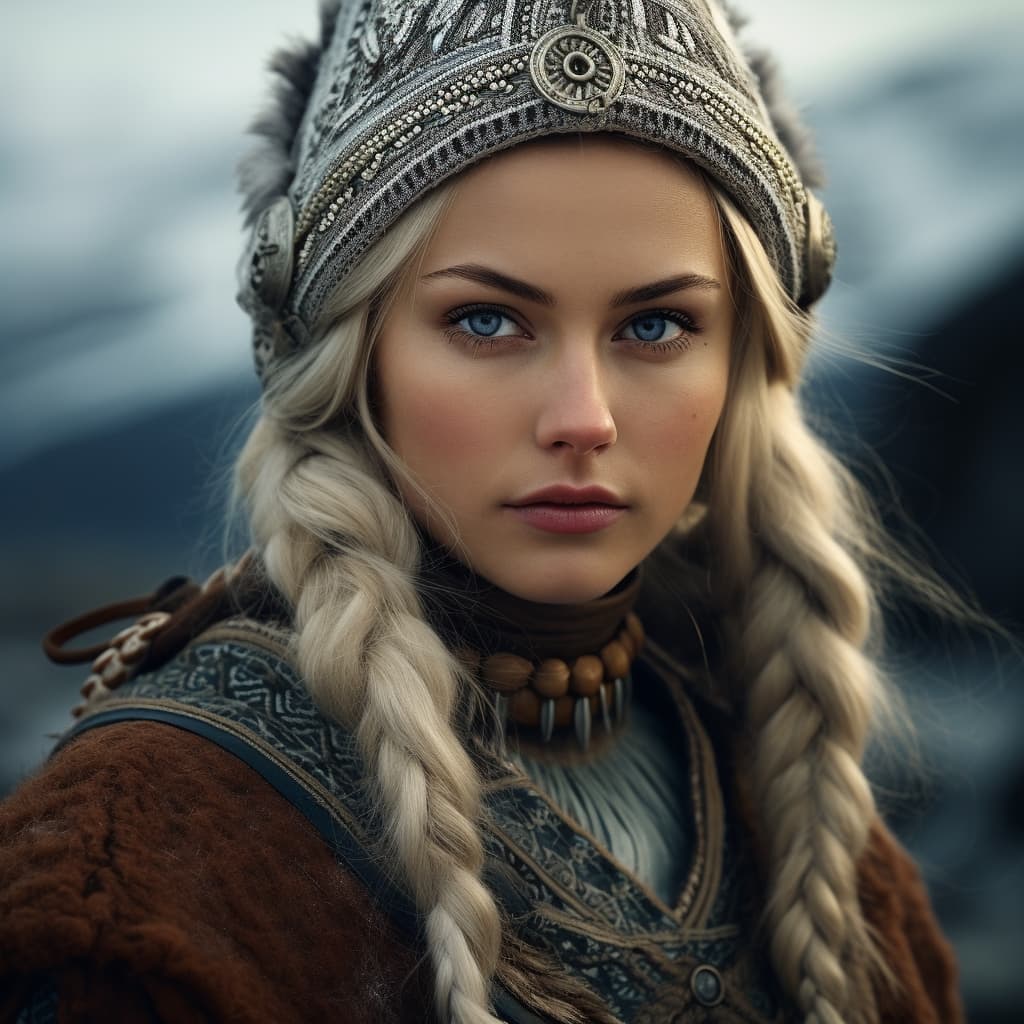
Icelanders Erotic
Iceland
Indo-European / Germanic / Nordic / Icelandic
Christianity / Protestantism
Northern Europe
About Icelanders People
Icelanders are the descendants of a ninth- and tenth-century settlement project, mostly Norse with a substantial Gaelic admixture from the Hebrides and Ireland, who arrived on an uninhabited volcanic island in the North Atlantic and have stayed put ever since. The population is small — roughly the size of a mid-sized European city — and concentrated on a coastal strip, with the interior left to lava fields, glaciers, and sheep tracks. That smallness shapes everything. Genealogy is a near-universal hobby because almost any two Icelanders can establish a common ancestor within a few generations, and a public database called Íslendingabók makes the search trivial.
The language is the conservative outlier of the Nordic family. While Norwegian, Swedish, and Danish drifted toward each other and shed grammatical complexity, Icelandic kept the four-case noun system and much of the vocabulary of Old Norse, so a literate speaker today can read the medieval sagas without translation. New technology gets native coinages rather than loanwords — a computer is a tölva, from the words for number and seeress — and a state-backed language committee mints these terms deliberately. Personal names follow the patronymic system: a man named Jón whose father was Einar is Jón Einarsson, and his sister is Jónsdóttir, which is why the phone book is alphabetized by first name.
The conversion to Christianity in the year 1000 was decided by parliamentary vote at the Alþingi, the open-air assembly that had been running since 930 and is one of the oldest continuous legislative bodies in the world. The Lutheran state church has been the official faith since the Reformation and still claims most of the population on paper, though active religious practice is modest and the country is comfortably secular in daily life. What persists more visibly is a folk tradition that takes the unseen seriously — the huldufólk, or hidden people, are referenced often enough in road planning and construction that the topic is not entirely a joke.
The saga literature, written in the thirteenth and fourteenth centuries about events two or three hundred years earlier, gives Icelanders a literary canon older and more developed than most European nations possess, and a self-image as a reading and writing people. Per capita book publication remains among the highest in the world, and the Christmas season centers on a tradition called jólabókaflóð — the Yule book flood — in which new titles are exchanged on the evening of the 24th and the night is spent reading.
Typical Icelanders Phenotypes
Reference for AI generation — hair, eyes, skin, facial structure, build
Icelanders are one of the most genetically homogeneous populations in Europe, the result of a small Norse and Gaelic founder population settling a remote North Atlantic island around the 9th century and breeding largely among themselves for over a millennium. The phenotype reflects that bottleneck: a narrow, recognizable Nordic-Celtic range with less variation than mainland Scandinavia.
Hair runs from pale ash blond and strawberry blond through mid and dark brown, with true platinum less common in adulthood than in childhood — many Icelanders are tow-headed as kids and darken to a dirty blond or light brown by their twenties. Texture is typically straight to loosely wavy, fine to medium in density. Natural red and auburn appear at meaningful frequency — a clear Gaelic inheritance from the Irish and Scottish women in the founding population — though not at Scottish-Irish levels.
Eye color skews heavily blue and grey-blue, with green and hazel common and pure brown a minority. The eye shape is open and round to almond, with no epicanthic fold, often set under pale, sparse brows. Skin is Fitzpatrick I to II — very fair, pink or neutral undertones, freckling readily under sun exposure that the Icelandic climate rarely provides. Many adults retain a translucent, slightly ruddy complexion year-round.
Facial structure tends toward a longer mid-face, a straight or slightly high-bridged narrow nose, a defined jawline, and lips on the thinner side of the European range. Cheekbones are moderate rather than dramatic. Björk's broad, flat cheek plane and small features are recognizably Icelandic but sit at one end of the range; the more angular, long-faced look seen in figures like Baltasar Kormákur is closer to the male median.
Build is tall — Icelandic men average around 181 cm and women around 168 cm, among the tallest in Europe — with broad shoulders, long limbs, and a tendency toward solid, athletic frames rather than slender ones. The overall impression is uniformly Northern European, dialed slightly toward the Celtic by the redhead and freckling frequency.
Data depth
83/100Coverage of image-grounded phenotype observations · drives AI generation diversity
- Sample size
- 40/40· 57 images
- Image quality
- 28/30· 56% high
- Confidence
- 15/20· mean 0.72
- Source diversity
- 0/10· wikipedia
- ·Wikipedia-only source — not population-representative
Observed Distribution — Image Sample
Empirical observations from analyzed photographs · supplementary signal, not population truth
Sample: 57 images analyzed (57 wikipedia). Quality: 32 high, 20 medium, 3 low, 2 very_low. Avg analyzer confidence: 0.72.
Skin tone (Fitzpatrick): II (88%), III (5%), IV (2%), unclear (5%)
Hair color: gray/white (44%), light/medium brown (21%), black (14%), blonde (9%), dark brown (4%), red/auburn (4%), other (2%), unclear (4%)
Hair texture: straight (49%), wavy (37%), curly (4%), bald (4%), covered (4%), unclear (4%)
Eye color: blue (46%), dark brown (11%), hazel (4%), brown (2%), unclear (39%)
Epicanthic fold: 0% present, 86% absent, 14% unclear
Caveats: Sample is 100% Wikipedia notable people — skews toward male, public-life, and modern figures, not population-representative.
Last aggregated: May 7, 2026
Explore phenotype categories
Structured taxonomy with peer-reviewed scales · 22 anatomical categories
Notable Icelanders People
100 reference figures — sourced from Wikipedia
- Björgólfur Thor Björgólfsson — billionaire entrepreneur
- Björgólfur Guðmundsson — former billionaire entrepreneur, father of Thor Björgólfsson (above)
- Eggert Magnússon — businessman and former chairman of the English Premiership football club West…
- Hreiðar Már Sigurðsson — businessman
- Jón Ásgeir Jóhannesson — billionaire and founder of the Bónus supermarket and the Baugur Group
- Magnús Þorsteinsson — businessman
- Arnor Sighvatsson — economist
- Einar Benediktsson — writer, poet
- Einar Hjörleifsson Kvaran — editor, novelist, poet, dramatist
- Guðmundur G. Hagalín — writer, poet
- Halldór Kiljan Laxness — writer, poet, Nobel Prize winner
- Jón Kalman Stefánsson — writer, poet
- Jónas Hallgrímsson — writer, poet
- Halldóra Bjarnadóttir — educator, author
- Jóhannes úr Kötlum — writer, poet
- Magnus Magnusson — television presenter, writer
- Nína Björk Árnadóttir — poet, novelist, playwright
- Sjón — poet, writer, lyricist
- Snorri Sturluson — historian, poet
- Steinunn Sigurðardóttir — writer, poet
- Stephan G. Stephansson — Western Icelander, poet
- Þórarinn Eldjárn — writer, poet
- Þórbergur Þórðarson — writer, poet
- Ágústa Eva Erlendsdóttir — best known as Silvía Nótt (Silvia Night), actress, singer, model, TV personal…
- Baltasar Kormákur — film actor and film director
- Egill (Eagle) Örn Egilsson — cinematographer, Director, TV Production
- Friðrik Þór Friðriksson — film director
- Gunnar Hansen — film actor
- Hilmir Snær Guðnason — film actor
- Hrafn Gunnlaugsson — film director
- Karl Júlíusson — film production designer/costume designer
- Magnús Scheving — writer, actor, athlete, creator of LazyTown
- Markús Örn Antonsson — former mayor of Reykjavík and former director of RÚV
- Páll Magnússon — former director of RÚV, a member of the Icelandic parliament
- Ragnar Bragason — director
- Tinna Gunnlaugsdóttir — actress and former Artistic Director of the National Theatre of Iceland
- Örvar Þóreyjarson Smárason — poet, writer, musician
- Anna Mjöll — singer-songwriter
- Arndís Halla — born 1969), opera singer, songwriter and entertainer
- Ásgeir Trausti — singer-songwriter
- Bára Gísladóttir — born 1989), musician and composer
- Björk Guðmundsdóttir — singer-songwriter more commonly known as Björk
- Bragi Ólafsson — musician
- Daði Freyr — musician
- Diddú — Sigrún Hjálmtýsdóttir), soprano and songwriter
- Emilíana Torrini — singer-songwriter
- Einar Örn Benediktsson — musician
- Eiríkur Hauksson — musician
- Eythor Arnalds — musician
- Gabríel Ólafs — composer
- Greta Salóme Stefánsdóttir — singer, violinist
- Gunnsteinn Ólafsson — musician, composer
- Hafdís Bjarnadóttir — born 1977), composer and musician
- Halldor Mar — songwriter and guitarist
- Haukur Tómasson — composer
- Hildur Guðnadóttir — musician and composer, first solo woman to win a Golden Globe Award for Best …
- Hallgrímur Helgason — composer, conductor, violinist, and musicologist
- Hilmar Örn Hilmarsson — musician, art director, and chief goði of the Icelandic Ásatrú Association
- Jóhann Jóhannsson — composer, musician, producer
- Jón Jósep Snæbjörnsson — Jónsi) singer
- Jón Leifs — composer
- Jón Þór Birgisson — singer, guitarist
- Jóhanna Guðrún Jónsdóttir — pop singer (Yohanna)
- Kjartan Ólafsson — born 1958), composer, professor
- Laufey Lín Jónsdóttir — musician
- Mugison — composer, musician
- Nanna Bryndís Hilmarsdóttir — musician
- Ólafur Arnalds — composer, musician
- Páll Óskar Hjálmtýsson — Paul Oscar), pop singer, songwriter and disc jockey
- Ragnheiður Gröndal — musician
- Sigurður Bragason — baritone singer and composer
- Hólmfríður "Hófí" Karlsdóttir — Miss World 1985
- Linda Pétursdóttir — Miss World 1988
- Unnur Birna Vilhjálmsdóttir — Miss World 2005
- Ari Þorgilsson — priest and author of Íslendingabók, a historical work
- Björn Sveinsson Björnsson — first born son of Sveinn Björnsson, and an Waffen-SS volunteer
- Egill Skallagrímsson — Viking skald
- Eiríkur rauði — e. Eirík the Red, Old Norse. Eirīkr hinn rauði) named Greenland
- Guðríður Þorbjarnardóttir — explorer
- Leifur Eiríksson — e. Leif Ericson, Old Norse Leifr Eiríksson), discovered America in the year 1…
- Loftur Sæmundsson — priest and chieftain at Oddi
- Solveig Guðmundsdóttir — heir and landlord
- Þorleifur Skaftason — priest and Galdrmaster
- Vilhjálmur Stefánsson — Western Icelander, Arctic explorer
- Þóra Magnúsdóttir — born 1100 in Norway, daughter of Magnus III of Norway, a direct descendant of…
- Albert Guðmundsson — former minister
- Árni Sigfússon — politician
- Ásgeir Ásgeirsson — former president
- Bergdis Ellertsdóttir — ambassador
- Birgitta Jónsdóttir — member of parliament
- Björn Bjarnason — minister of justice and ecclesiastical affairs
- Davíð Oddsson — former prime minister and former mayor of Reykjavík
- Geir H. Haarde — former prime minister, former foreign minister
- Guðni Thorlacius Jóhannesson — former president
- Halla Tómasdóttir — current president
- Halldór Ásgrímsson — former prime minister
- Halldór Blöndal — former minister
- Hannes Hafstein — first prime minister
- Hannibal Valdimarsson — chairman of two parties and one electoral alliance
- Hulda Jakobsdóttir — 1911–1998), Iceland's first woman mayor






More from Northern Europe
Generate Icelanders AI Content
Use this ethnicity's phenotype data to create AI-generated content with accurate physical traits and cultural context.
Open Creator Studio