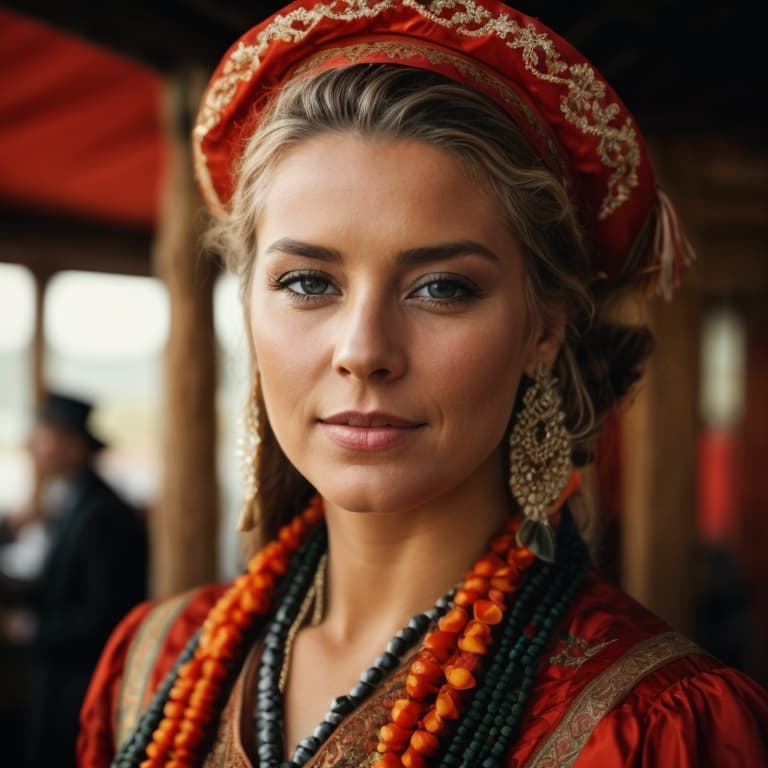
Danes Erotic
Denmark
Indo-European / Germanic / Nordic / Danish
Christianity / Protestantism
Significant populations in the United States, Canada, Greenland, and Germany.
Northern Europe
About Danes People
Danes are the people of the Jutland peninsula and the archipelago that spills out from it into the Baltic — somewhere around six million on a flat, water-cut country where nowhere is more than fifty kilometres from the sea. That geography matters. Denmark is small, ice-scraped, and almost entirely arable, and the Danish self-image has long been shaped by the absence of mountains, fortresses, or natural boundaries: the country was always going to live or die by what it could negotiate with its neighbours. The Vikings sailing out of Jelling and Roskilde in the ninth and tenth centuries are the same population that, a millennium later, settled into one of the most consensus-driven welfare states in the world. Both impulses — outward reach, inward solidarity — are still legible in how Danes talk about themselves.
The Danish language belongs to the North Germanic branch and is closely enough related to Norwegian and Swedish that the three are mostly mutually intelligible in writing, though spoken Danish is notoriously soft-edged, with swallowed consonants and the famous glottal stød that gives the speech its clipped, almost reluctant cadence. Danish is the working language of Denmark proper, the Faroe Islands, and Greenland, and survives in pockets in Schleswig in northern Germany, where the border with the Danish-speaking minority was redrawn after a 1920 plebiscite — one of the rare twentieth-century border changes settled by a vote rather than a war.
Religiously, the country is Lutheran by default rather than by fervour. Around three-quarters of Danes are members of the Folkekirke, the state-supported Evangelical Lutheran church, but weekly attendance is among the lowest in Europe; the church functions less as a religious institution than as a civic one, marking births, marriages, confirmations, and funerals for people who otherwise rarely set foot in it. What Danes will defend with real heat instead is a cluster of social habits — hygge, the cultivated coziness that gets exported as a marketing concept; the Jante Law's allergic reaction to people who think too well of themselves; an instinct for flat hierarchies and first-name address even with bosses and ministers. The diaspora — substantial in the American Midwest, Canada's prairie provinces, Greenland, and northern Germany — tends to retain the social manners longer than the language.
Typical Danes Phenotypes
Reference for AI generation — hair, eyes, skin, facial structure, build
Danes sit at the lighter, taller end of the Northern European phenotype spectrum, but with noticeably more variation than the Scandinavian stereotype suggests. Hair color clusters around dark blond and ash blond in adulthood, with a substantial light-brown contingent and a smaller fraction of natural platinum or near-white blond seen mostly in childhood. True black hair is uncommon and usually signals recent admixture; natural red sits in the low single digits, less than the British Isles but more than continental Europe further south. Texture is overwhelmingly straight to gently wavy, fine to medium in diameter, and tends to darken several shades from infancy through the twenties — the iconic platinum Danish toddler often becomes a dark-blond adult.
Eyes are predominantly light: blue dominates, followed by grey, green, and hazel, with brown a clear minority. The eye shape is open and almond, set under a relatively flat brow ridge, with no epicanthic fold outside the small Greenlandic Inuit-descended population (where the fold, broader cheekbones, and straight black hair are the norm — Makka Kleist is a useful anchor). Skin is Fitzpatrick I–II, pink or neutral-cool in undertone, freckling readily and tanning poorly; visible capillaries through thin facial skin are common.
Facial structure tends toward a long, narrow midface with a straight or slightly convex nasal bridge, a narrow alar base, and a defined chin. Lips are thin to medium — fuller lips are not typical. Cheekbones are moderate, jaws often squared in men. Stature is among the highest in the world: Danish men average around 181 cm and women around 168 cm, with long limbs and a lean-to-athletic build through young adulthood; broader-shouldered, larger-framed body types are well represented. Nikolaj Coster-Waldau and Iben Hjejle illustrate the modal look — tall, light-eyed, fair-skinned, with restrained features rather than dramatic ones.
Data depth
66/100Coverage of image-grounded phenotype observations · drives AI generation diversity
- Sample size
- 40/40· 70 images
- Image quality
- 16/30· 33% high
- Confidence
- 10/20· mean 0.69
- Source diversity
- 0/10· wikipedia
- ·Wikipedia-only source — not population-representative
Observed Distribution — Image Sample
Empirical observations from analyzed photographs · supplementary signal, not population truth
Sample: 70 images analyzed (70 wikipedia). Quality: 23 high, 36 medium, 11 low, 0 very_low. Avg analyzer confidence: 0.69.
Skin tone (Fitzpatrick): I (1%), II (94%), III (3%), IV (1%)
Hair color: black (31%), gray/white (29%), light/medium brown (21%), blonde (13%), dark brown (6%)
Hair texture: straight (30%), wavy (50%), curly (7%), shaved (4%), covered (9%)
Eye color: blue (27%), dark brown (14%), hazel (11%), light brown / amber (4%), brown (4%), unclear (39%)
Epicanthic fold: 0% present, 97% absent, 3% unclear
Caveats: Sample is 100% Wikipedia notable people — skews toward male, public-life, and modern figures, not population-representative.
Last aggregated: May 7, 2026
Explore phenotype categories
Structured taxonomy with peer-reviewed scales · 22 anatomical categories
Notable Danes People
100 reference figures — sourced from Wikipedia
- Ellen Aggerholm — 1882–1963), stage and screen actress
- Ane Grethe Antonsen — 1855–1930), actress
- Anna Bård — 1980–), model, actress
- Gry Bay — 1974–), actress
- Rasmus Bjerg — 1976–), actor
- Anna Bloch — 1868–1953), actress
- Lars Bom — 1961–), actor
- Charlotte Bournonville — 1832–1911), actress and opera singer
- Johanne Brun — 1874–1954), opera singer
- Hans Egede Budtz — 1889–1968), actor
- Poul Bundgaard — 1922–1998), actor
- Jesper Christensen — 1948–), actor
- Nikolaj Coster-Waldau — 1970–), actor
- Karl Dane — 1886–1934), silent film actor, comedian
- Mille Dinesen — 1974–), actress
- Uffe Ellemann-Jensen — 1941-2022), Minister of Foreign Affairs and President of the European Liberal…
- Olaf Fønss — 1882–1949), silent film actor
- Morten Grunwald — 1934-2018), actor
- Ruth Guldbæk — 1919–2006), opera singer
- John Hahn-Petersen — 1930-2006), actor
- Caroline Halle-Müller — 1755–1826), actor, singer and dancer
- Holger Juul Hansen — 1924-2013), actor
- Betty Hennings — 1850–1939), actress, famous for her roles in Ibsen's plays
- Jean Hersholt — 1886–1956), film actor (Academy Awards Jean Hersholt Humanitarian Award)
- Iben Hjejle — 1971–), actress
- Astrid Holm — 1893–1961), actress
- Gudrun Houlberg — 1889–1940), actress
- Inge Hvid-Møller — 1912–1970), actress and theatre director
- Allan Hyde — 1989–), actor
- Bodil Ipsen — 1889–1964), actress
- Katja K — 1968–), ex-adult performer, actor
- Tina Kiberg — 1958–), opera singer
- Lone Koppel — 1938–), opera singer
- Nikita Klæstrup — 1994–), political commentator, model, reality TV star
- Nikolaj Lie Kaas — 1973–), actor
- Bodil Kjer — 1917–2003), actress
- Makka Kleist — born 1951), Greenlandic actress
- Brigitte Kolerus — 1941–2001), actress and theatre director
- Tenna Kraft — 1885–1954), opera singer
- Johanne Krarup-Hansen — 1870–1958), opera singer
- Lilly Lamprecht — 1887–1976), opera singer
- Dorothy Larsen — 1911–1990), opera singer
- Lau Lauritzen Jr. — 1910–1977), director, actor, producer
- Thure Lindhardt — 1974–), actor
- Julie Lund — 1979–), actress
- Augusta Lütken — 1855–1910), opera singer
- Mia Lyhne — 1971–), film and television actress
- Anders Matthesen — 1975–), actor, comedian
- Svend Melsing — 1888–1946), actor, playwright
- Svend Methling — 1891–1977), actor
- Mads Mikkelsen — 1965–), actor
- Lars Mikkelsen — 1964–), actor
- Viggo Mortensen — 1958–), actor (half Danish)
- Sigrid Neiiendam — 1873–1955), actress
- Birthe Neumann — 1947–), actress at the Royal Danish Theatre
- Asta Nielsen — 1883–1972), silent film star, actress
- Brigitte Nielsen — 1963–), actress, former wife of Sylvester Stallone
- Connie Nielsen — 1965–), film actress
- Oda Nielsen — 1851–1936), actress in Copenhagen theatres
- Ghita Nørby — 1935–), film actress
- Jens Okking — 1939—2018), actor
- Kirsten Olesen — 1949–), actress
- Dagmar Orlamundt — 1863–1939), comic actress
- Elna Panduro — 1882–1983), actress, operetta singer
- Dirch Passer — 1926–1980), actor
- Johanne Pedersen-Dan — 1860–1934), actress and operetta singer
- Ulf Pilgaard — 1940–2024), actor
- Søren Pilmark — 1955–), actor
- Clara Pontoppidan — 1883–1975), actress
- Valdemar Psilander — 1884–1917), silent film star
- Poul Reichhardt — 1913–1985), actor
- Asbjørn Riis — 1957–), actor, professional wrestler
- Kirsten Rolffes — 1928–2000), actress
- Lisbeth Cathrine Amalie Rose — 1738–1793), actress
- Louise Sahlgreen — 1818–1891), opera singer
- Emilie Sannom — 1886–1931), actress and stunt woman
- Johanne Louise Schmidt — 1983–), actress
- Jonas Schmidt — 1973–), actor
- Ib Schønberg — 1902–1955), actor
- Clara Schønfeld — 1856–1938), actress
- Else Schøtt — 1895–1989), opera singer
- Ingeborg Skov — 1893–1990), actress
- Lis Smed — 1914–1944), actress
- Ingeborg Spangsfeldt — 1895–1968), early film actress
- Ove Sprogøe — 1919–2004), actor
- Paprika Steen — 1964–), film actress and director
- Karl Stegger — 1913–1980), actor
- Ingeborg Steffensen — 1888–1964), opera singer
- Inger Stender — 1912–1989), stage, film and television actress
- Yutte Stensgaard — 1946–), film and television actress
- Ebba Thomsen — 1887–1973), silent movie actor
- Emma Thomsen — 1863–1910), actress
- Ulrich Thomsen — 1963–), actor
- Sven-Ole Thorsen — 1944–), actor
- Emilie Ullerup — 1984–), actress
- Nicolai Vemming — born 1961), theatre producer and director
- Soffy Walleen — 1861–1940), actress
- Lilian Weber Hansen — 1911–1987), opera singer
- Charlotte Wiehe-Berény — 1865–1947), ballet dancer and actress
- Viggo Wiehe — 1874–1956), actor
More from Northern Europe
Generate Danes AI Content
Use this ethnicity's phenotype data to create AI-generated content with accurate physical traits and cultural context.
Open Creator Studio