Breast
13 structured phenotype dimensions · drawn from peer-reviewed scales
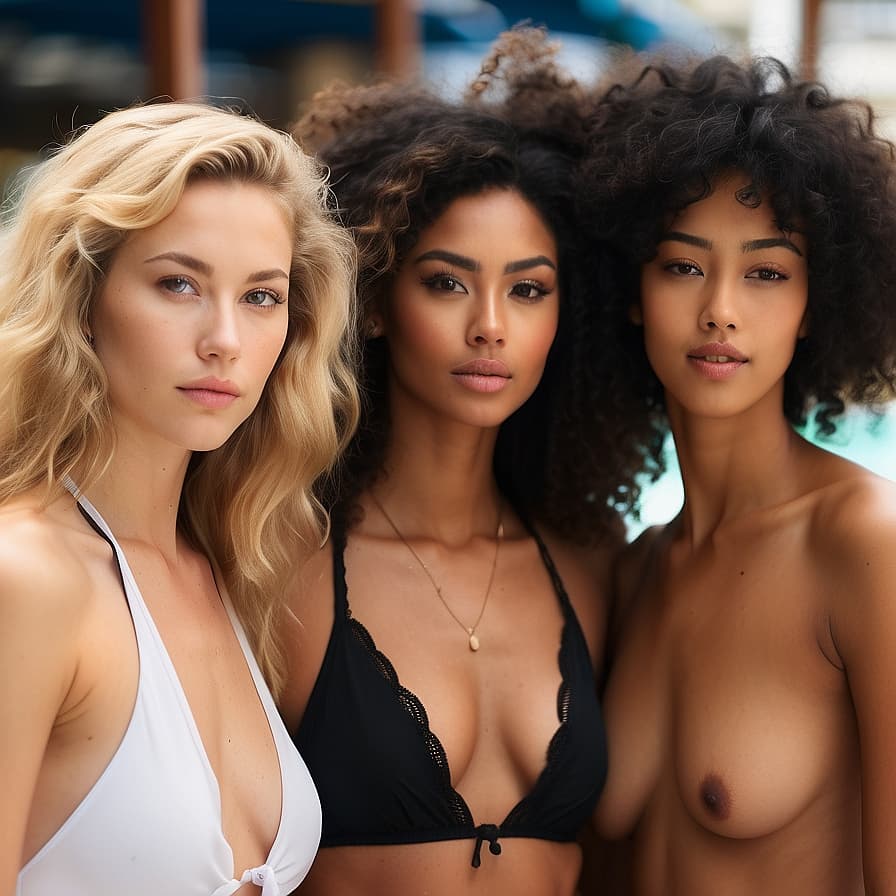
Breasts
General Description: Breasts are mammary glands composed of fat, connective tissue, and glandular tissue. In women, they play a key role in lactation and are also significant in reproductive health and sexual characteristics.
Ethnic Variations: Breast size, shape, and density can vary widely among different ethnic groups, influenced by genetic, hormonal, and environmental factors. These variations are a normal aspect of human diversity.
Cultural Significance: Breasts have various cultural significances across societies, often symbolizing femininity, fertility, and beauty. However, these perceptions are subjective and culturally specific.
AI Character Design Considerations: When creating AI characters, considering the diversity in breast size and shape is important for authenticity. It's crucial to represent this diversity respectfully and avoid stereotyping.
Breast — taxonomy
13 dimensions · 12 photo-assessable · v1.0.0 · UBERON: UBERON:0000310
Anatomical and morphological observations of the female breast. Dimensions are drawn from established plastic-surgery, dermatology, oncology, and aesthetic-anthropometry literature. The schema is comprehensive — some dimensions are not assessable from a single photograph and are flagged accordingly via the `observability` block.
Dimensions
Shape
photo-observablecategorical · halls_extended
Overall morphology of the breast envelope, classified along an extended categorical scheme combining the original Halls (1998) shape classes with widely-used additions from subsequent aesthetic-anatomy literature.
Halls MH (1998). Aesthetic Plastic Surgery, 22(5). Extended with categories described in subsequent plastic-surgery literature (Mallucci & Branford 2014; Goldwyn 1999).
Valid values (7)
roundRound— Symmetric upper- and lower-pole fullness with approximately equal projection above and below the nipple-areolar complex (NAC). Base width approximates projection.teardropTeardrop— Less upper-pole fullness than lower; greater projection below the NAC than above. NAC sits at or near the apex of projection.athleticAthletic— Wider base, smaller volume, more muscular and less subcutaneous-fat envelope. Projection is reduced relative to base width.slenderSlender / conical— Narrow base with conical projection; reduced volume; pointed apex at or near the NAC.asymmetricAsymmetric— Volume or shape difference greater than approximately one-half cup size between left and right breasts. Used when asymmetry is the dominant morphological feature, not as a fine-grained quantification.tuberousTuberous— Constricted base diameter, herniated parenchyma into the areola, narrow inframammary fold, and elevated NAC. Per Grolleau et al. (1999) classification.east_westEast-west / wide-set— Lateral splay of the NAC away from midline; intermammary distance approximates or exceeds breast base diameter. Common variant noted in aesthetic-anatomy literature.
Ptosis grade
photo-observableordinal · regnault_1976
Degree of breast ptosis (descent) defined by the position of the nipple relative to the inframammary fold (IMF) and the lower breast pole.
Regnault P (1976). Breast ptosis: definition and treatment. Clinics in Plastic Surgery, 3(2): 193-203.
Valid values (5)
grade_0_noneGrade 0 — no ptosis— Nipple sits above the IMF; breast tissue is firm and contained above the IMF.grade_1_mildGrade I — mild ptosis— Nipple at the level of the IMF, above the lower breast contour.grade_2_moderateGrade II — moderate ptosis— Nipple below the IMF but above the lower breast contour. NAC visible from frontal view as the most projected point of the lower pole.grade_3_severeGrade III — severe ptosis— Nipple below the IMF and at or below the lower breast contour, pointing downward.pseudoptosisPseudoptosis— Nipple above the IMF, but the breast tissue itself has descended below the IMF — glandular ptosis without NAC ptosis.
Size estimate
partly photo-observableordinal · us_cup_size_proxy
Visual estimate of breast size mapped onto the US cup-size convention, treated as an ordinal scale. Subject to image-angle, posture, and clothing variance; should not be treated as a measured dimension.
Visual proxy for US bra cup-size convention. Volumetric measurement (per Bouman 1994; Smith et al. 1986) is the academically-rigorous alternative but requires direct measurement, not a photograph.
Valid values (9)
AAAAAABBCCDDDDDD / EDDD_FDDD / FGGH_plusH+
Base diameter (relative)
photo-observableordinal · narrow_medium_wide_relative_to_chest
Width of the breast base as a fraction of chest-wall width. Relative measure rather than absolute distance.
Mallucci P, Branford OA (2014). Concepts in aesthetic breast dimensions. Plastic and Reconstructive Surgery, 134(1): 8e-16e.
Valid values (3)
narrowNarrow— Base diameter substantially less than half of chest-wall width.mediumMedium— Base diameter approximately one-third to one-half of chest-wall width.wideWide— Base diameter approaching or exceeding half of chest-wall width.
Projection (relative)
photo-observableordinal · low_moderate_high_relative_to_base
Anterior projection of the breast relative to base diameter. Distinguishes flatter from more conical morphologies independent of overall size.
Mallucci P, Branford OA (2014). Plastic and Reconstructive Surgery, 134(1).
Valid values (3)
lowLow— Projection less than ~40% of base diameter.moderateModerate— Projection ~40-60% of base diameter.highHigh— Projection greater than ~60% of base diameter.
Upper-pole fullness
photo-observablecategorical · mallucci_branford_2014
Convexity of the upper pole between the clavicle and the NAC. The Mallucci-Branford paper identifies the upper-pole slope as a primary determinant of perceived natural shape.
Mallucci P, Branford OA (2014). Plastic and Reconstructive Surgery, 134(1): 8e-16e. Defines the aesthetic 45:55 upper-pole-to-lower-pole proportion as the reference for natural breast shape.
Valid values (3)
concaveConcave / under-filled— Upper pole slopes inward from clavicle to NAC; insufficient soft-tissue fill.straightStraight / aesthetically natural— Upper pole forms a straight line from approximately the second intercostal space to the NAC. Considered the aesthetic reference per Mallucci & Branford 2014.convexConvex / over-filled— Upper pole bulges outward; over-projection above the natural reference line.
Lower-pole fullness
photo-observablecategorical · mallucci_branford_2014
Distribution of breast volume in the lower pole — between the NAC and the inframammary fold (IMF). Paired with `upper_pole_fullness`; together these capture the 45:55 aesthetic ratio when both are 'balanced'.
Mallucci P, Branford OA (2014). Plastic and Reconstructive Surgery, 134(1).
Valid values (3)
under_projectedUnder-projected— Lower pole carries less than ~50% of breast volume; gland feels superior-shifted.balancedBalanced (~55%)— Lower pole carries approximately 55% of volume; aesthetic reference per Mallucci & Branford.over_projectedOver-projected— Lower pole substantially overfilled relative to upper; common with ptosis and post-lactational changes.
Inframammary fold definition
partly photo-observableordinal · imf_definition_qualitative
Sharpness of the IMF as a visible anatomical landmark.
Boutros S, Kattash M, Wienfeld A, et al. (1998). The intradermal anatomy of the inframammary fold. Plastic and Reconstructive Surgery, 102(4).
Valid values (3)
sharpSharp— Clearly defined fold with a crisp transition from breast to chest wall.softSoft— Gradual transition; fold visible but not crisp.indistinctIndistinct— Fold not clearly visible; breast tissue blends gradually into the chest wall — common in tuberous and constricted-base morphologies.
Areolar diameter (relative)
photo-observableordinal · areolar_diameter_relative_to_breast_base
Diameter of the areola relative to the breast base diameter, treated as ordinal.
Hauben DJ, Mahler D (1983). A reappraisal of the importance of areolar pigmentation. Plastic and Reconstructive Surgery, 71(6). Normative areolar-diameter ranges discussed; relative-to-base scale used here as a photo-friendly proxy.
Valid values (3)
smallSmall— Areolar diameter less than ~25% of breast base diameter.mediumMedium— Areolar diameter approximately 25-40% of breast base diameter.largeLarge— Areolar diameter greater than ~40% of breast base diameter.
Areolar pigmentation
photo-observableordinal · areolar_pigmentation_qualitative
Pigmentation intensity of the areolar complex, observed independently of overall skin Fitzpatrick category.
Pigmentation gradient described qualitatively; Fitzpatrick I–VI does not directly map to areolar pigmentation, which can be substantially darker than surrounding breast skin (Hauben & Mahler 1983).
Valid values (5)
very_lightVery light— Pink or near-skin-tone; minimal pigmentation contrast against breast skin.lightLight— Slightly pigmented; visible contrast against breast skin.mediumMedium— Moderately pigmented; tan or light brown.darkDark— Strongly pigmented; medium to dark brown.very_darkVery dark— Deep brown to nearly black pigmentation.
Nipple morphology
partly photo-observablecategorical · hoffman_extended
Morphology of the nipple itself, including inversion grading.
Hoffman classification of nipple inversion, as commonly cited in breastfeeding-medicine and aesthetic-surgery literature (e.g., Han & Hong 1999, extending Hoffman's original framework).
Valid values (5)
evertedEverted— Nipple protrudes outward at rest. The typical configuration.flatFlat— Nipple level with the areola at rest; protrudes with cold or stimulation.inverted_grade_1Inverted — Grade I— Nipple inverted at rest but easily everts manually or with stimulation; no fibrotic banding.inverted_grade_2Inverted — Grade II— Nipple inverted; everts with difficulty and retracts when released; mild fibrotic banding.inverted_grade_3Inverted — Grade III— Nipple permanently inverted; cannot be manually everted; significant fibrotic banding.
Symmetry
photo-observableordinal · symmetry_qualitative
Degree of symmetry between left and right breasts.
Brody GS (1981). Aesthetic and reconstructive symmetry assessment. Surveyed in subsequent aesthetic-surgery literature.
Valid values (4)
symmetricSymmetric— No discernible asymmetry.mild_asymmetryMild asymmetry— Small but observable difference in volume, shape, or NAC position; less than approximately one-quarter cup difference.moderate_asymmetryModerate asymmetry— Difference of approximately one-half cup or comparable shape difference.marked_asymmetryMarked asymmetry— Difference of one full cup or greater, or substantial shape divergence.
Tissue density (mammographic)
not from photocategorical · birads_5e
Mammographic breast density classification. Included in the schema for completeness; assessment requires X-ray imaging and is not derivable from a photograph.
American College of Radiology (2013). BI-RADS Atlas, 5th Edition.
Valid values (4)
a_almost_entirely_fattyBI-RADS A — almost entirely fattyb_scattered_fibroglandularBI-RADS B — scattered fibroglandularc_heterogeneously_denseBI-RADS C — heterogeneously densed_extremely_denseBI-RADS D — extremely dense
References (10)
- Halls MH (1998). Aesthetic Plastic Surgery, 22(5).
- Regnault P (1976). Clinics in Plastic Surgery, 3(2): 193-203.
- Mallucci P, Branford OA (2014). Plastic and Reconstructive Surgery, 134(1): 8e-16e.
- Hauben DJ, Mahler D (1983). Plastic and Reconstructive Surgery, 71(6).
- Boutros S, Kattash M, Wienfeld A, et al. (1998). Plastic and Reconstructive Surgery, 102(4).
- Grolleau JL, et al. (1999). Tuberous-breast classification. Plastic and Reconstructive Surgery, 104(7).
- Marshall WA, Tanner JM (1969). Archives of Disease in Childhood, 44(235): 291-303.
- American College of Radiology (2013). BI-RADS Atlas, 5th Edition.
- Bouman FG (1994). Volumetric measurement of the human breast. Plastic and Reconstructive Surgery, 93(5).
- Smith DJ, et al. (1986). Breast volume by photogrammetry. Plastic and Reconstructive Surgery, 78(2).
Top-coverage ethnic groups
Groups with the most image-grounded phenotype data — sorted by Data Depth score
- Soninken=39 · 85/100
- Tatarsn=70 · 85/100
- Uzbeksn=59 · 85/100
- Tuluvasn=52 · 84/100
- Irishn=49 · 84/100
- Iranunn=48 · 83/100
- Makassaresen=46 · 83/100
- Icelandersn=57 · 83/100
- Igbon=52 · 82/100
- Welshn=66 · 82/100
- Ibann=39 · 80/100
- Belarusiansn=62 · 80/100
- Ga-Adangben=35 · 79/100
- Estoniansn=73 · 79/100
- Javanesen=72 · 79/100
- Minangkabaun=51 · 79/100
- Mandinkan=54 · 79/100
- Tajiksn=37 · 79/100
- Ossetiansn=33 · 78/100
- Kadazan-Dusunn=33 · 78/100
- Kikuyun=34 · 78/100
- Garhwalisn=41 · 78/100
- Susun=26 · 77/100
- Tigrayansn=60 · 76/100