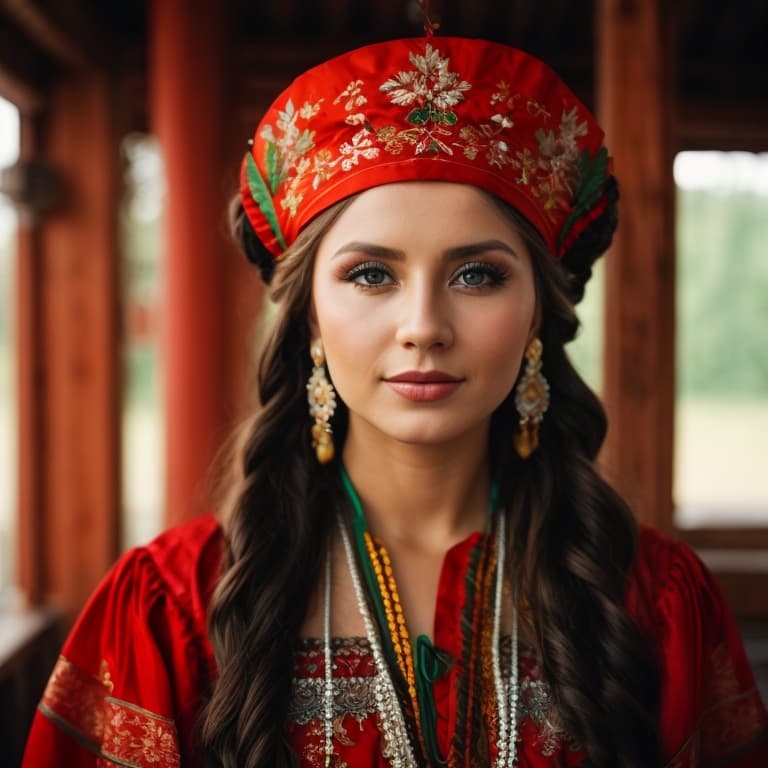
Belarusians Erotic
Belarus
Indo-European / Slavic / Belarusian
Christianity / Eastern Orthodoxy
Significant populations in the United States, Ukraine, and Russia
Eastern Europe
About Belarusians People
Belarusians are an East Slavic people whose homeland sits on the flat, lake-pocked, forested plain between Poland and Russia — a corridor that armies have crossed in both directions for a thousand years. That geography explains a great deal. There are no mountains to retreat into, no coastline to look outward from; the country is woods, marsh, and slow rivers, and Belarusian self-understanding has been shaped by living on a route rather than at a destination.
The language is East Slavic, a near-cousin to Ukrainian and Russian, and its position is genuinely complicated. Belarusian shares a great deal of vocabulary with Russian but its grammar, phonology, and cadence sit closer to Ukrainian and to the older Ruthenian written language used in the Grand Duchy of Lithuania. For most of the twentieth century Russian dominated education, administration, and city life, and today a hybrid spoken register called trasianka — a mixture of the two languages, often unselfconscious — is more widely heard than literary Belarusian. Speaking pure Belarusian in public has, depending on the decade, been a folk habit, a political statement, or quietly discouraged.
Religiously, the dominant tradition is Eastern Orthodoxy, but Belarus is one of the few places in the Slavic east with a meaningful Catholic minority, concentrated in the west around Hrodna — a residue of the long Polish-Lithuanian period. The Greek Catholic (Uniate) Church, suppressed in the nineteenth century, was once the majority confession and has only recently begun to return in small numbers. Religion in daily life tends to be observed at the level of holidays, weddings, and cemeteries rather than weekly attendance.
The historical inflection points that matter most to Belarusian identity are not the medieval ones but the modern: the Grand Duchy of Lithuania, in which Old Belarusian was a chancery language; the partitions that placed the territory under the Russian Empire; and the Second World War, which killed roughly a quarter of the population and destroyed nearly every town. The postwar Soviet decades rebuilt the country as an industrial and agricultural republic, and that legacy — collective farms, mid-century apartment blocks, a dense network of provincial factories — still shapes the landscape.
Distinctive folk customs survive in pockets, especially in rural Polesia in the south, where pre-Christian seasonal rites, embroidered rushnyk towels with regional patterns, and a living tradition of kinship-based village singing have outlasted both Soviet modernization and post-Soviet emigration.
Typical Belarusians Phenotypes
Reference for AI generation — hair, eyes, skin, facial structure, build
Belarusians sit at the lighter end of the Eastern European spectrum, closer in coloring to Lithuanians and northern Poles than to Ukrainians or southern Russians. The dominant phenotype runs cool and pale, with substantial blond representation that thins with age — many adults retain ash or dishwater blond hair into their thirties, while childhood platinum is common. Light brown and mid-brown shades fill out most of the rest, with darker brown appearing more often in the southern Polesia region and along the Ukrainian border. True black hair is uncommon. Texture is overwhelmingly straight to loosely wavy; tight curls are rare outside Jewish-Belarusian heritage.
Eye color skews lighter than the European average. Blue and grey-blue dominate, with green and hazel well represented and pure brown forming a clear minority. Eyes tend to be set somewhat deep under a flat or only mildly arched brow, with no epicanthic fold and a relatively narrow palpebral opening — a quieter, more recessed eye shape than the rounder Mediterranean form. Lashes and brows often run a shade or two darker than the scalp hair, which gives the face more definition than the pale coloring would suggest.
Skin is predominantly Fitzpatrick I–II, pink or neutral undertoned, prone to flushing and sunburn rather than tanning. Facial structure tends toward broad, softly squared faces with high but rounded cheekbones, straight to slightly concave nasal bridges, and moderate alar width. Lips are typically medium-thin; a full pout is not the regional default. Jawlines run from soft-oval in women to broad and square in men — Andrei Arlovski's heavy brow and wide jaw are unusually pronounced but recognizably Belarusian.
Build trends tall and broad-framed. Men commonly clear 178–183 cm with thick bone structure through shoulders and hips; women average around 166–168 cm with a tendency toward straighter, longer-limbed proportions than seen further south. The athletic phenotype — long-limbed, large-jointed, lean-muscular — surfaces repeatedly in the country's hockey players, throwers, and tennis professionals.
Data depth
80/100Coverage of image-grounded phenotype observations · drives AI generation diversity
- Sample size
- 40/40· 62 images
- Image quality
- 25/30· 50% high
- Confidence
- 15/20· mean 0.71
- Source diversity
- 0/10· wikipedia
- ·Wikipedia-only source — not population-representative
Observed Distribution — Image Sample
Empirical observations from analyzed photographs · supplementary signal, not population truth
Sample: 62 images analyzed (62 wikipedia). Quality: 31 high, 21 medium, 7 low, 3 very_low. Avg analyzer confidence: 0.71.
Skin tone (Fitzpatrick): II (76%), III (15%), IV (2%), unclear (8%)
Hair color: gray/white (29%), light/medium brown (29%), black (27%), dark brown (6%), blonde (5%), unclear (3%)
Hair texture: straight (73%), wavy (18%), covered (8%), unclear (2%)
Eye color: dark brown (27%), blue (19%), hazel (11%), brown (8%), other (2%), unclear (32%)
Epicanthic fold: 0% present, 94% absent, 6% unclear
Caveats: Sample is 100% Wikipedia notable people — skews toward male, public-life, and modern figures, not population-representative.
Last aggregated: May 7, 2026
Explore phenotype categories
Structured taxonomy with peer-reviewed scales · 22 anatomical categories
Notable Belarusians People
77 reference figures — sourced from Wikipedia
- Belarusian Orthodox Church — also Autocephalous
- Catholic Church in Belarus — also Belarusian Greek Catholic Church
- Hanna Rovina — 1893–1980), Israeli actress
- Naum Gabo — sculptor
- Guillaume Apollinaire — Belarusian mother
- Avraham Even-Shoshan — 1906–1984), Israeli linguist and lexicographer
- Mendele Mocher Sforim — founder of modern Yiddish and modern Hebrew literature
- Leonard — and Phil Chess
- Menachem Begin — Prime Minister of Israel
- Isser Harel — head of the Israeli Mossad
- Nasta Palazhanka — activist
- Shimon Peres — Prime Minister and President of Israel
- Zalman Shazar — President of Israel
- Dzianis Sidarenka — diplomat
- Chaim Weizmann — President of Israel
- Shneur Zalman of Liadi — Rabbi and Founder of Chabad-Lubavitch Hasidic movement
- Menachem Mendel Schneersohn — the Tzemach Tzedek, 3rd Lubavitcher Rebbe
- Yisrael Meir Kagan — famous 19th century Rabbi (Chofetz Chaim)
- Joseph Lookstein — Rabbi and President of Bar-Ilan University
- Zhores Ivanovich Alferov — Nobel Prize laureate
- Morris Raphael Cohen — Jewish philosopher
- Valery Fabrikant — mechanical engineer, mass murderer
- Konstanty Jelski — ornithologist and zoologist
- Pyotr Klimuk — cosmonaut
- Elena Korosteleva — political scientist
- Vladimir Kovalyonok — cosmonaut
- Salomon Maimon — Jewish philosopher
- Leonid Mandelstam — Jewish physicist
- Mark Nemenman — Jewish computer scientist
- Spiridon Sobol — printer, educator and writer
- Andrei Arlovski — former UFC Heavyweight Champion and MMA fighter
- Vladimir — and Alexander Artemev, father and son gymnasts
- Victoria Azarenka — tennis player
- Benjamin Blumenfeld — chess player
- Pavel Bure — ice hockey player
- Cypher — real name Alexey Yanushevsky, professional gamer
- Darya Domracheva — biathlete, four-time Olympic champion
- Yuri Foreman — middleweight and World Boxing Association super welterweight boxing champion
- Leonid Geishtor — sprint canoer, Olympic champion Canadian pairs 1,000-meter
- Boris Gelfand — chess player
- Mikhail Grabovski — ice hockey player
- Alexander Hleb — footballer
- Alexey Ignashov — K1 Superstar
- Andrei Kostitsyn — ice hockey player
- Sergei Kostitsyn — ice hockey player
- Abraham Kupchik — chess player
- Vladimir Matyushenko — MMA fighter
- Vladimir Samsonov — table tennis player
- Alexander Medved — weightlifter
- Max Mirnyi — tennis player
- Georgiy Monastyrskiy — footballer
- Georgi Mondzolevski — Olympic and world champion volleyball player
- Yulia Nesterenko — sprinter
- Evgenia Pavlina — rhythmic gymnast
- Lev Polugaevsky — chess player
- Yulia Raskina — Olympic silver medalist in rhythmic gymnastics
- Roman Rubinshteyn — born 1996), Belarusian-Israeli basketball player in the Israeli Basketball Pr…
- Ruslan Salei — ice hockey player
- Vitaly Scherbo — artistic gymnast
- Gennady Korotkevich — competitive programmer
- Aryna Sabalenka — tennis player
- Maria Sharapova — tennis player
- Valery Shary — Olympic champion weightlifter (light-heavyweight)
- Nadezhda Skardino — Olympic champion biathlete
- Anna Smashnova — born 1976), Belarusian-born Israeli tennis player
- Ilya Smirin — chess player
- Roman Sorkin — born 1996), Israeli basketball player in the Israeli Basketball Premier League
- Veronika Vitenberg — Israeli Olympic rhythmic gymnast
- Diana Vaisman — Belarusian-born Israeli sprinter
- Alexandra Zaretski — ice dancer, Olympian
- Roman Zaretski — ice dancer, Olympian
- Ina Žukava — rhythmic gymnast
- Svetlana Zilberman — badminton player
- Natasha Zvereva — tennis player
- Janice Dickinson — American supermodel of Belarusian and Polish descent
- Tanya Dziahileva — Belarusian model of Polish, Belarusian, and Ukrainian descent
- Maryna Linchuk — Belarusian model of Russian descent, born in Minsk, Belarus






Generate Belarusians AI Content
Use this ethnicity's phenotype data to create AI-generated content with accurate physical traits and cultural context.
Open Creator Studio