Czechs Erotic
Czech Republic
Indo-European / Slavic / Czech
Christianity / Catholicism
Bohemians, Moravians, Silesians, along with significant populations in United States and Canada
Eastern Europe
About Czechs People
The Czechs are a West Slavic people whose identity sits on a quiet paradox: among the most secular populations in Europe, yet shaped at every turn by the Catholic and Hussite Christianity they have spent five centuries arguing with. Their homeland is the basin between the Bohemian and Moravian highlands — a country ringed by mountains and drained by the Vltava and the Elbe, small enough to cross in a day, dense enough to have produced Prague, Brno, and a thousand market towns with their own dialect and beer. The split between Bohemia in the west, Moravia in the east, and the sliver of Czech Silesia in the north is not a bureaucratic line. Moravians sing differently, drink wine where Bohemians drink lager, and will tell you so within ten minutes of meeting.
Czech belongs to the West Slavic branch alongside Polish and Slovak, and a Czech and a Slovak can hold a conversation each in their own language without much trouble — a fact that made the twentieth-century federation feel natural and its 1993 dissolution feel oddly amicable. The language is famous among learners for its consonant clusters and for ř, a sound linguists single out as nearly unique. It is also a language that was nearly lost: after the Habsburg victory at White Mountain in 1620, German became the language of administration and high culture, and Czech survived in villages and kitchens until the nineteenth-century National Revival deliberately rebuilt it as a literary tongue. Much of what reads today as Czech intellectual character — the dry skepticism, the preference for the small and the local over the grand and imperial — was forged in that long period of being a nation without a state.
Catholicism remains the largest religious affiliation by tradition, but practice is thin; the Hussite reformation of the fifteenth century, the forced re-Catholicization that followed, and forty years of state atheism under communism have left a population that is culturally Christian and personally agnostic in roughly equal measure. The figures who anchor the modern self-image — Hus, Comenius, Masaryk, Havel — are moralists and educators rather than warriors or saints. Outside Europe, the largest Czech communities sit in Texas, the Midwest, and the Canadian prairies, where late-nineteenth-century emigrants brought kolaches, brass bands, and Sokol gymnastic halls that still operate.
Typical Czechs Phenotypes
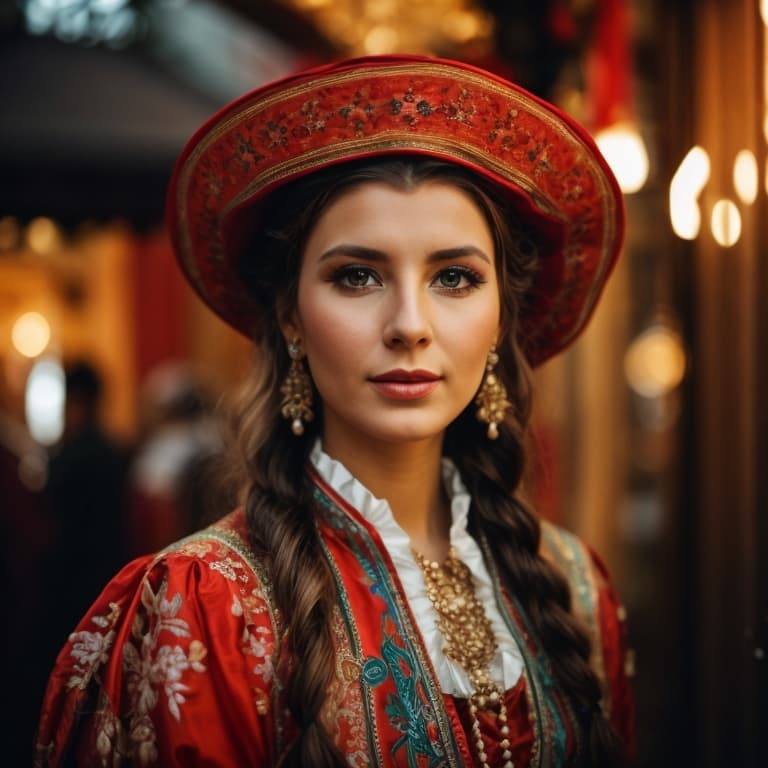
Reference for AI generation — hair, eyes, skin, facial structure, build
Czechs sit at the western edge of the Slavic world, and the phenotype reflects centuries of contact with German-speaking Central Europe — closer in many features to Austrians and southern Germans than to East Slavs. Hair runs predominantly in the mid-to-dark brown range, with a meaningful minority of natural blonds (especially among children, often darkening to ash or light brown by adulthood) and a smaller share of true black. Texture is overwhelmingly straight to lightly wavy; tight curls are uncommon. Red and auburn appear at low but visible frequencies, more often as undertones in brown hair than as full ginger.
Eye color is unusually varied for a single nation: blue, grey, and green together account for a slim majority, with hazel and brown filling out the rest. The epicanthic fold is essentially absent. Eye shape tends to be almond to slightly rounded, often deep-set under a flat or gently arched brow. Skin sits in the Fitzpatrick II–III band — fair, with neutral-to-cool undertones that flush pink rather than tanning deeply. True olive complexions are rare; freckling is moderately common in lighter-haired individuals.
Facial structure leans toward high, broad cheekbones and a relatively wide midface — the most reliably "Slavic" cue. Noses are typically straight or with a slight high bridge, narrow to medium in alar width; the heavy aquiline profile common further south is uncommon. Lips are average in fullness, jaws moderate, chins often softly squared rather than pointed. Think of Markéta Irglová's open, broad-cheeked face as a recognizable type.
Build is tall by European averages — Czech men cluster around 180 cm, women around 167 cm — with long limbs and a tendency toward lean-to-medium frames that broaden in middle age. Regional variation is mild but real: Moravians and Silesians average slightly darker hair and eyes than Bohemians, reflecting older gradients toward Slovak and Polish populations to the east.
Data depth
71/100Coverage of image-grounded phenotype observations · drives AI generation diversity
- Sample size
- 40/40· 86 images
- Image quality
- 21/30· 42% high
- Confidence
- 10/20· mean 0.66
- Source diversity
- 0/10· wikipedia
- ·Wikipedia-only source — not population-representative
Observed Distribution — Image Sample
Empirical observations from analyzed photographs · supplementary signal, not population truth
Sample: 86 images analyzed (86 wikipedia). Quality: 36 high, 35 medium, 14 low, 1 very_low. Avg analyzer confidence: 0.66.
Skin tone (Fitzpatrick): II (87%), III (6%), unclear (7%)
Hair color: gray/white (41%), black (37%), blonde (10%), dark brown (5%), light/medium brown (2%), unclear (5%)
Hair texture: straight (50%), wavy (36%), curly (7%), covered (5%), unclear (2%)
Eye color: blue (22%), dark brown (19%), hazel (7%), brown (6%), light brown / amber (2%), unclear (44%)
Epicanthic fold: 0% present, 90% absent, 10% unclear
Caveats: Sample is 100% Wikipedia notable people — skews toward male, public-life, and modern figures, not population-representative.
Last aggregated: May 7, 2026
Explore phenotype categories
Structured taxonomy with peer-reviewed scales · 22 anatomical categories
Notable Czechs People
100 reference figures — sourced from Wikipedia
- Anny Ondra — Anna Ondráková)
- John of Rokycan — Jan Rokycana)
- Vojtěch Jírovec — also known as Adalbert Gyrowetz)
- Jan Křtitel Kuchař — also known as Johann Baptist Kucharz)
- František Xaver Richter — Franz Xaver Richter)
- Anton Stamitz — Cz. Stamic) (half-German)
- Karel Stamitz — Cz. Stamic) (half-German)
- Johann Stamitz — Cz. Stamic)
- Pavel Vranický — also known as Paul Wranitzky)
- Johann Baptist Wanhal — Jan Ignatius Vaňhal)
- Karel Ančerl — conductor
- Jiří Bělohlávek — conductor
- Gabriela Beňačková — opera singer
- Ema Destinnová — opera singer
- Ewa Farna — pop singer
- Maria Jeritza — opera singer
- Jiří Jirmal — guitarist
- Markéta Irglová — singer, actress, Oscar prize winner
- Mikolas Josef — pop singer
- Gabriela Gunčíková — pop singer
- Martina Bárta — pop singer
- Marta Jandová — pop singer
- Vaclav Noid Barta — pop singer
- Tomas Kalnoky — singer, guitarist and composer
- Karel Kovařovic — conductor
- Magdalena Kožená — opera singer
- Ivan Kral — guitarist and singer
- Karel Kryl — songwriter
- Jan Kubelík — violinist
- Ferdinand Laub — violinist
- Jan Antonín Losy — lute player
- Waldemar Matuška — singer-songwriter and actor
- Eduard Nápravník — conductor
- Václav Neumann — conductor
- Jaromír Nohavica — guitarist and songwriter
- Jarmila Novotná — opera singer
- Libor Pešek — conductor
- Karel Plíhal — guitarist and songwriter
- Friederike Proch Benesch — pianist and composer
- Otakar Ševčík — violinist
- Leo Slezak — opera singer
- Jiří Stivín — flute player
- Vaclav Talich — conductor
- Vilém Tauský — conductor
- Štěpán Rak — guitarist
- Zuzana Růžičková — harpsichordist
- Antonín Vranický — also known as Anton Wrani(t)zky), violinist
- František Čáp — film director
- Věra Chytilová — film director
- Miloš Forman — film director
- Karl Freund — film director
- Jan Hřebejk — film director
- Jaromil Jireš — film director
- Elmar Klos — film director
- Oldřich Lipský — film director, screenwriter
- Jiří Menzel — film director, actor
- Zdeněk Miler — film director
- Georg Wilhelm Pabst — film director
- Ivan Passer — film director
- Jan Pinkava — animator, film director
- Břetislav Pojar — film director
- Alfréd Radok — film and theatre director
- Emil Radok — film director
- Karel Reisz — film director
- Bohdan Sláma — film director
- Ladislav Smoljak — film director
- Jan Švankmajer — film director, animator
- Jan Svěrák — film director, actor
- Jan Tománek — film director, artist and writer
- Jiří Trnka — film director, animator
- Zdeněk Troška — film director, screenwriter
- Hermína Týrlová — stage designer, cartoonist
- Otakar Vávra — film director
- František Vláčil — film director
- Karel Zeman — film director, animator
- Jan Kubiš — paratrooper, the assassination of Heydrich
- Jozef Gabčík — paratrooper, the assassination of Heydrich (Slovak)
- Josef Alexej Eisenberger — World War II general
- Alois Eliáš — army officer, member of the Czechoslovak legion
- Josef František — pilot ace
- Radola Gajda — army officer, member of the Czechoslovak legion
- Kurt Knispel — German Tank Ace (Sudeten German)
- Karel Kuttelwascher — general, pilot ace
- František Moravec — military intelligence officer, member of the Czechoslovak legion in World War I
- František Peřina — pilot ace
- Prokop the Great — Hussite leader
- Joseph Radetzky von Radetz — field marshal
- Ludvík Svoboda — general, president
- Jan Syrový — general, prime minister, member of the Czechoslovak legion
- Albrecht von Wallenstein — warlord during Thirty Years' War
- Jan Žižka — Hussite leader
- Otakar Jaroš — army officer during World War II
- Karel Klapálek — army officer during World War II, commander of the Czechoslovak 11th Infantry…
- Josef Šnejdárek — soldier of French Foreign Legion, commander of the Czechoslovak army and Czec…
- Tereza Fajksová — born 1989)
- Eva Herzigová — born 1973)
- Karolína Kurková — born 1984)
- Tereza Maxová — born 1971)
- Petra Němcová — born 1979)
- Daniela Peštová — born 1970)
Generate Czechs AI Content
Use this ethnicity's phenotype data to create AI-generated content with accurate physical traits and cultural context.
Open Creator Studio