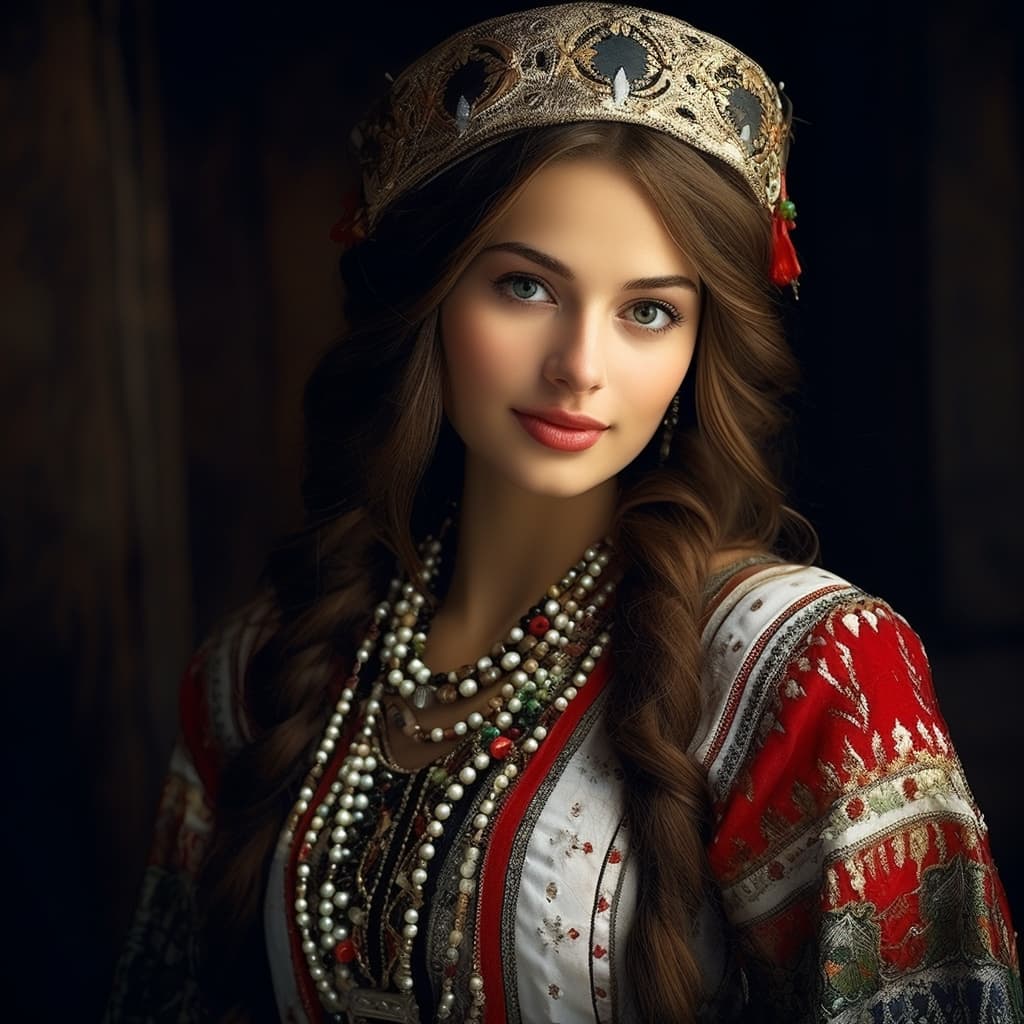
Hungarians Erotic
Hungary, Székely Land (Romania), Felvidék (Slovakia)
Uralic / Ugric / Hungarian
Christianity / Catholicism
Jasz, Palóc, along with significant populations in Romania (including Székelys and Csangos), Slovakia, Serbia, Ukraine, Croatia, Slovenia, Germany, the United States, and Canada
Eastern Europe
About Hungarians People
Hungarians are the linguistic odd ones out in their corner of Europe. Surrounded on every side by Slavic, Germanic, and Romance speakers, they speak a Uralic language whose nearest serious relatives — Mansi and Khanty — are spoken in western Siberia, and whose only sizeable cousin in Europe is Finnish, itself a distant one. The structural strangeness is real: agglutinative grammar, vowel harmony, eighteen or so cases depending on how you count, no grammatical gender at all. A Hungarian sentence built for a German or Slovak ear sounds like it has been encoded.
The homeland is the Carpathian Basin, a flat, river-cut interior ringed by mountains, settled by the Magyar tribal confederation at the end of the ninth century after a long migration from the steppe. The basin's geography matters: open in the middle, walled at the edges, it has historically been easy to enter and hard to leave intact. The Mongol invasion of 1241, the Ottoman occupation that split the kingdom in three for a century and a half, the Habsburg centuries, and finally the Treaty of Trianon in 1920 — which cut roughly two-thirds of the historical kingdom away — are the inflection points anyone raised in a Hungarian school can name without thinking. Trianon in particular still defines the map: the Székelys of eastern Transylvania, the Csángós scattered further east in Romanian Moldavia, the Hungarians of southern Slovakia's Felvidék, of Vojvodina, of Subcarpathia in Ukraine — these are not diaspora in the usual sense but communities that stayed put while the border moved.
Religious life is mostly Catholic, with a substantial Calvinist minority concentrated in the east — Debrecen has been called the Calvinist Rome for four hundred years — and a smaller Lutheran population, largely in the north among the Palóc. The Reformation took unusually deep root here for a country that ended up Catholic on balance, and the split still shows in regional character. The Jász, descendants of an Iranian-speaking Alan group absorbed in the medieval period, and the Palóc of the northern uplands retain distinct dialects and folk traditions, though the linguistic differences are narrower than they once were.
Practically, Hungarians tend to identify strongly with the language itself — more than with the state, more than with the church. It is the thing that survived every partition, and the thing that has to be actively kept up in the communities outside the current borders, where school instruction in Hungarian is a recurring political question rather than a settled fact.
Typical Hungarians Phenotypes
Reference for AI generation — hair, eyes, skin, facial structure, build
Hungarians sit at a phenotypic crossroads — visibly Central European on the surface, with a substrate that gives the population more variation than its neighbors. The Magyar arrival from the Pontic steppe in the late 9th century left a thin but real Asian-derived signal that occasionally surfaces in modern Hungarians as slightly broader cheekbones, a shorter nasal bridge, or eye shapes that read faintly almond — most discussed in the Palóc of the northern hills and the Székely and Csángó of Transylvania, though the underlying genetic share is small. The dominant look is solidly European.
Hair runs the full Central European range. Brown is the plurality — mid-brown to dark chestnut — with a substantial blond minority, particularly across the western and northern counties, and black hair common in the south and east. Texture is overwhelmingly straight to loosely wavy; tight curls are uncommon. Eyes are most often brown or hazel, but blue and grey-green are well represented, especially among Palóc and Transdanubian populations. The epicanthic fold is generally absent, though a soft inner-corner fold appears occasionally in eastern subgroups and reads as a slightly almond-set eye rather than a true Asian fold.
Skin is typically Fitzpatrick II–III, fair to light olive, with a neutral-to-warm undertone that tans rather than reddens. Truly pale, freckled complexions exist but are less common than in the Slavic north. Facial structure tends toward a moderate-to-broad face with defined cheekbones, a straight or gently convex nose with a medium bridge — wider alae among the Alföld and Jasz than among western Hungarians — and lips of medium fullness. Jaws are usually squared rather than pointed.
Build is solidly average-tall for Europe, with adult men averaging around 177–178 cm and women near 164 cm. Body composition skews mesomorphic — broader-shouldered and shorter-limbed than Scandinavians, with a tendency to gain weight centrally in middle age. The Székely of Transylvania are the subgroup where the steppe-derived features survive most visibly, while urban western Hungarians are phenotypically indistinguishable from Austrians.
Data depth
67/100Coverage of image-grounded phenotype observations · drives AI generation diversity
- Sample size
- 40/40· 72 images
- Image quality
- 17/30· 35% high
- Confidence
- 10/20· mean 0.62
- Source diversity
- 0/10· wikipedia
- ·Wikipedia-only source — not population-representative
Observed Distribution — Image Sample
Empirical observations from analyzed photographs · supplementary signal, not population truth
Sample: 72 images analyzed (72 wikipedia). Quality: 25 high, 34 medium, 8 low, 5 very_low. Avg analyzer confidence: 0.62.
Skin tone (Fitzpatrick): II (75%), III (13%), IV (3%), unclear (10%)
Hair color: gray/white (54%), black (24%), light/medium brown (7%), dark brown (4%), red/auburn (1%), unclear (10%)
Hair texture: straight (54%), wavy (22%), curly (4%), bald (6%), shaved (1%), covered (10%), unclear (3%)
Eye color: blue (24%), dark brown (21%), hazel (8%), brown (7%), unclear (40%)
Epicanthic fold: 0% present, 88% absent, 13% unclear
Caveats: Sample is 100% Wikipedia notable people — skews toward male, public-life, and modern figures, not population-representative.
Last aggregated: May 7, 2026
Explore phenotype categories
Structured taxonomy with peer-reviewed scales · 22 anatomical categories
Notable Hungarians People
100 reference figures — sourced from Wikipedia
- Lajos Kozma — [hu], architect and critic
- Susan Kozma-Orlay — designer in Australia
- Tamás Király — avant-garde fashion designer
- Lea Gottlieb — 1918–2012), Israeli fashion designer and founder of Gottex
- Andrew Grove — pioneer in the semiconductor industry; a chairman and CEO of Intel
- Éva Hegedüs — 1957–), Chairman-CEO and majority shareholder of Gránit Bank
- Radovan Jelašić — governor of the National Bank of Serbia
- Sándor Kenyeres — 1949–), international business magnate, and scientific philanthropist
- Peter Munk — Canadian-Hungarian entrepreneur, founder of Barrick Gold, and philanthropist
- Tibor Rosenbaum — businessman
- George Soros — Hungarian-American business magnate, investor, philosopher and philanthropist
- Bálint Bakfark — composer
- Kristóf Baráti — violinist
- Béla Bartók — composer and pianist
- János Bihari — violinist
- Attila Csihar — vocalist
- György Cziffra — pianist and composer
- Ernő Dohnányi — Ernst von Dohnanyi), composer, pianist and conductor
- Antal Doráti — conductor
- Péter Eötvös — composer and conductor
- Ferenc Erkel — composer
- László Fassang — organist and pianist
- Iván Fischer — conductor and composer
- Endre Granat — violinist
- Zoltán Jeney — composer
- Joseph Joachim — violinist
- Pál Kadosa — composer
- Zoltán Kocsis — pianist and conductor
- Zoltán Kodály — composer
- Rezső Kókai — composer
- György Kurtág — composer
- Franz Lehár — composer
- György Ligeti — composer
- Franz Liszt — composer and pianist
- János Négyesy — violinist
- Eugene Ormandy — conductor
- Veronika Harcsa — vocalist
- György Pauk — violinist
- Fritz Reiner — conductor
- Eduard Reményi — violinist
- Rezső Seress — composer and pianist
- Georg Solti — conductor
- Gábor Szabó — guitarist
- Georg Szell — conductor
- László Vidovszky — composer
- Jon Lovitz — of Hungarian descent)
- Viktor Orbán — born 1963), current Prime Minister of Hungary (1998–2002, 2010–present)
- László Almásy — 1895–1951), desert explorer, author, the inspiration for the fictionalised ch…
- Gyula Andrássy — 1823–1890), statesman
- József Antall — 1932–1993), Prime Minister of Hungary (1990–1993)
- Albert Apponyi — 1846–1933), statesman
- Gordon Bajnai — born 1968), former Prime Minister of Hungary (2009–2010)
- Tamás Bakócz — 1442–1521), archbishop, cardinal and statesman
- Gábor Baross — 1848–1892), statesman
- Erzsébet Báthory — 1560–1614), countess István Báthory (1477–1534), Governor of Transylvania Ist…
- Zsigmond Báthory — 1572–1613), Prince of Transylvania
- Vilma Beck — 1810–1851), writer and freedom fighter
- Ödön Beöthy — 1796–1854), Hungarian deputy and orator
- Béla Bugár — born 1958), politician
- Krisztina Csáky — 1654–1723), Hungarian countess, resistance fighter
- Pál Csáky — born 1956), politician
- Aurél Dessewffy — 1808–1842), journalist and politician
- Péter Doszpot — born 1962), former member of parliament
- Ignaz Aurelius Fessler — 1756–1839), court councillor and minister to Alexander I of Russia
- Catharina Anna Grandon de Hochepied — 1767–1803), noble and amateur actress
- András Hadik — 1710–1790), count
- Theodor Herzl — Tivadar Herzl, 1860–1904), journalist, modern Zionism
- Miklós Horthy — 1868–1957), admiral and regent (1920–1944)
- Stephen I of Hungary — Stephen I, Szent István, Stephanus Rex, I. István) (975–1038) first King of H…
- János Kádár — 1912–1989), communist leader
- Charles I of Hungary — Károly Róbert) (1288–1342), King of Hungary (1308–1342)
- Mihály Károlyi — 1875–1955), first President of Hungary (1919)
- Lajos Kossuth — 1802–1894), Hungarian politician later Regent-President of Hungary
- Teddy Kollek — born Tivadar Kollek, 1911–2007), Israeli Mayor of Jerusalem
- Béla Kun — 1886–1938), minister, revolutionist (1919)
- Louis I of Hungary — Louis I, Nagy Lajos, 1326–1382), king of Hungary (1342–1382)
- Tom Lantos — 1928–2008), former U.S. Congressman from California
- Géza Malasits — 1874–1948), deputy in parliament
- József Mindszenty — 1892–1975), cardinal, imprisoned by communist government
- Imre Nagy — 1896–1958), prime minister in 1953 and 1956
- Ágnes Osztolykán — born 1974), Hungarian politician and Romani activist
- Mátyás Rákosi — 1892–1971), communist leader
- Ferenc Szálasi — 1897–1946), head of Arrow Cross Party, Head of State, Prime Minister of Hunga…
- László Szalay — 1813–1864), statesman and historian
- Count Széchenyi István — 1791–1860)
- Istvan Tisza — 1861–1918), Prime Minister of Hungary (1903–1905; 1913–1917)
- Toma András — Tamás András), Hungarian World War II prisoner found in Russian mental hospit…
- László Tőkés — born 1952), Reformed Church pastor and an instigator of the Romanian Revoluti…
- Anna Wesselényi — Countess Anna Wesselényi (1584–1649), countess and writer
- Zrínyi Miklós — Count Zrínyi Miklós (1508–1566), Hungarian general who held Szigetvár against…
- János Zsámboky — humanist
- Ferenc Anisits — inventor of the BMW diesel engine (1983)
- Oszkár Asbóth — inventor of helicopter (1928)
- Donát Bánki — inventor of the cross-flow turbine
- Béla Barényi — inventor in field of automobile safety
- László Bíró — inventor of the ballpoint pen (1931)
- Ottó Bláthy — inventor of the voltage regulator, co-inventor (with Miksa Déri and Károly Zi…
- János Csonka — inventor of the carburetor
- Miksa Déri — co-inventor (with Ottó Bláthy and Károly Zipernowsky) of the transformer
- Dénes Gábor — inventor of holography (1947)






Generate Hungarians AI Content
Use this ethnicity's phenotype data to create AI-generated content with accurate physical traits and cultural context.
Open Creator Studio