Georgians Erotic
Georgia
Kartvelian / Georgian
Christianity / Eastern Orthodoxy
Adjarians, Mingrelians, Svans, Tushetians, Meskhetians, Bats
Eastern Europe
About Georgians People
Georgians call themselves Kartvelebi and their country Sakartvelo — a name the rest of the world has never quite adopted. They occupy a wedge of land between the Greater and Lesser Caucasus, with the Black Sea to the west and a hard mountain wall to the north separating them from Russia. The geography matters: Georgia is small, but it folds into so many valleys that distinct sub-peoples developed within a few hours' drive of one another. Mingrelians on the western lowlands speak a language closely related to Georgian but not mutually intelligible with it. Svans, in the high villages of the northwest, speak a third Kartvelian language and kept stone defensive towers standing in their yards into the modern era. Adjarians along the southwest coast are Georgians who, under Ottoman rule, became Muslim and stayed that way. Tushetians and the tiny Bats community hold the eastern highlands. These are not minorities within Georgia in the usual sense — they are Georgians, with their own tongues and tempers.
The Georgian language sits in its own family, Kartvelian, with no demonstrated relatives outside the Caucasus. It is written in Mkhedruli, a rounded script unrelated to Cyrillic, Greek, or Latin, and is one of the few alphabets in the world recognized as a UNESCO heritage element in its own right. Georgia adopted Christianity in the early fourth century, making it one of the oldest Christian states anywhere; the Georgian Orthodox Church remains a serious institutional force, and the patriarch is consistently among the most trusted figures in the country's polling. Religious holidays still organize the calendar in villages, and church construction continues at a pace that has nothing to do with tourism.
Two cultural facts are worth knowing because they get caricatured. The first is wine: Georgians have been making it in buried clay qvevri for roughly eight thousand years, and the practice is unbroken — this is not revival heritage but continuous craft. The second is the supra, the formal feast presided over by a tamada, or toastmaster, whose toasts run long, build in sequence, and are taken seriously as a literary form. Hospitality in Georgia is codified, not casual; refusing a toast is a social act with weight. Modern Georgia is also a country shaped by recent injury — the 2008 war with Russia and the loss of effective control over Abkhazia and South Ossetia are not historical footnotes but live political facts that define the national mood.
Typical Georgians Phenotypes
Reference for AI generation — hair, eyes, skin, facial structure, build
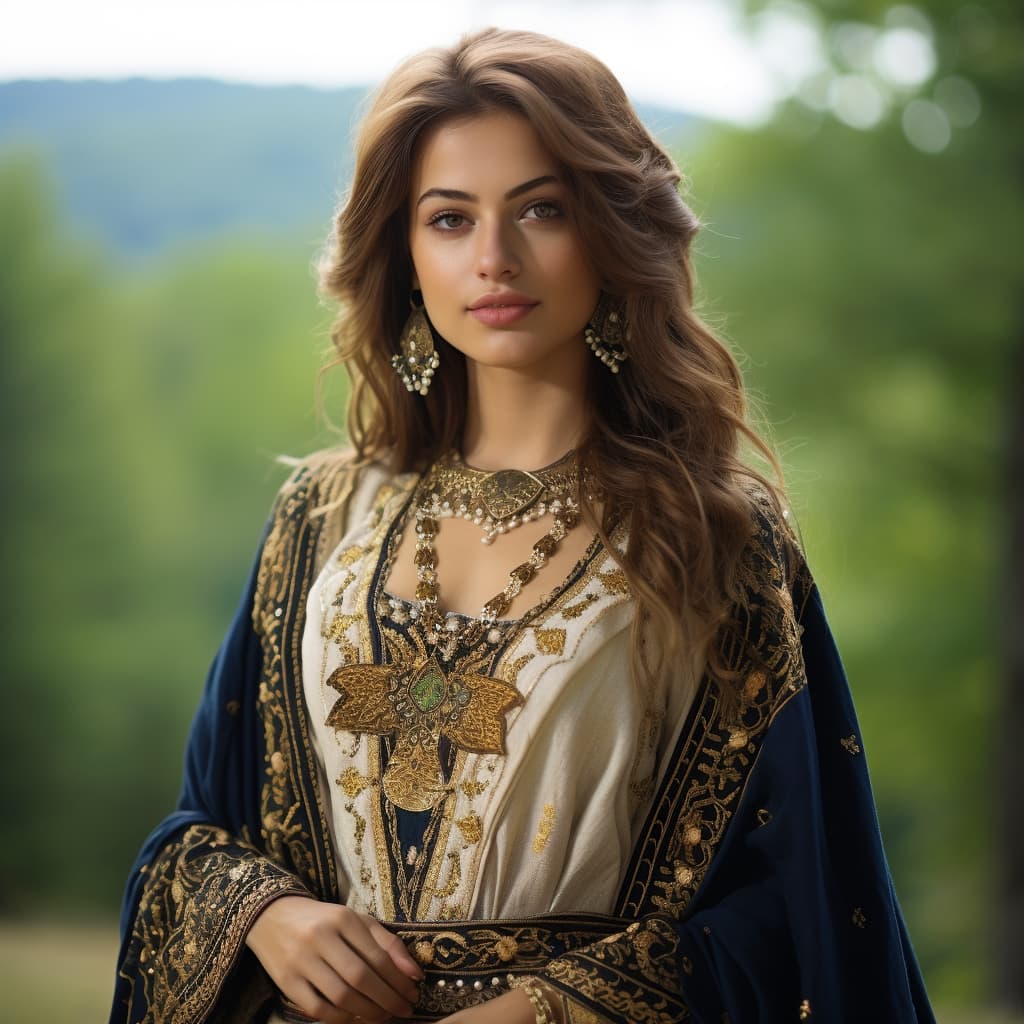
Georgians sit at the Caucasian crossroads, and their phenotype reflects it: predominantly Caucasoid features with the heavier pigmentation, denser hair, and stronger facial relief that characterize highland populations of the South Caucasus. The dominant impression is dark hair against fair-to-olive skin, with sharply defined features and a notably tall, broad-shouldered build by European averages.
Hair runs overwhelmingly dark — deep brown to true black, often with a cool ash or near-blue-black cast — and tends to be thick, with a moderate wave more common than poker-straight. Light brown appears among Svans and other highland populations, where occasional auburn and even rare blonde traces surface; redheads exist but are uncommon. Body and facial hair is dense in men, beard growth heavy and early. Eyes are most often dark brown to hazel, but Georgia carries a meaningful minority of green and grey-blue eyes, particularly in the mountain provinces of Svaneti, Khevsureti, and Tusheti — paired sometimes with lighter hair, producing the striking light-eyed, dark-haired combination the region is known for. Eyelids are European in shape, no epicanthic fold, with the upper lid often deep-set under a pronounced brow.
Skin sits predominantly Fitzpatrick II–III, with warm olive undertones; the lowland Adjarian and Mingrelian populations of the Black Sea coast trend slightly warmer and tan readily, while highland Svans and Tushetians often present as paler with cool undertones. Noses are a defining feature: long, high-bridged, frequently aquiline, with a narrow alar base. Lips are moderate, jaws strong and squared, cheekbones high and well-defined. Stature is tall — Georgian men average around 175–178 cm, among the taller in Europe — with a robust, broad-chested frame; women are slender-waisted but generally taller and longer-limbed than Mediterranean averages. Svans skew shorter and stockier; Mingrelians and Adjarians lean leaner and more Mediterranean in proportion. The overall Kartvelian look — dark, sharp-featured, tall, vertically built — is consistent enough to be recognizable across the diaspora.
Data depth
52/100Coverage of image-grounded phenotype observations · drives AI generation diversity
- Sample size
- 40/40· 59 images
- Image quality
- 7/30· 14% high
- Confidence
- 5/20· mean 0.49
- Source diversity
- 0/10· wikipedia
- ·Low overall confidence
- ·Mostly low-quality source images
- ·Wikipedia-only source — not population-representative
Observed Distribution — Image Sample
Empirical observations from analyzed photographs · supplementary signal, not population truth
Sample: 59 images analyzed (59 wikipedia). Quality: 8 high, 35 medium, 13 low, 3 very_low. Avg analyzer confidence: 0.49.
Skin tone (Fitzpatrick): II (44%), III (29%), IV (5%), V (2%), unclear (20%)
Hair color: gray/white (41%), black (41%), light/medium brown (2%), brown (2%), dark brown (2%), unclear (14%)
Hair texture: straight (37%), wavy (24%), curly (2%), coily (3%), bald (7%), covered (20%), unclear (7%)
Eye color: dark brown (34%), hazel (8%), brown (5%), blue (5%), light brown / amber (2%), unclear (46%)
Epicanthic fold: 0% present, 81% absent, 19% unclear
Caveats: Quality skews toward older or low-resolution photos; phenotype detail may be lossy. Low average analyzer confidence — many photos partially obscured or historical. Sample is 100% Wikipedia notable people — skews toward male, public-life, and modern figures, not population-representative.
Last aggregated: May 7, 2026
Explore phenotype categories
Structured taxonomy with peer-reviewed scales · 22 anatomical categories
Notable Georgians People
100 reference figures — sourced from Wikipedia
- Colchians — list) and Iberians in antiquity
- Georgian name — and surname (princely families)
- Georgian art — Georgian Golden Age)
- Georgian literature — list, Shairi)
- Music — Iavnana, Shen Khar Venakhi, Chakrulo)
- Sport — Lelo burti)
- Dances — Khorumi, Gandagana, Perkhuli, Erisioni)
- Mythology — Kartlos, Q'ursha, Dali)
- Cuisine — Keipi, Supra, Tamada, Alaverdi)
- Georgian — Proto-Kartvelian, Proto–Georgian–Zan, Svan, Zan, Mingrelian, Laz)
- Georgian dialects — Adjaran dialect, Judaeo-Georgian)
- Georgian grammar — Georgian conjugation, Screeve)
- Georgian Orthodox Church — Christianization, Bible translations, Catholicoi, Concordat of 2002)
- Georgian monarchs — lists) (family trees, consorts, mothers)
- Georgian Americans — Georgian horsemen in Wild West shows)
- Five-cross flag — Bolnisi cross)
- Pharnavaz I — King of Iberia from 302 to 237 BC
- Vakhtang I Gorgasali — King of Iberia from 447/449–502/522
- David the Builder — 1073–1125), King of Georgia from 1089 to 1125
- Tamar the Great — 1160–1213), Queen of Georgia from 1184 to 1207/1213
- George V The Brilliant — King of Georgia from 1299 to 1302 and from 1314 to 1346
- Heraclius II — King of Kartli-Kakheti from 1762 to 1798
- Noe Zhordania — 1868–1953), revolutionary and chairman of the Government of the Democratic Re…
- Joseph Stalin — 1878–1953), Soviet dictator from 1924 to 1953
- Zviad Gamsakhurdia — 1939–1993), first President of the Republic of Georgia from 1991 to 1992
- Eduard Shevardnadze — 1927–2014), Foreign Minister of the USSR and second President of the Republic…
- Mikheil Saakashvili — third president of Georgia from 2004 to 2013
- Qasim Barid I — a founder of the Bidar Sultanate, one of the five Deccan sultanates in early …
- Bijapur Sultanate — Yusuf Adil Shah, a founder of the Bijapur Sultanate, one of the five Deccan s…
- Nata Menabde — born 1960), executive director of the World Health Organization
- Grigol Bakurianis-dze — 11th century), general in the Byzantine service
- Giorgi Saakadze — 1570–1629), Georgian, Safavid and Ottoman military commander who won many bat…
- Allahverdi Khan — c. 1560 – June 3, 1613), Iranian general and statesman of Georgian origin who…
- Imam-Quli Khan — Iranian military and political leader of Georgian origin who served as a gove…
- Daud Khan Undiladze — Iranian military commander and politician of Georgian origin; governor (begla…
- Rostom-Khan Saakadze — c. 1588 – 1 March 1643), Iranian Safavid military commander (sipah-salar) of …
- Prince Alexander of Imereti — 1674–1711), Georgian prince and commander of the artillery of the Russian Emp…
- Yusef Khan-e Gorji — Iranian military leader of Georgian origin
- Pyotr Bagration — 1765–1812), one of the most prominent generals in Russian military history an…
- Alexandre Bagrationi — 1770–1844), Georgian prince and resistance fighter
- Roman Bagration — 1778–1834), prominent general of the Imperial Russian army, distinguished com…
- Ivane Bagration of Mukhrani — 1812–1895), major general of the Russian Empire; revolutionizer of the wine i…
- Ivane Amilakhvari — 1829–1905), general of the Russian Empire and distinguished commander during …
- Alexander Imeretinsky — 1837–1900), Georgian-Russian prince; lieutenant general and hero of the Russo…
- Ivane Kazbegi — 1860–1943), major general of the Russian Empire, then major general of the Po…
- Kote Abkhazi — 1867–1923), general of the Russian Empire and Georgian resistance fighter
- Zakaria Bakradze — 1870–1938), brigadier general of the Polish army
- Giorgi Mazniashvili — 1872–1937), general in Russian and Georgian service; defeated three enemy arm…
- Giorgi Kvinitadze — 1874–1970), Russian general and later commander-in-chief of the Democratic Re…
- Leo Kereselidze — 1878–1942)
- Alexandre Chkheidze — 1878–1940), general of the Polish army
- Valiko Jugheli — 1887–1924), Georgian general and resistance fighter
- Kaikhosro (Kakutsa) Cholokashvili — 1888–1930), Georgian resistance fighter
- Konstantin Mikeladze — 1895–1935), commander in the Iranian army
- Grigor Mikeladze — 1898–1955), first lieutenant in the Iranian army
- Shalva Maglakelidze — 1893–1976), Georgian general and later in charge of the German Georgian Legio…
- Pore Mosulishvili — 1916–1944), Soviet soldier and partisan in the Italian resistance movement
- Valerian Tevzadze — 1894–1987), colonel of the Polish army and resistance fighter in World War II…
- Lavrentiy Beria — 1899–1953), marshal of the Soviet Union and main ideologist and architect, as…
- Konstantin Leselidze — 1903–1944), colonel general of the Soviet Union, commander of the Caucasus fr…
- Dimitri Amilakhvari — 1906–1942), colonel of the French Foreign Legion, fighting on almost every im…
- Vladimir Janjgava — 1907–1982), lieutenant general and hero of the Soviet Union
- Alexi Inauri — 1908–1993), colonel general and hero of the Soviet Union
- Vasilij Shalvovich Kvachantiradze — 1907–1950), Soviet sniper who scored 215-500 kills, hero of the Soviet Union
- Yaroslav Iosseliani — 1912–1978), submarine commander, hero of the Soviet Union
- Archil Gelovani — 1915–1978), marshal of the engineer troops
- Jerzy Tumaniszwili — 1916–2010), counter admiral of the Polish navy
- Noe Adamia — 1914–1942), Soviet sniper, hero of the Soviet Union
- Meliton Kantaria — 1920–1993), sergeant of the Red Army who raised the Soviet victory banner ove…
- Geno Adamia — 1936–1993), Georgian major general and garrison commander of Sokhumi; execute…
- John Shalikashvili — Poland, 1936–2011), general of the United States, chairman of the Joint Chief…
- Saint Nino — c. 296 – c. 338 or 340), a woman from Cappadocia, heavily involved in the Chr…
- Thirteen Assyrian Fathers — among them Abibos of Nekresi, Assyrian missionaries, said to have arrived fro…
- Gregory of Khandzta — 759–861), a prominent ecclesiastic figure, active in Tao-Klarjeti
- George of Chqondidi — died c. 1118), a churchman and court minister, advisor to David IV of Georgia
- Arsen of Iqalto — died c. 1127), a prominent churchman and scholar
- Antim Iverianul — Antimoz Iverieli) (1650–1716), Metropolitan of Romania
- Nikoloz Cholokashvili — Niceforo Irbachi) (1585–1658), Orthodox priest
- Eudemus I of Georgia — died 1642), churchman serving as Catholicos-Patriarch of All Georgia from 163…
- Anton II of Georgia — 1762 or 1763–1827), member of the Bagrationi dynasty and Catholicos-Patriarch…
- Dositheus of Tbilisi — died 1795), Archbishop of Tbilisi and a martyr
- Peter Kharischirashvili — 1804/05–1890), Catholic monk
- Shio Batmanishvili — 1885–1937), Catholic priest and martyr
- Michel Tamarati — 1858–1911), Catholic priest
- Ambrosius — 1861–1927), Catholicos-Patriarch of All Georgia from 1921 to 1927
- Grigol Peradze — 1899–1942), Archimandrite, historian (Poland)
- Elie Melia — 1915–1988), Orthodox priest and church historian
- Gabriel — 1929–1995), Orthodox monk, venerated as Saint Gabriel, Confessor and Fool for…
- Ilia II — 1933–2026), Catholicos-Patriarch of All Georgia since 1977
- Peter the Iberian — c. 417 – 491), theologian and philosopher, one of the founders of Christian N…
- Martviri Sabatsmindeli — 6th century, monk, calligrapher and writer at Mar Saba; foreman of Sabbas the…
- Basili Sabatsmindeli — 8th century, monk, calligrapher and writer at Mar Saba
- Makari of Leteti — 9th century, calligrapher and scholar at Mar Saba
- Mikaeli — 9th century, calligrapher; known for Adysh Gospels
- Euthymius the Athonite — c. 955–1024), monk, philosopher and scholar
- Gabrieli — 10th century, calligrapher
- Mikael Modrekili — 10th century, calligrapher, poet, writer and scholar; best known for Iadgari …
- Ioane Berai — 10th century, calligrapher
- John Zosimus — 10th century, monk, religious writer, and calligrapher; best known for his hy…
- Gabriel Patarai — 10th century, calligrapher

Generate Georgians AI Content
Use this ethnicity's phenotype data to create AI-generated content with accurate physical traits and cultural context.
Open Creator Studio