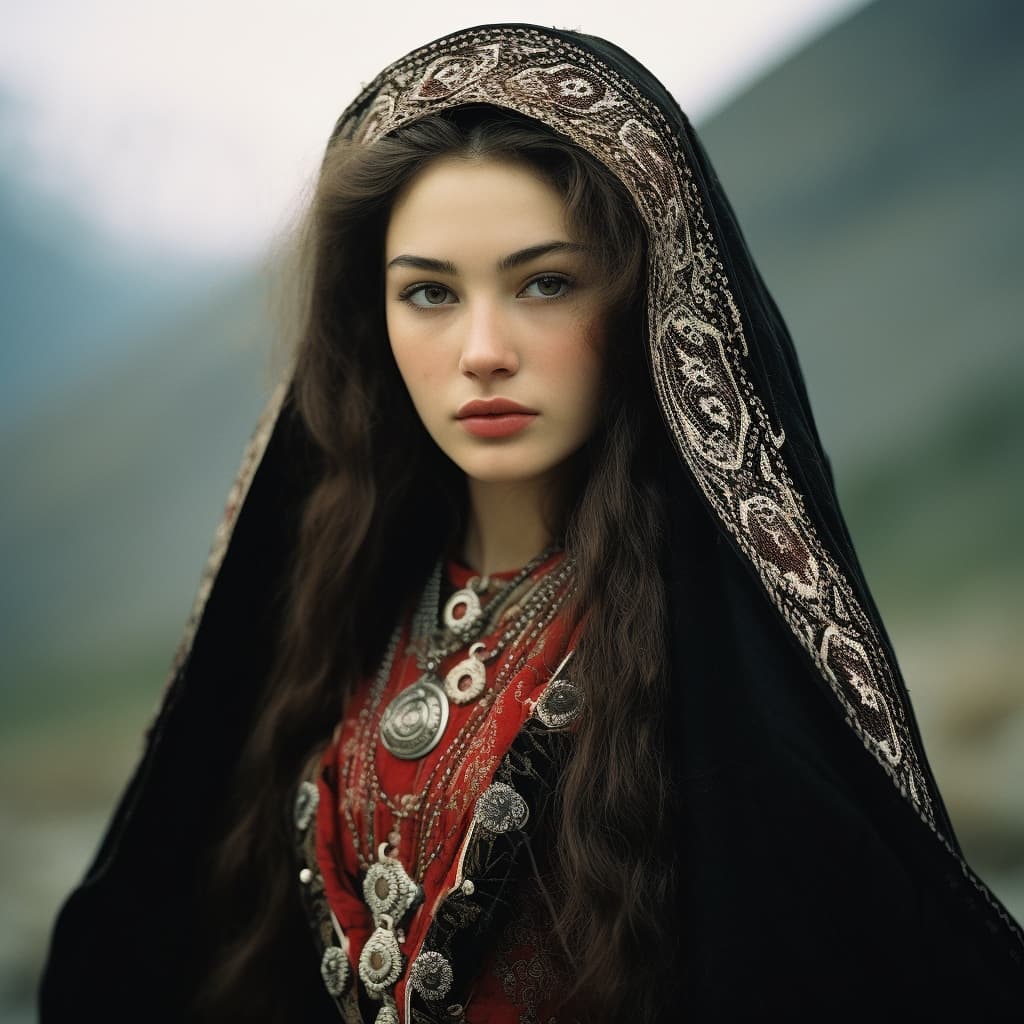
Ingush Erotic
Ingushetia (Russia)
Northeast Caucasian / Nakh / Ingush
Islam / Sunni Islam
Eastern Europe
About Ingush People
The Ingush call themselves Ghalghai, and the name carries a specific claim: that the stone tower-villages still standing in the gorges of the Caucasus mountains — Erzi, Vovnushki, Egikal — were built by their ancestors and mark the older heart of the people. Most Ingush today live on the lowland plain of Ingushetia, the smallest of Russia's federal republics, but the highland towers remain a reference point for clan identity in a way that has no real analogue among their flatland neighbors. They are closely related to the Chechens; the two peoples share the Vainakh branch of the Nakh language family, and an Ingush and a Chechen speaker can usually understand each other after a few minutes of adjustment. Beyond Vainakh, the language has no living relatives outside the Northeast Caucasian family, a small and ancient cluster confined almost entirely to this corner of the mountains.
Society is organized through the teip, a patrilineal clan that still functions as a real unit of obligation rather than a historical curiosity — questions of marriage, hospitality, mediation, and blood-feud resolution often run through teip elders before they touch any state institution. Customary law, adat, coexists with Sunni Islam, which arrived late by Caucasian standards and took firm hold only in the 18th and 19th centuries; Sufi brotherhoods, particularly the Qadiri and Naqshbandi orders, shaped how the religion settled into Ingush life and remain visible in funeral rites and the loud, circling zikr. Hospitality is not a soft virtue here but a near-legal duty, and the codes around guests, women's honor, and restraint in speech are tighter than outsiders usually expect.
The defining wound of the modern Ingush is the February 1944 deportation, when Stalin had the entire population — along with the Chechens — loaded into cattle cars and sent to Central Asia under accusations of Nazi collaboration that no serious historian has since defended. Tens of thousands died in transit and exile. They were allowed to return only after 1957, and to find parts of their territory, particularly the Prigorodny district, reassigned to North Ossetia; the dispute over that land flared into open conflict in 1992 and remains unresolved. Ingushetia today is poor, young, conservative, and unusually self-contained, a republic that watched the Chechen wars from very close range and drew its own quieter conclusions about how to survive Moscow.
Typical Ingush Phenotypes
Reference for AI generation — hair, eyes, skin, facial structure, build
The Ingush phenotype sits at the dense, mountain-built end of the Northeast Caucasian range — close to Chechen neighbors, but with its own consistencies. Hair runs dark by default: deep brown to near-black, occasionally medium brown in northern lowland families, with a recurring chestnut streak that lightens noticeably in childhood before settling. Texture is typically straight to gently wavy; tighter curl is uncommon. Adult men often go salt-and-pepper early, and full beards grow in dense and dark — a trait visible across the wrestlers, generals, and political figures the group is known for.
Eyes skew lighter than outsiders expect. Hazel and grey-green are common, true blue appears in a meaningful minority, and dark brown remains the plurality rather than the overwhelming majority. There is no epicanthic fold; the eye opening is almond to slightly deep-set, with a strong, often unbroken brow line. Lashes and brows are heavy and dark even when scalp hair is lighter.
Skin runs Fitzpatrick II–III, occasionally IV in highland families with heavier sun exposure. Undertones are warm-neutral to lightly olive — paler in winter, tanning evenly rather than reddening. Faces are angular and built on bone: a tall, often high-bridged nose with a narrow-to-medium alar width, frequently with a subtle convexity rather than a Roman arch. Cheekbones sit high and forward, the jaw is square and clearly defined, and lips are typically medium — not thin, not full. Foreheads are broad; chins are firm and prominent.
Build is the most distinctive thing about Ingush men: compact, broad-shouldered, thick through the chest and back, with short-to-medium limb proportions that translate into the country's outsized record in wrestling, weightlifting, and combat sports — figures like Musa Evloev and Israil Arsamakov are physical archetypes, not outliers. Average male stature lands around 173–177 cm. Women trend slim-to-athletic with the same strong facial bone structure, narrow waists, and a tendency toward darker hair than the men. Sub-group variation is mild — highland teips skew darker-haired and stockier, lowland families lighter-eyed and longer-limbed.
Data depth
56/100Coverage of image-grounded phenotype observations · drives AI generation diversity
- Sample size
- 29/40· 24 images
- Image quality
- 17/30· 33% high
- Confidence
- 10/20· mean 0.69
- Source diversity
- 0/10· wikipedia
- ·Modest sample (n<25)
- ·Wikipedia-only source — not population-representative
Observed Distribution — Image Sample
Empirical observations from analyzed photographs · supplementary signal, not population truth
Sample: 24 images analyzed (24 wikipedia). Quality: 8 high, 7 medium, 8 low, 1 very_low. Avg analyzer confidence: 0.69.
Skin tone (Fitzpatrick): II (38%), III (50%), IV (8%), unclear (4%)
Hair color: black (63%), gray/white (33%), light/medium brown (4%)
Hair texture: straight (75%), wavy (8%), curly (4%), bald (4%), covered (8%)
Eye color: dark brown (58%), blue (8%), brown (4%), green (4%), light brown / amber (4%), hazel (4%), unclear (17%)
Epicanthic fold: 4% present, 88% absent, 8% unclear
Caveats: Sample size 24 is modest — secondary patterns may not be reliable. Sample is 100% Wikipedia notable people — skews toward male, public-life, and modern figures, not population-representative.
Last aggregated: May 7, 2026
Explore phenotype categories
Structured taxonomy with peer-reviewed scales · 22 anatomical categories
Notable Ingush People
39 reference figures — sourced from Wikipedia
- Sultan-Murza — prince of village Lars
- Muhammed from Ingushetia — mufti of Ichkeria and naib of Aukh
- Utsig Malsag — commander of the Russian Empire
- Yaponts Abadiyev — commander of several Red Army cavalry regiments during World War II
- Rashid-bek Akhriev — first North Caucasian pilot
- Bashir Aushev — Deputy Prime Minister of Ingushetia from 2002 to 2008
- Maksharip Aushev — opposition leader
- Ruslan Aushev — lieutenant-general in the Red Army, Hero of the Soviet Union, negotiator duri…
- Sulumbek of Sagopshi — Ingush abrek
- Mandre Nalgiev — Ingush sniper and avenger
- Akhmed Khuchbarov — Ingush abrek
- Laysat Baysarova — Komsomol-educated Voroshilov shooter turned abrek
- Issa Kostoyev — prosecutor
- Shirvani Kostoyev — Il-2 pilot during World War II; Hero of the Russian Federation
- Ahmed Malsagov — Pe-2 pilot during World War II; Hero of the Russian Federation
- Sulom-Bek Oskanov — Major General of the Air Force, Hero of the Russian Federation
- Murad Ozdoev — World War II fighter pilot, concentration camp survivor; Hero of the Russian …
- Asiyat Tutaeva — Army medic during World War II
- Yunus-bek Yevkurov — Major-general, Hero of the Russian Federation, third president of Ingushetia
- Magomed Yevloyev — journalist and critic of Murat Zyazikov
- Murat Zyazikov — Second president of Ingushetia
- Ali Taziev — Ingush warlord, Commander of the Caucasian Front
- Ruslan Khuchbarov — Ingush warlord
- Magomed Khashiev — Ingush warlord
- Israil Arsamakov — weightlifter and olympic champion
- Bekkhan Ozdoev — wrestler
- Magomed Ozdoyev — Central Midfielder for PAOK FC in the Super League Greece
- Musa Evloev — Greco-Roman wrestler, two-time world champion and two-time national champion
- Zelimkhan Bakayev — right winger for FC Spartak Moscow.
- Movsar Evloev — Mixed martial artist.
- Maksharip Muzhukhoev — historian and archeologist (dr. of historical sciences).
- Nureddin Akhriev — arabist, orientalist.
- Alimbek Kurkiev — linguist and philologist (dr. of philological sciences).
- Firuza Ozdoeva — linguist and philologist (dr. of philological sciences).
- Mikhail Gutseriyev — one of Russia's richest people with an estimated net worth of US$6.4 billion
- Said Gutsiriev — son of Mikhail Gutseriyev and CEO of ForteInvest
- Musa Keligov — former vice president of Lukoil
- Mikail Shishkhanov — banker and financier
- Ruslan Mamilow — sculptor






Generate Ingush AI Content
Use this ethnicity's phenotype data to create AI-generated content with accurate physical traits and cultural context.
Open Creator Studio