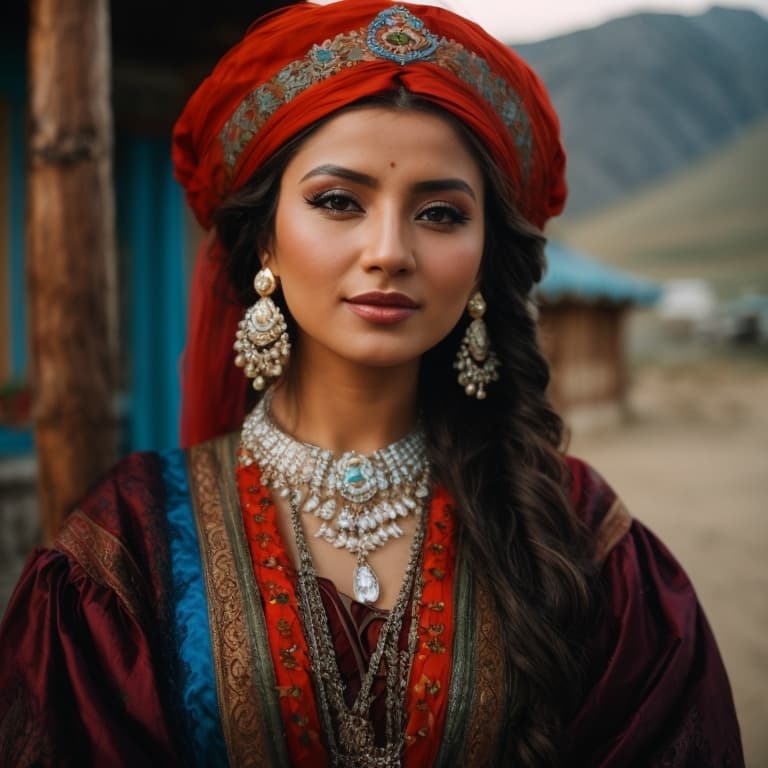
Dargins Erotic
Dagestan (Russia)
Northeast Caucasian / Dargwa
Islam
Kajtak, Kubachi, Itsari, Chirag
Eastern Europe
About Dargins People
The Dargins are the second-largest people of Dagestan, concentrated in the central uplands between the Caspian shore and the spine of the Greater Caucasus. They identify less by a single homeland village than by a cluster of mountain districts — Levashi, Akusha, Dakhadayev, Sergokala — where the terrain alone has shaped how the group cohered. The valleys are narrow and the ridges are sharp, and for centuries each Darginian community ran itself: a federation of free communes (the Akusha-Dargo league being the best known) negotiated with khans and tsars from a position of stubborn local autonomy rather than as subjects.
What anthropologists usually call the Dargin language is more accurately a continuum. Dargwa belongs to the Northeast Caucasian family, the same deep-rooted group that includes Avar, Lezgian, and Chechen, and within it the Kajtak, Kubachi, Itsari, and Chirag varieties diverge enough that speakers often switch to Russian — or to standard Dargwa, built on the Akusha dialect — when talking across branches. Kubachi in particular is sometimes counted as a separate language; its speakers occupy a single mountain town famous for centuries of metalwork, and the silver and niello traditions of Kubachi smiths are among the few Dagestani crafts known well outside the republic. Kajtak villages, lower down toward the coast, share more vocabulary with their Turkic-speaking neighbors and once had a distinct script written in Hebrew letters by their Jewish trading partners.
Islam came to the Dargins gradually, mostly Sunni and largely Shafi'i, layered on top of older clan-based codes that still set the terms for marriage, hospitality, and the long calculus of feud and reconciliation. The Sufi orders — Naqshbandi and Shadhili tariqas — matter more here than mosque attendance figures suggest, and they were the organizing backbone of the nineteenth-century resistance to Russian conquest under Imam Shamil, in which Dargin communities played a central part. The Soviet period flattened much of the public religious life and pulled many families down off the slopes into the lowland towns of Izberbash, Kaspiysk, and the suburbs of Makhachkala; the highland villages emptied but did not die, and seasonal return is still a recognizable rhythm.
Dargin households tend to be tightly patrilineal, with a strong sense of tukhum — the extended kin network that vouches for a person's standing — and a corresponding code of restraint in public conduct that outsiders sometimes mistake for coldness. It is closer to a working theory of dignity.
Typical Dargins Phenotypes
Reference for AI generation — hair, eyes, skin, facial structure, build
Dargins sit firmly within the Northeast Caucasian phenotype cluster, and the build is usually the first thing you notice. Men trend stocky and densely muscled with broad shoulders, thick necks, and short-to-medium stature — typically 168–175 cm — a frame the region's wrestling and combat-sports pipeline did not invent so much as inherit. Women are generally compact and curvier through hip and bust than the Slavic norm to the north, with the same short-limbed proportions.
Hair is overwhelmingly dark brown to black, thick, and coarse, usually straight to loosely wavy; tight curls are uncommon. Body and facial hair runs heavy in men, and full dark beards grow in early. A small minority carry chestnut or dark-auburn tones, more often in the highland Kubachi and Kajtak villages where isolation preserved older variation. Graying tends to come late.
Eyes are most often dark brown, with a meaningful minority — perhaps one in five — in hazel, green, or grey-green. The eye shape is almond and deep-set under heavy, often unbroken brows; no epicanthic fold. Lashes read as dense and dark.
Skin is typically Fitzpatrick III–IV with warm olive-to-tawny undertones, tanning rapidly and rarely burning. Highland Kubachi families skew lighter — Fitzpatrick II–III, sometimes pink-undertoned and freckling in summer — while lowland Kajtak communities sit closer to a Mediterranean tan.
The facial signature is angular and architectural. Noses are prominent, usually high-bridged with a straight or slightly convex profile and a narrow-to-medium alar width; the strong aquiline form is common but not universal. Cheekbones sit high and wide, jaws are square and heavy in men, and chins are firm. Lips are medium in fullness — neither thin nor pillowy — with a clearly defined cupid's bow. Hasbulla's case is a well-known GHD-related developmental condition and is not phenotypically representative. For grounding, fighters like Rashid Magomedov read closer to the Dargin baseline: dark coloring, dense build, that high-bridged Caucasian nose, deep-set eyes under a strong brow.
Data depth
64/100Coverage of image-grounded phenotype observations · drives AI generation diversity
- Sample size
- 14/40· 6 images
- Image quality
- 30/30· 67% high
- Confidence
- 20/20· mean 0.86
- Source diversity
- 0/10· wikipedia
- ·Small sample (n<10)
- ·Wikipedia-only source — not population-representative
Observed Distribution — Image Sample
Empirical observations from analyzed photographs · supplementary signal, not population truth
Sample: 6 images analyzed (6 wikipedia). Quality: 4 high, 2 medium, 0 low, 0 very_low. Avg analyzer confidence: 0.86.
Skin tone (Fitzpatrick): II (33%), III (67%)
Hair color: black (67%), gray/white (33%)
Hair texture: straight (67%), wavy (17%), shaved (17%)
Eye color: dark brown (83%), blue (17%)
Epicanthic fold: 0% present, 100% absent, 0% unclear
Caveats: Sample size 6 is small — observed distribution should be treated as suggestive, not definitive. Sample is 100% Wikipedia notable people — skews toward male, public-life, and modern figures, not population-representative.
Last aggregated: May 7, 2026
Explore phenotype categories
Structured taxonomy with peer-reviewed scales · 22 anatomical categories
Notable Dargins People
20 reference figures — sourced from Wikipedia
- Taimas Gubdensky — [ru], Dargin warrior from the Caucasian War.
- Abakar-Hadji Akushinsky — [ru], Dargin warrior from the Caucasian War.
- Gasan Umalatov — mixed martial artist, 2008 World champion in Kick Jitsu, two-time World champ…
- Hasbulla — internet personality
- Magomed-Ali Magomedov — ex-president of Dagestan.
- Magomedsalam Magomedov — ex-president of Dagestan.
- Patimat Abakarova — Olympic bronze medalist in Taekwondo.
- Magomed-Shapi Suleymanov — footballer.
- Shahbulat Shamhalaev — retired mixed martial artist and kickboxer.
- Magomedrasul Medzhidov — olympic and professional boxer.[citation needed]
- Ali Isaev — mixed martial artist and former amateur wrestler.
- Magomed Umalatov — mixed martial artist fighting in PFL and former GFC welterweight champion.
- Gadzhi Rabadanov — mixed martial artist, current fighting in the Lightweight division of Bellato…
- Timur Khizriev — mixed martial artist, current fighting in the Featherweight division of the P…
- Said Amirov — former mayor of Makhachkala
- Ruslan Magomedov — former Heavyweight mixed martial artist
- Mahammad Mirzabeyov — Russian-Azerbaijani former professional football player
- Rustam Asildarov — Islamic militant
- Amir Hamza III — khan of Kaitags who ruled Kaitag Utsmiate from 1751 to 1787
- Rashid Magomedov — mixed martial artist






Generate Dargins AI Content
Use this ethnicity's phenotype data to create AI-generated content with accurate physical traits and cultural context.
Open Creator Studio