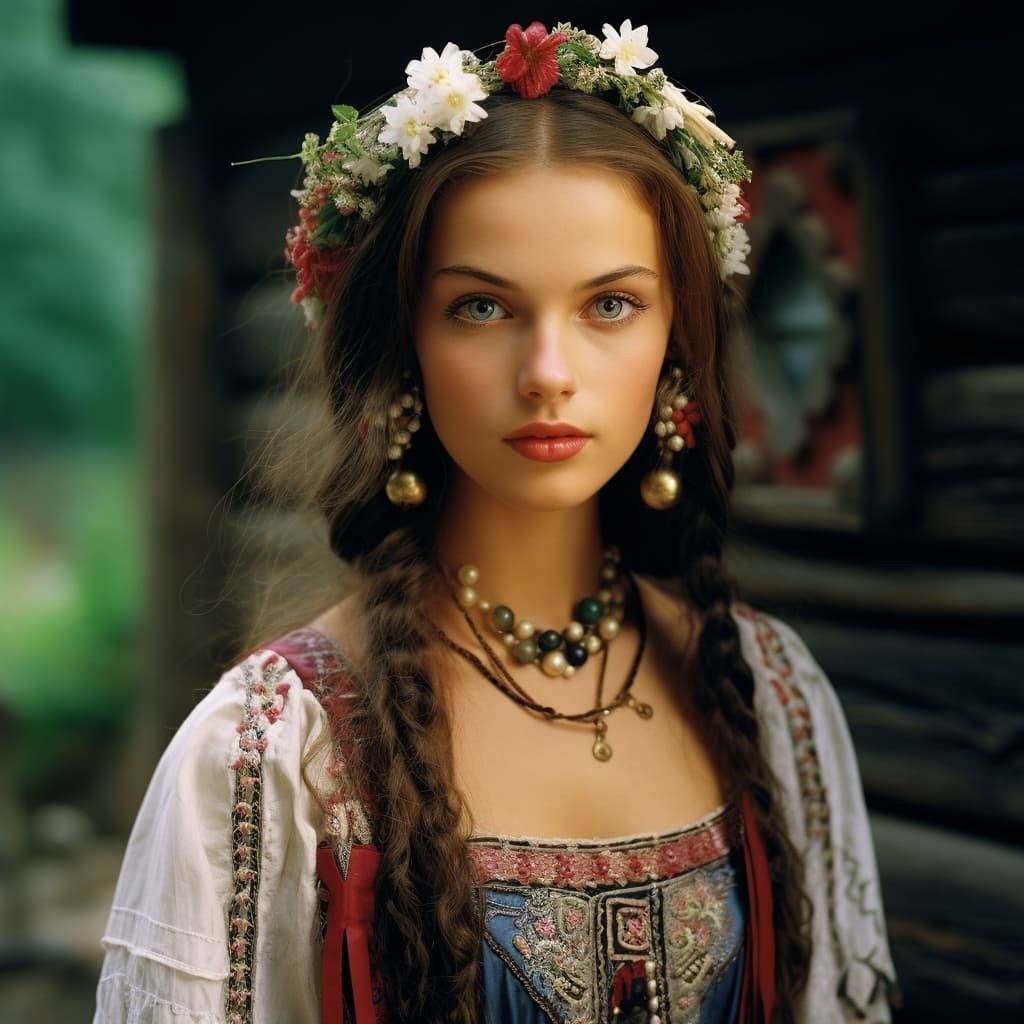
Kashubians Erotic
Kashubia (Poland)
Indo-European / Slavic / Kashubian
Christianity / Catholicism
Eastern Europe
About Kashubians People
The Kashubians are a West Slavic people of Poland's northern coast, concentrated in the lake-pocked, pine-heavy belt of land west and southwest of Gdańsk known as Kashubia. Their identity is bound up with that specific landscape — the Baltic shoreline, the moraine hills left by retreating ice, the chain of glacial lakes around Wdzydze and Charzykowy — and with a long history of being the Slavs who stayed when others were absorbed. They are the last remaining branch of the Pomeranian Slavs, the medieval populations who once stretched along the southern Baltic from the Oder to the Vistula before being progressively Germanized over centuries. Kashubians held on, partly because their villages sat in agriculturally marginal forest country that nobody bothered to colonize aggressively, and partly because they were stubborn about it.
Kashubian itself is the linguistic anchor. It is West Slavic, closest to Polish but not a dialect of it — the two are not mutually intelligible without effort, and Kashubian preserves features (a movable stress, certain vowels, a stratum of Low German loanwords from centuries of contact) that mark it as its own language. Polish authorities resisted that designation for a long time; Kashubian only gained official recognition as a regional language in Poland in 2005, and bilingual road signs in Kashubia date from after that. The language is taught in some local schools now, and there is a small but real literary tradition — Aleksander Majkowski's early-twentieth-century novel Życie i przygody Remusa is the standard reference point — but daily transmission to children has been thinning for decades, and that worries people.
Catholicism runs deep and is woven into the calendar rather than treated as a separate religious sphere. The annual pilgrimages — to Wejherowo, to Swarzewo — are as much Kashubian as Catholic events, and folk piety blends with older agricultural and maritime customs in ways the local clergy have generally tolerated. The community splits internally between inland farmers and the fishing villages of the Hel Peninsula and Puck Bay, with noticeable differences in dialect and self-image between the two. Kashubian material culture has a recognizable visual signature: floral embroidery built around a fixed seven-color palette, painted ceramics from Chmielno, and the snuff horn, an everyday object that turns up in regional iconography with a frequency outsiders find puzzling until they spend time there. Günter Grass, who grew up among them in pre-war Danzig, wrote about Kashubians often and from the inside.
Typical Kashubians Phenotypes
Reference for AI generation — hair, eyes, skin, facial structure, build
Kashubians sit at a phenotypic crossroads — a West Slavic population shaped by centuries of intermarriage with Pomeranian Germans, Baltic peoples, and the Pomeranian fishing communities of the southern Baltic coast. The result is a look that reads more North European than the Polish heartland inland: lighter on average, with a higher incidence of unmixed blue-eyed, blond-childhood phenotypes than you find south of the Vistula.
Hair runs the cool end of the European range. Childhood blond is common and often persists into adulthood as ash, dirty blond, or light brown; full dark brown appears but pure black is rare. Texture is predominantly straight to loosely wavy, fine to medium in density. Eye color skews light — blue and blue-grey dominate, with green and hazel well-represented; pure brown is the minority allele here, more common in the southern Kashubian belt than along the coast. The eye opening is typically wide and almond-shaped with no epicanthic fold; brow ridges sit low and the lid crease is usually visible but not deep. Skin is Fitzpatrick II–III, pink-to-neutral undertone, freckling common in childhood, tans poorly and reddens in summer — a coastal-Baltic complexion.
Facial structure tends toward the long-headed Northern European pattern: narrow-to-medium nose with a straight or slightly convex bridge and modest alar width, medium lip fullness with a defined cupid's bow, and a squared jaw with cheekbones that sit forward rather than high-and-wide. The face often reads slightly elongated rather than round. Build trends tall — Kashubian men cluster around 178–182 cm, women 165–170 cm — with a robust, broad-shouldered fishing-and-farming frame; lean in youth, thickening with age. Donald Tusk and Danuta Stenka are useful anchors for the central Kashubian look: light eyes, ash-brown to blond hair, fair skin, long oval face. Subgroup variation runs north-to-south: coastal northern Kashubians (Słowińcy, Bylacy) carry more of the blond-and-blue Baltic signal, while southern groups closer to Tuchola show slightly darker hair and a higher rate of brown eyes from greater Polish admixture.
Data depth
51/100Coverage of image-grounded phenotype observations · drives AI generation diversity
- Sample size
- 26/40· 20 images
- Image quality
- 15/30· 30% high
- Confidence
- 10/20· mean 0.64
- Source diversity
- 0/10· wikipedia
- ·Modest sample (n<25)
- ·Wikipedia-only source — not population-representative
Observed Distribution — Image Sample
Empirical observations from analyzed photographs · supplementary signal, not population truth
Sample: 20 images analyzed (20 wikipedia). Quality: 6 high, 9 medium, 4 low, 1 very_low. Avg analyzer confidence: 0.63.
Skin tone (Fitzpatrick): II (85%), III (5%), unclear (10%)
Hair color: gray/white (55%), black (25%), light/medium brown (5%), other (5%), unclear (10%)
Hair texture: straight (65%), wavy (25%), bald (5%), unclear (5%)
Eye color: blue (20%), dark brown (10%), brown (10%), hazel (5%), unclear (55%)
Epicanthic fold: 5% present, 80% absent, 15% unclear
Caveats: Sample size 20 is modest — secondary patterns may not be reliable. Sample is 100% Wikipedia notable people — skews toward male, public-life, and modern figures, not population-representative.
Last aggregated: May 7, 2026
Explore phenotype categories
Structured taxonomy with peer-reviewed scales · 22 anatomical categories
Notable Kashubians People
44 reference figures — sourced from Wikipedia
- Czarnina — Czarwina) – a type of soup made of goose blood
- Brzadowô zupa — a kind of sweet soup with e.g. apples
- Kaszëbsczi kùch marchewny — Kashubian carrot cake)
- Evan Wenskay — 1992-) Musician, paté provocateur.
- Lech Bądkowski — 1920–1984) writer, journalist, translator, political, cultural, and social ac…
- Józef Borzyszkowski — 1946– ) historian, politician, founder of the Kashubian Institute
- Edward Breza — [pl] (1932–2017) award winner etymologist, and professor
- Paul Breza — 1937–2025) American priest, Kashubian-American activist
- Jerzy Łysk — 1950– ) Kashubian poet, composer, singer and cultural animator, manager of cu…
- Jan Romuald Byzewski — 1842–1905) Kashubian-born American priest and social activist
- Florian Ceynowa — 1817–1881) political activist, writer, linguist, and revolutionary
- Arnold Chrapkowski — [pl] (1968– ) Father General of the Order of Saint Paul the First Hermit
- Hieronim Derdowski — 1852–1902) Kashubian-born American writer, newspaper editor, and political ac…
- Konstantyn Dominik — [pl] (1870–1942) auxiliary bishop of Chełmno (now Pelplin)
- Jan Gierszewski — 1882–1951), co-founder of the secret WW2 military organization Kashubian Grif…
- Günter Grass — 1927–2015) Nobel Prize-winning German author of Kashubian descent
- Hilary Jastak — 1914–2000) a Polish priest prelate, Doctor of Theology, Chaplain of Solidarit…
- Marian Jeliński — 1949– ) Veterinarian, author, Kashubian activist
- Wojciech Kasperski — 1981– ) film director, screenwriter
- Zenon Kitowski — 1962– ) clarinet player
- Józef Kos — 1900–2007) World War I veteran
- Gerard Labuda — 1916–2010) historian
- Mark Lilla — 1956–) American writer, intellectual historian
- Aleksander Majkowski — 1876–1938) author, publicist, play writer, cultural activist
- Marian Majkowski — [pl] (1926–2012) author, architect
- Paul Mattick — 1904–1981) German-American Marxist writer of Kashubian descent
- Mestwin II — 1220–1294) ruler of united Eastern Pomerania
- Jerzy Samp — 1951–2015) writer, publicist, historian, and social activist
- Wawrzyniec Samp — 1939– ) sculptor and graphic artist
- Franziska Schanzkowska — 1896–1984); a.k.a. Anna Anderson, impostor who claimed to be, Anastasia Roman…
- Danuta Stenka — 1962– ) actress
- Swantopolk II — 1195–1266) powerful ruler of Eastern Pomerania
- Brunon Synak — 1943–2013) professor of sociology and a Kashubian activist
- Jerzy Treder — 1942–2015), philologist and linguist, known as an expert in Kashubian studies
- Jan Trepczyk — 1907–1989) poet, songwriter, lexicographer and creator of the Polish-Kashubia…
- Donald Tusk — 1957– ) historian, politician, leader of Civic Platform, Prime Minister of Po…
- Ludwig Yorck von Wartenburg — 1759–1830) Prussian Field Marshal of the Napoleonic era
- Erich von Manstein — Fritz Erich Georg Eduard von Lewinski) (1887–1973), German Field Marshal
- Friedrich Bogislav von Tauentzien — 1710 in Tawęcino (German:Tauenzien), † 21. März 1791 in Wrocław (Breslau)/ Pr…
- Erich von dem Bach-Zelewski — 1899–1972) Nazi war criminal and pioneer of genocidal anti-partisan tactics
- Emil von Zelewski — 1854–1891), Prussian officer
- Paul Yakabuski — 1922–1987), First Kashubian MPP elected in Canada in 1963
- Nationalities Papers — Synak, Brunon (December 1997). "The Kashubes during the post-communist transf…
- Tomasz Wicherkiewicz — Borzyszkowski J.: The Kashubs, Pomerania and Gdańsk; [transl. by Tomasz Wiche…






Generate Kashubians AI Content
Use this ethnicity's phenotype data to create AI-generated content with accurate physical traits and cultural context.
Open Creator Studio