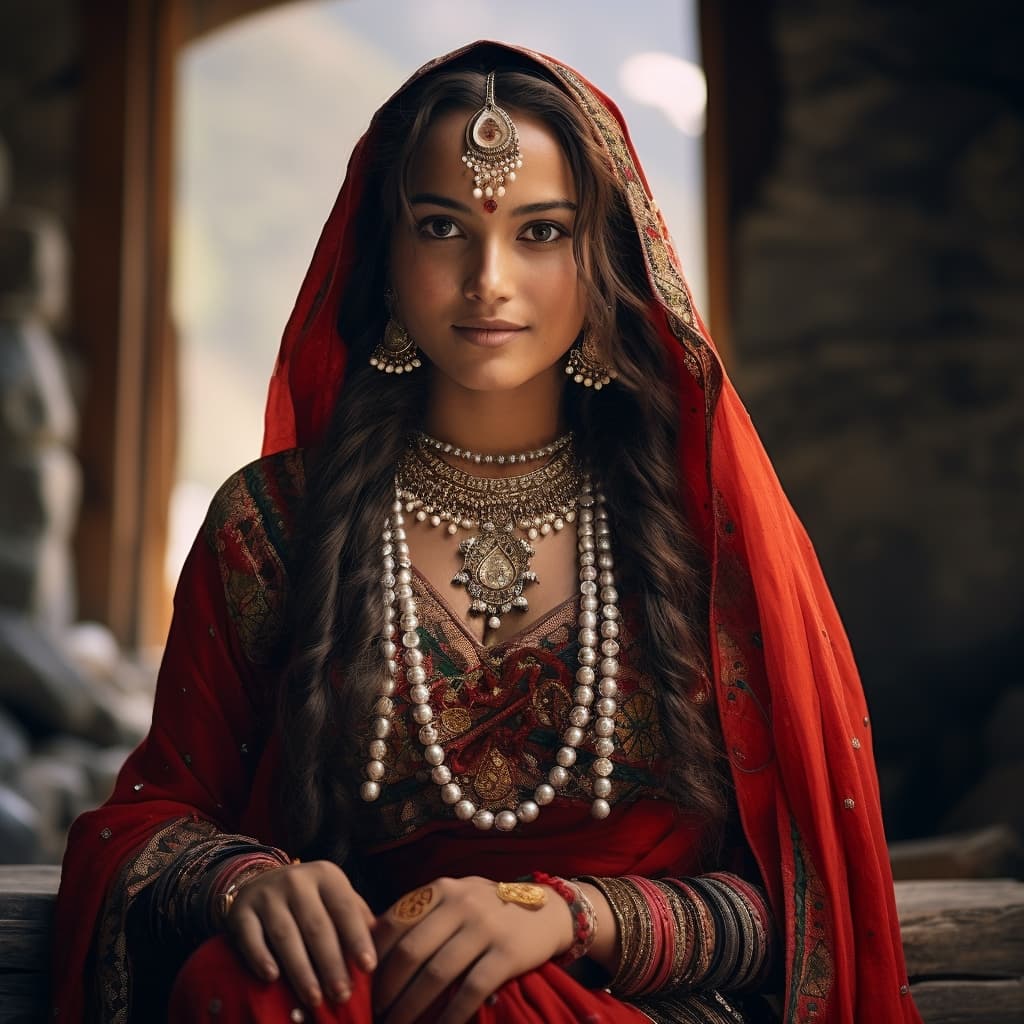
Garhwalis Erotic
Uttarakhand (India)
Indo-European / Indo-Aryan / Garhwali
Hinduism
Southern Asia
About Garhwalis People
The Garhwalis are a hill people of the central Himalayas, concentrated in the Garhwal division of Uttarakhand — the western half of the state, running from the Bhabar foothills up through Tehri, Pauri, Chamoli, Rudraprayag, and Uttarkashi to the high passes on the Tibetan frontier. Their homeland is defined by altitude more than by any single river or city: terraced fields cut into steep slopes, pine and deodar forests, villages strung along ridgelines, and the headwater valleys of the Ganga and the Yamuna. Identity here is layered with the land. Most Garhwalis will name not just their district but their patti and ancestral village, and the question of which side of which ridge a family comes from still carries weight.
Garhwali is an Indo-Aryan language of the Central Pahari group, sister to Kumaoni across the Pindar river and more distantly related to Hindi, with which it shares the Devanagari script but not the same vocabulary or rhythm. It splinters into a dozen named dialects — Srinagaria, Tehrwali, Jaunsari on the western edge shading toward Himachali speech — that locals can place by ear within a sentence or two. Hindi dominates schooling, government, and the army, so Garhwali survives mostly at home and in song; the jagar tradition of all-night ritual ballads, in which a possessed medium speaks for a local deity, is one of the strongest carriers of the language as living literature.
Religion is Hindu, but Himalayan Hindu, organized around clan and locality rather than the pan-Indian pantheon. The dominant figures are the regional deities — Nanda Devi, Nagaraja, Ghantakarna, the Pandavas treated as living patrons — and the four dhams of Badrinath, Kedarnath, Gangotri, and Yamunotri, which sit in Garhwali territory and shape the rhythm of the year through the opening and closing of the high shrines. Brahmin and Rajput lineages predominate, with the Rajputs claiming descent from refugee chieftains who drifted into the hills after defeats on the plains; the small kingdom of Garhwal, ruled from Srinagar and later Tehri, kept a measure of autonomy until the Gorkha invasions of the early 1800s and the British settlement that followed. Out-migration to the plains and to military service has hollowed many villages — the term ghost villages is used without irony in Uttarakhand — but remittances, returning retirees, and a slow tourism economy keep the hill culture in motion rather than in storage.
Typical Garhwalis Phenotypes
Reference for AI generation — hair, eyes, skin, facial structure, build
Garhwalis are a Pahari hill population from the western Uttarakhand Himalaya, and their phenotype reads as North Indian with a clear cool-climate, mid-altitude inflection — generally lighter and more sharply-featured than the plains populations south of them, but distinct from the more East-Asian-influenced look of higher-Himalayan groups like Bhotiyas or Tibetans.
Hair is almost uniformly black to very dark brown, occasionally warming to a deep coffee shade in sunlight. Texture runs straight to loosely wavy, fine to medium in diameter, and holds length well — tight curls and coils are uncommon. Eyes are typically dark brown to near-black; lighter hazel or honey eyes turn up rarely but are noted often enough to be unsurprising. The eye shape is almond, set on a relatively flat brow; epicanthic folds are absent or only mildly present in most individuals, distinguishing Garhwalis from neighbouring trans-Himalayan groups.
Skin tone covers Fitzpatrick III through V, weighted toward the lighter end of that range — wheatish to fair-olive is the modal complexion, with warm golden or rosy undertones, while terraced-field labour produces sharper face-and-forearm tans. Facial structure tends toward a narrow, high-bridged nose with a refined alar base, defined cheekbones, a tapered jaw, and lips of moderate fullness. The overall impression is angular rather than rounded, and this aquiline-nose profile is one of the more reliable Garhwali markers — visible across actresses like Tripti Dimri and Urvashi Rautela.
Build is moderate: men commonly fall around 165–172 cm, women 152–158 cm, both lean and wiry from generations of vertical hill terrain rather than bulky. Limbs are proportionally long for the torso, hips and shoulders narrower than plains averages.
Sub-regional variation is mostly cline rather than category — Tehri and Pauri Garhwal lean toward the lighter, sharper-featured end, while communities closer to the Bhotiya borderlands in upper Chamoli and Uttarkashi show occasional epicanthic-fold presence and slightly broader cheekbones from gene-flow with trans-Himalayan neighbours.
Data depth
78/100Coverage of image-grounded phenotype observations · drives AI generation diversity
- Sample size
- 36/40· 41 images
- Image quality
- 27/30· 54% high
- Confidence
- 15/20· mean 0.77
- Source diversity
- 0/10· wikipedia
- ·Wikipedia-only source — not population-representative
Observed Distribution — Image Sample
Empirical observations from analyzed photographs · supplementary signal, not population truth
Sample: 41 images analyzed (41 wikipedia). Quality: 22 high, 13 medium, 4 low, 2 very_low. Avg analyzer confidence: 0.77.
Skin tone (Fitzpatrick): III (15%), IV (61%), V (22%), unclear (2%)
Hair color: black (46%), gray/white (37%), dark brown (12%), red/auburn (2%), unclear (2%)
Hair texture: straight (51%), wavy (22%), curly (5%), covered (22%)
Eye color: dark brown (88%), unclear (12%)
Epicanthic fold: 7% present, 80% absent, 2% partial, 10% unclear
Caveats: Sample is 100% Wikipedia notable people — skews toward male, public-life, and modern figures, not population-representative.
Last aggregated: May 7, 2026
Explore phenotype categories
Structured taxonomy with peer-reviewed scales · 22 anatomical categories
Notable Garhwalis People
100 reference figures — sourced from Wikipedia
- Brijendra Kala — actor, dialogue writer)
- Chitrashi Rawat — actress)
- Himani Shivpuri — actress)
- Madhurima Tuli — actress)
- Sanjay Khanduri — director)
- Tigmanshu Dhulia — dialogue writer, director, actor, screenwriter, producer and casting director)
- Tripti Dimri — actress)
- Urvashi Rautela — actress)
- Aditi Sajwan — actress)
- Alka Kaushal — actress)
- Asha Negi — actress)
- Barkha Sengupta — actress)
- Priyanka Kandwal — actress)
- Raghav Juyal — dancer, choreographer and actor)
- Shivangi Joshi — actress)
- Shruti Bisht — actress)
- Shruti Ulfat — actress)
- Abhilash Thapliyal — radio jockey and actor)
- Anukriti Gusain — actress, Femina Miss India, Miss Asia Pacific World 2014)
- Manasvi Mamgai — model, Femina Miss India 2010)
- Navi Rawat — Indian-American actress)
- Basanti Bisht — folk singer, Padma Shri award recipient)
- Chander Singh Rahi — folk singer, composer, poet musician)
- Jeet Singh Negi — folk singer)
- Meena Rana — folk singer)
- Narendra Singh Negi — folk singer and composer, Padma Shri and Sangeet Natak Akademi Award recipient)
- Pritam Bhartwan — folk singer, Padma Shri award recipient)
- Abodh Bandhu Bahuguna — Hindi writer and poet)
- Ganga Prasad Vimal — Hindi writer and poet)
- Leeladhar Jagudi — Hindi writer, poet, Padma Shri and Sahitya Akademi Award recipient)
- Manglesh Dabral — Hindi writer, poet and journalist, Sahitya Akademi Award recipient)
- Mola Ram — 18th century Indian painter, who originated the Garhwal branch of the Pahari/…
- Ranbir Singh Bisht — Indian painter and the Principal of the College of Fine Arts, Lucknow Univers…
- Taradutt Gairola — lawyer, author, editer)
- Viren Dangwal — Hindi writer, poet, journalist and academician, Sahitya Akademi Award recipient)
- Girish Tiwari — Hindi/Kumaoni poet and folk singer)
- Shekhar Pathak — historian, editor, publisher, activist, traveller associated with the Chipko …
- Anil Prakash Joshi — environmentalist, Padma Shri and Padma Bhushan recipient)
- Chandi Prasad Bhatt — environmentalist, Chipko movement leader, Padma Bhushan and Ramon Magsaysay A…
- Gaura Devi — Leader of Mahila Mangal Dal of Chipko movement) - Indira Priyadarshini Vriksh…
- Kunwar Singh Negi — braille editor and social worker, Padma Shri and Padma Bhushan recipient)
- Sunderlal Bahuguna — environmentalist, Chipko movement leader, Padma Vibhushan recipient)
- Nagendra Saklani — Indian revolutionary and freedom fighter)
- Ram Prasad Nautiyal — Indian freedom fighter and politician)
- Sri Dev Suman — Indian freedom fighter, journalist and civil rights leader)
- Teelu Rauteli — folk heroine of Garhwal, Uttarakhand
- Dabral Baba — Indian yogi and mystic)
- Hans Maharaj — Indian spiritual leader)
- Prem Rawat — Indian American spiritual leader, founder of the Divine Light Mission)
- Swami Rama — founder of the Himalayan Institute Hospital Trust)
- Anand Sharan Raturi — economist and first vice-chancellor of Mahatma Jyotiba Phule Rohilkhand Unive…
- Aditya Narayan Purohit — Plant physiologist, Padma Shri awarded and vice-chancellor of H.N.B. Garhwal …
- Anirudh Kala — psychiatrist)
- Chandra Prakash Kala — ecologist)
- Prem Lal Joshi — accounting researcher and professor)
- Ruchi Badola — ecologist)
- Vijay Prasad Dimri — geophysical scientist, Padma Shri recipient)
- Darwan Singh Negi — Naik Darwan Singh Negi, Victoria Cross from 1st Battalion of 39th Garhwal Rifles
- Gabar Singh Negi — Rifleman Gabar Singh Negi, Victoria Cross from 2nd Battalion, 39th Garhwal Ri…
- Gajender Singh Bisht — Havildar Gajender Singh Bisht, Operation Black Tornado 2008, Ashoka Chakra (p…
- Jaswant Singh Rawat — Rifleman Jaswant Singh Rawat, hero of Indo-China War, 1962; Maha Vir Chakra (…
- Bipin Rawat — General Bipin Rawat, Chief of Defence Staff and former Chief of the Army Staff
- Anil Chauhan — Lt. Gen. Anil Chauhan, Director General of Military Operations (DGMO), Indian…
- Anil Kumar Bhatt — Lt. Gen. Anil Kumar Bhatt, General Officer Commanding (GOC) XV Corps, also ca…
- Jaiveer Singh Negi — Lt. Gen. Jaiveer Singh Negi, Commandant of Indian Military Academy, Indian Army
- Balwant Singh Negi — Lt. Gen. Balwant Singh Negi (Retd.), former General Officer Commander-in-Chie…
- Madan Mohan Lakhera — Lt. Gen. Madan Mohan Lakhera (Retd.), former Governor of Mizoram, former Lieu…
- Tejpal Singh Rawat — Lt. Gen. Tejpal Singh Rawat (Retd.), former Director General of the Assam Rif…
- Rajendra Singh — Director-General Rajendra Singh, former Director General of the Indian Coast …
- B. C. Khanduri — Maj. Gen. B. C. Khanduri (Retd.), former Union Minister of Surface Transport,…
- Brijesh Dhar Jayal — Air Marshal Brijesh Dhar Jayal (Retd.), PVSM AVSM VM & Bar (served as Air Off…
- Arvindra Singh Butola — Air Marshal Arvindra Singh Butola, Air Officer Commander-in-Chief (AOC-in-C),…
- Surendra Singh Panwar — Brigadier Surendra Singh Panwar (Retd.)
- S. K. S. Negi — Brigadier S. K. S. Negi (Retd.)
- Ajay Kothiyal — Colonel Ajay Kothiyal (Retd.), Kirti Chakra and Shaurya Chakra recipient
- Ajit Doval — National Security Adviser of India, Kirti Chakra, President's Police Medal an…
- Anil Dhasmana — former chief of the Research and Analysis Wing, the external intelligence age…
- Mukandi Lal — barrister, judge, politician, writer, and art critic from the Princely State …
- Sudhanshu Dhulia — Justice, Uttarakhand High Court. Judge In-Charge Education, Uttarakhand Judic…
- Ravindra Maithani — Judge at the High Court of Uttarakhand at Nainital since December 2018)
- Anil Baluni — journalist, politician, MP Rajya Sabha)
- Bhakt Darshan — politician, former Union Minister of State for Education and Transport, forme…
- Brahm Dutt — politician, former Union Minister of State for Petroleum and Natural Gas, for…
- Dimple Rawat Yadav — politician, Samajwadi Party, wife of Akhilesh Yadav)
- Chandra Mohan Singh Negi — politician, former MP Lok Sabha)
- Dhan Singh Negi — politician, Former MLA of Tehri)
- Hemwati Nandan Bahuguna — politician, former Chief Minister of Uttar Pradesh)
- Kamalendumati Shah — former Queen of the Princely State of Tehri Garhwal, former MP Lok Sabha)
- Mahant Avaidyanath — politician, former Mahant of Gorakhnath Math, former MP Lok Sabha)
- Manabendra Shah — Lt. Col. Manabendra Shah (politician, former King of the Princely State of Te…
- Manohar Kant Dhyani — politician, former MP Rajya Sabha)
- Manorama Dobriyal Sharma — politician, former MP Rajya Sabha)
- Paripoornanand Painuli — politician, former MP Lok Sabha)
- Ramesh Pokhriyal — politician, Union Minister of Human Resource Development, former Chief Minist…
- Rita Bahuguna Joshi — politician, MP Lok Sabha)
- Satpal Maharaj — politician, former MP Lok Sabha)
- Tirath Singh Rawat — politician, Chief Minister of Uttrakhand)
- Trepan Singh Negi — politician, former MP Lok Sabha)
- Trivendra Singh Rawat — politician, Former Chief Minister of Uttarakhand)
- Vijay Bahuguna — politician, former Chief Minister of Uttarakhand)
Generate Garhwalis AI Content
Use this ethnicity's phenotype data to create AI-generated content with accurate physical traits and cultural context.
Open Creator Studio