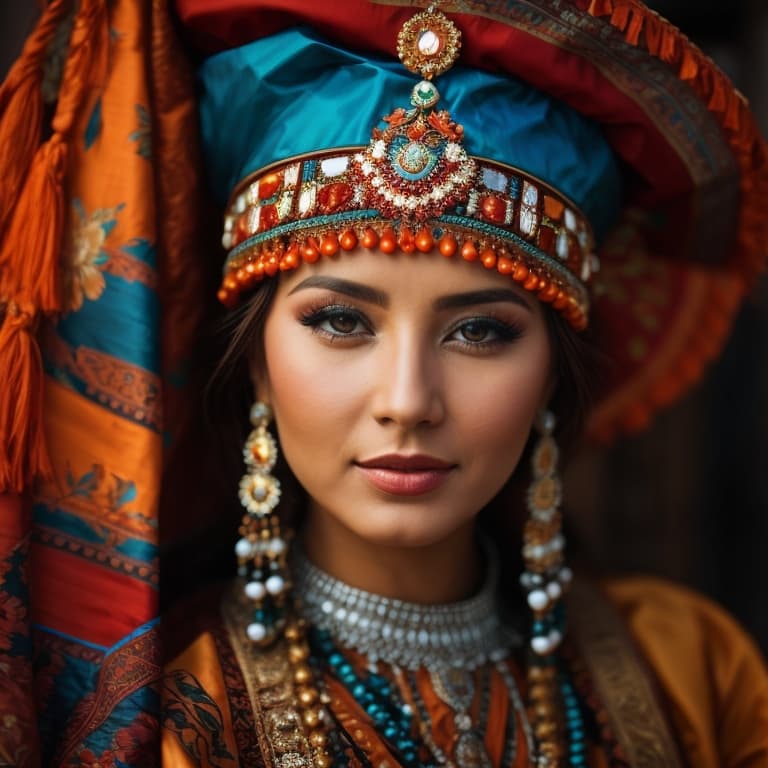
Bashkirs Erotic
Bashkortostan (Russia)
Turkic / Kipchak / Bashkir
Islam
Southern Asia
About Bashkirs People
The Bashkirs are a Turkic people of the southern Urals, concentrated in the Republic of Bashkortostan where the steppe runs up against forested mountains and broad river valleys — the Belaya, the Ural, the Sakmara. That meeting of zones shaped them. They were pastoralists who summered their horses and sheep in the high meadows and wintered in the lowlands, and the older folkways still carry the imprint of that mobility: a horseman's culture, a deep tradition of mounted hunting, and the only surviving practice of wild-honey gathering from forest hives, called bortnichestvo, which is genuinely theirs and which UNESCO has noted is preserved nowhere else in this form.
Their language belongs to the Kipchak branch of Turkic, sister to Tatar but distinct enough that Bashkirs will firmly correct anyone who conflates the two. The split is audible — Bashkir has a set of interdental fricatives more reminiscent of English th sounds than of its neighbors — and the literary language was codified separately in the early Soviet period, partly as a deliberate assertion that Bashkirs were not Tatars under another name. That distinction matters historically: Bashkir lands were absorbed into Muscovy in the sixteenth century, and the centuries that followed saw a string of revolts against land seizures and forced settlement, the largest of them feeding into the Pugachev rebellion of the 1770s. Salavat Yulayev, the young warrior-poet who rode with Pugachev, remains the figure on the republic's coat of arms.
Islam arrived gradually from the south, carried by Volga Bulgar and later Central Asian missionaries, and Bashkirs are predominantly Sunni of the Hanafi school. The religion settled into the culture without ever fully displacing the older layer beneath it — pre-Islamic spirit-belief in mountains, springs, and the dead persists in folk practice, and the kuray, an open-ended reed flute whose drone-and-melody style is unmistakably ancient, is still the instrument that opens national ceremonies. The epic Ural-batyr, transmitted orally for generations before being written down in the 1910s, sits at the center of Bashkir self-understanding the way the Kalevala does for Finns.
Today roughly a million and a half Bashkirs live in their republic, with smaller populations across the Urals and into western Siberia. They are an urbanized people now — Ufa, the capital, is a city of over a million — but the rural districts retain working knowledge of horse husbandry, fermented mare's milk (kumys), and the seasonal gatherings, particularly the summer Sabantuy, that mark the year.
Typical Bashkirs Phenotypes
Reference for AI generation — hair, eyes, skin, facial structure, build
Bashkirs sit at a genuine crossroads: a Turkic-speaking population of the southern Urals whose phenotype reflects centuries of admixture between Volga-Ural Mongoloid and European populations. The result is a face that often reads as mixed at first glance — recognizably Eurasian without resolving cleanly to either pole. Eastern, mountain-dwelling Bashkirs generally show stronger East Eurasian features; western Bashkirs near Tatarstan trend more European.
Hair is overwhelmingly dark — black or dark brown — and predominantly straight to gently wavy, with the coarse, thick texture characteristic of Turkic-Siberian populations. Light brown appears in the western admixed zones; true blondness and red are rare. Facial hair on men is moderate, less dense than in West Asian groups.
Eyes are most often brown to dark brown, occasionally hazel or grey-green in the western branches. Eyelid morphology is the most distinctive feature: a partial or full epicanthic fold is common — not as pronounced or universal as in East Asian groups, but present in a clear majority. The eye opening tends to be narrower and set into a flatter orbital region, giving the characteristic Bashkir gaze that singers like Aigul Akhmetshina and Zemfira carry plainly.
Skin is light — Fitzpatrick II–III dominates, with neutral-to-warm undertones rather than the olive cast of Mediterraneans. Cheekbones are broad and prominent, the malar projection lateral rather than forward. Noses are typically straight to slightly concave with a low-to-medium bridge and moderate alar width — not the high, narrow nose of the Caucasus, not the broad nose of inner Asia. Lips are medium fullness, jawlines tend to be wider than tall, producing a face that's more rounded or square than oval.
Build is medium — men typically 170–175 cm, women 160–165 cm — historically wiry and durable rather than tall, reflecting a steppe-pastoralist physical heritage. Athletes like wrestler Vener Galiev exemplify the compact, broad-shouldered frame that recurs in the population.
Data depth
75/100Coverage of image-grounded phenotype observations · drives AI generation diversity
- Sample size
- 32/40· 30 images
- Image quality
- 28/30· 57% high
- Confidence
- 15/20· mean 0.70
- Source diversity
- 0/10· wikipedia
- ·Wikipedia-only source — not population-representative
Observed Distribution — Image Sample
Empirical observations from analyzed photographs · supplementary signal, not population truth
Sample: 30 images analyzed (30 wikipedia). Quality: 17 high, 9 medium, 4 low, 0 very_low. Avg analyzer confidence: 0.70.
Skin tone (Fitzpatrick): II (53%), III (30%), IV (10%), unclear (7%)
Hair color: black (53%), gray/white (20%), dark brown (10%), blonde (7%), brown (3%), unclear (7%)
Hair texture: straight (53%), wavy (30%), covered (10%), unclear (7%)
Eye color: dark brown (43%), hazel (13%), blue (13%), brown (7%), unclear (23%)
Epicanthic fold: 23% present, 67% absent, 3% partial, 7% unclear
Caveats: Sample is 100% Wikipedia notable people — skews toward male, public-life, and modern figures, not population-representative.
Last aggregated: May 7, 2026
Explore phenotype categories
Structured taxonomy with peer-reviewed scales · 22 anatomical categories
Notable Bashkirs People
41 reference figures — sourced from Wikipedia
- Ruslan Fazlyev — internet entrepreneur
- Salavat Fidai — sculptor
- Ural Rakhimov — oligarch
- Ildar Abdrazakov — born 1976), bass opera singer
- Aigul Akhmetshina — born 1996), mezzo-soprano opera singer
- Gaziz Al'mukhametov — tenor opera singer
- Roza Akkuchukova — 1950–2021), pop singer
- Miftahetdin Akmulla — 1831–1895), Bashkir poet and philosopher, famous for his patriotic chants and…
- Shaikhzada Babich — 1895–1919), Bashkir poet, writer and playwright. Member of the Bashkir nation…
- Mustai Karim — 1919–2005), Bashkir Soviet poet, writer and playwright
- Zagir Ismagilov — 1917–2003), composer and educator
- Yakup Kulmiy — 1918–1994), poet
- Rudolf Nureyev — 1938–1993), ballet dancer and choreographer
- Lyasan Utiasheva — born 1985), TV show host, socialite and former rhythmic gymnast
- Alina Ibragimova — born 1985), violinist
- Morgenshtern — born 1998), rapper and internet personality
- Zemfira Ramazanova — born 1976), indie rock singer and musician
- Beder Yusupova — 1901–1969), Soviet Bashkiria actress, teacher
- Musa Gareyev — 1922–1987), twice Hero of the Soviet Union
- Salawat Yulayev — 1756–1800), Bashkir national hero
- Shagit Hudayberdin — Communist revolutionary
- Tagir Kusimov — 1909–1986), Soviet military leader
- Zekeria Aknazarov — Communist party leader
- Murtaza Rakhimov — first president of Bashkortostan
- Rustem Khamitov — second president of Bashkortostan
- Radiy Khabirov — head of Bashkortostan since 2018
- Zaynulla Rasulev — Jadid movement leader
- Zeki Velidi Togan — historian, Turkologist and leader of the Bashkir national movement of the ear…
- Igor Abdrazakov — footballer
- Ilshat Aitkulov — football coach
- Rodion Amirov — ice hockey player
- Vener Galiev — amateur wrestler, sambist and mixed martial artist
- Adelina Ibatullina — pentathelete
- Aygul Idrisova — international draughts player
- Svetlana Ishmouratova — biathlete
- Shakir Mukhamadullin — ice hockey player
- Kamilla Rakhimova — tennis player
- Liliya Shobukhova — long-distance runner
- Tamara Tansykkuzhina — international draughts player
- Arthem Vakhitov — kickboxer
- Irek Zaripov — biathlete and cross-country skier
Generate Bashkirs AI Content
Use this ethnicity's phenotype data to create AI-generated content with accurate physical traits and cultural context.
Open Creator Studio