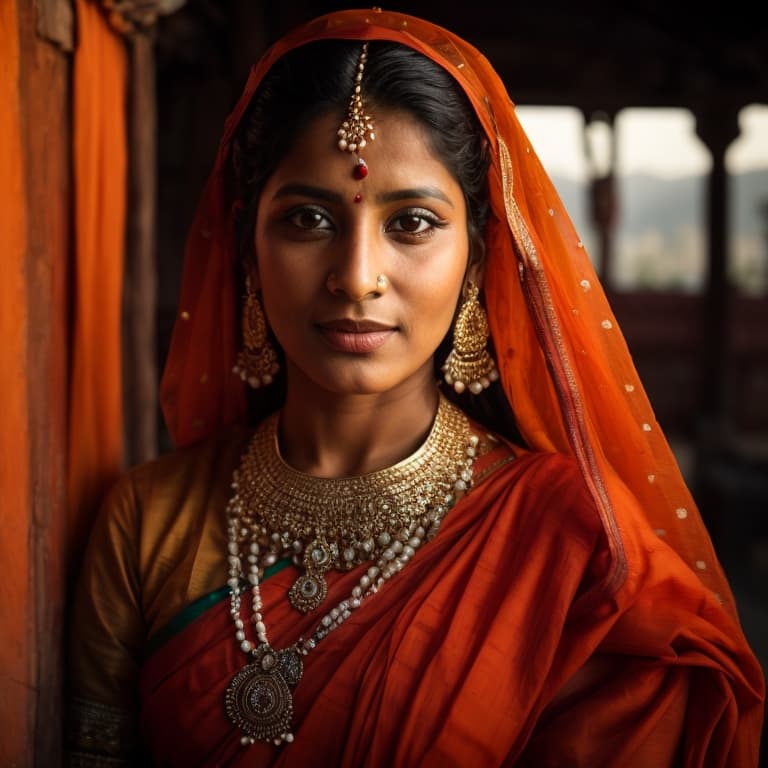
Dogra Erotic
Jammu Division (India)
Indo-European / Indo-Aryan / Dogri
Hinduism
Southern Asia
About Dogra People
The Dogras are the people of the lower Himalayan foothills of the Jammu region — the southern, Hindu-majority half of what was, until 1947, the princely state of Jammu and Kashmir. Their country is the patch of India where the plains of Punjab buckle into pine ridges and river gorges before climbing toward the high Himalaya: Jammu city sits in the heat and dust of the Tawi valley, but a few hours' drive north puts you in cedar forest and snow. That gradient — plains-fed agriculture below, pastoral hill life above — runs through almost everything about how Dogras have lived.
Dogri, their language, is Indo-Aryan and close kin to Punjabi and the Pahari speech of the western Himalaya, though Dogras are firm that it is its own language with its own literature, and they got their way: it was added to the Eighth Schedule of the Indian Constitution in 2003. It is written today in Devanagari, but an older script, Dogra Akkhar (Takri), survives on temple inscriptions and in the archives of the former court. The literary tradition leans on folk forms — long ballads, wedding songs, the seasonal chants tied to the agricultural calendar — rather than on a courtly canon.
Hinduism among Dogras has a distinct hill flavor. The household pantheon runs heavy on local kul devis — clan goddesses tied to particular shrines in the hills — and the major regional pilgrimage, Vaishno Devi in the Trikuta range above Katra, draws millions a year and structures a lot of the religious year for ordinary Dogra families. Shaivism is strong; so is the cult of Bawa Jitto and other local saint-figures whose stories sit somewhere between hagiography and peasant rebellion narrative.
The historical inflection point is the 19th century, when the Jamwal Rajput house of Jammu, under Gulab Singh, parlayed service to the Sikh empire into a treaty with the British that handed them Kashmir, Ladakh and Gilgit — an empire vastly larger than the Dogra heartland itself. That arrangement collapsed in 1947 and shaped the conflict over Kashmir that still defines the region. Within Dogra society, the older social architecture — Rajput martial lineages, Brahmin ritual specialists, a tradition of military service that continues in the Indian Army's Dogra Regiment — is still legible, though much eroded by migration to Jammu city, Delhi and the Gulf.
Typical Dogra Phenotypes
Reference for AI generation — hair, eyes, skin, facial structure, build
The Dogras are a Pahari-Punjabi population from the lower Himalayan foothills of Jammu, and their phenotype sits at the meeting point of Punjabi Plains stock and the highland Pahari belt — taller and lighter on average than peninsular North Indians, but without the distinct Tibeto-Burman features found further east in the Himalayas.
Hair is typically dark brown to black, with a meaningful minority showing softer dark-brown shades that lighten under sun. Texture runs straight to gently wavy; tight curl is uncommon. Beard growth in men is moderate to heavy, often with reddish-brown cast when sun-bleached. Eyes are most often dark brown, but light-brown and hazel turn up at higher rates than in lowland North India, and outright green or grey eyes appear occasionally in Jammu hill families with Kashmiri admixture. The eye is almond-shaped with a clean upper lid; epicanthic folds are absent.
Skin tone clusters around Fitzpatrick III–IV — wheatish to light-olive with warm yellow or rosy undertones — and trends noticeably lighter in the hill districts (Kishtwar, Doda, Bhaderwah) than in the plains around Jammu city, where IV–V is typical. Cheeks often hold visible flush in cold weather. The face is generally oval to slightly long, with a straight or modestly aquiline nose, a moderately tall bridge, and narrower alar base than is typical further south. Lips are medium in fullness; jawlines tend to be defined rather than soft, and cheekbones are present but not high-set.
Build skews tall for the subcontinent — men commonly 5'8"–6'0", with a martial-tradition reputation for broad shoulders and dense musculature that Vidyut Jammwal exemplifies in the public eye. Women tend toward slim-to-athletic frames with longer limbs than the Punjabi average. The Pahari sub-branches from the upper hill belts read fairer and finer-featured; the Jamwal, Pathania, and Jasrotia clans of the plains carry sturdier, more Punjabi-leaning builds.
Data depth
60/100Coverage of image-grounded phenotype observations · drives AI generation diversity
- Sample size
- 28/40· 23 images
- Image quality
- 22/30· 43% high
- Confidence
- 10/20· mean 0.67
- Source diversity
- 0/10· wikipedia
- ·Modest sample (n<25)
- ·Wikipedia-only source — not population-representative
Observed Distribution — Image Sample
Empirical observations from analyzed photographs · supplementary signal, not population truth
Sample: 23 images analyzed (23 wikipedia). Quality: 10 high, 9 medium, 3 low, 1 very_low. Avg analyzer confidence: 0.67.
Skin tone (Fitzpatrick): III (13%), IV (70%), V (13%), unclear (4%)
Hair color: black (74%), gray/white (17%), unclear (9%)
Hair texture: straight (39%), wavy (13%), curly (9%), covered (35%), unclear (4%)
Eye color: dark brown (87%), unclear (13%)
Epicanthic fold: 0% present, 91% absent, 9% unclear
Caveats: Sample size 23 is modest — secondary patterns may not be reliable. Sample is 100% Wikipedia notable people — skews toward male, public-life, and modern figures, not population-representative.
Last aggregated: May 7, 2026
Explore phenotype categories
Structured taxonomy with peer-reviewed scales · 22 anatomical categories
Notable Dogra People
38 reference figures — sourced from Wikipedia
- Banda Singh Bahadur — Sikh warrior and commander of Khalsa army
- Premchand Degra — Professional bodybuilder
- Akshay Dogra — Indian actor
- Girdhari Lal Dogra — Politician who served as Finance minister of Jammu and Kashmir
- Monica Dogra — American musician and actress
- Paras Dogra — Indian cricketer
- Prem Nath Dogra — Politician also known as Sher e Duggar
- Rajiv Dogra — Indian diplomat who served as Ambassador to Romania
- Riddhi Dogra — Indian actress
- Romesh Chander Dogra — Deputy speaker and former Health and Family Welfare minister of Punjab
- Tirath Das Dogra — Indian forensic pathologist
- Zakir Hussain — Indian tabla player and composer
- Vidyut Jammwal — Indian actor and martial artist
- Mian Dido Jamwal — dogra warrior who revolted against Sikh Empire
- Ranveer Jamwal — Indian mountaineer and army officer
- Ajay Singh Jasrotia — Indian military officer and martyr of Kargil war
- Arun Singh Jasrotia — Indian military officer was posthumously awarded the Ashoka Chakra
- Khudadad Khan — British Indian soldier and recipient of Victoria Cross
- Vijay Mahajan (academic) — Jammu-born Indian-American Professor of Marketing (The University of Texas at…
- Manjit Minhas — Canadian entrepreneur, television personality and venture capitalist.
- Rashid Minhas — Pilot in Pakistan Air Force and recipient of Nishan-e-Haider
- Anant Singh Pathania — Indian military personnel and first Indian recipient of Military Cross in the…
- Raghbir Singh Pathania — former Indian Lieutenant Colonel
- Alla Rakha — Hindustani classical musician from India
- Mukesh Rishi — Indian actor and film producer
- Gurbachan Singh Salaria — Indian military officer and member of UN peacekeeping
- Narain Singh Sambyal — Military personnel
- Shivkumar Sharma — Indian classical musician and santoor player
- Dhian Singh — longest serving wazir of Sikh Empire and aristocrat
- Gulab Singh — first Maharaja of the princely state of Jammu and Kashmir
- Hari Singh — former Maharaja of the princely state of Jammu and Kashmir
- Karan Singh — titular Maharaja of the princely state of Jammu and Kashmir and former Rajya …
- Rajinder Singh — officer in the Jammu and Kashmir State Forces also known as saviour of Kashmir
- Maharaja Ranbir Singh — former Maharaja of the princely state of Jammu and Kashmir
- Zorawar Singh — military general of first Sikh Empire and later Dogra dynasty
- Lohri — Heren, a traditional theatre form performed during the Lohri festival by 10–1…
- rubab — Karak, a narrative ballet sung by a community called 'Jogies'. They narrate a…
- auryia — a curd dish fermented by rye;


Generate Dogra AI Content
Use this ethnicity's phenotype data to create AI-generated content with accurate physical traits and cultural context.
Open Creator Studio