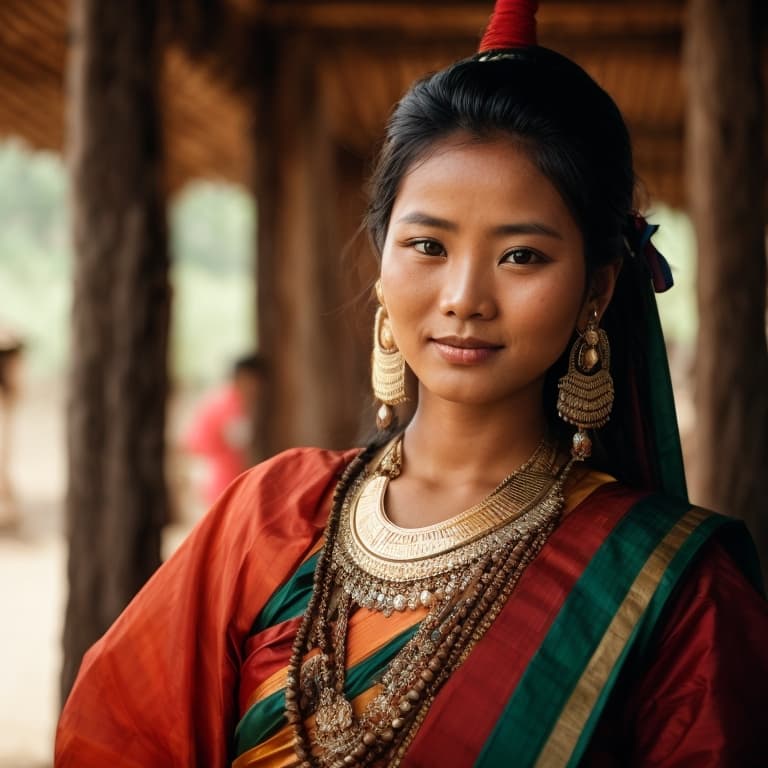
Bamars Erotic
Myanmar
Sino-Tibetan / Burmese
Buddhism / Theravada Buddhism
Taungyo, Yaw, Intha, Danu, Anglo-Burmese
Southern Asia
About Bamars People
The Bamars are the dominant people of Myanmar, the group whose language became the country's lingua franca and whose name the state itself was anglicized from. Their heartland is the dry zone of central Myanmar — the Irrawaddy basin, the broad alluvial plain that runs from Mandalay south toward the delta — flanked on three sides by hill country occupied by other peoples. That geography matters: Bamar history is largely a story of a lowland rice-growing majority looking up at the Shan, Kachin, Chin, Karen and others in the surrounding highlands, and the modern Burmese state has spent most of its existence trying to negotiate, absorb, or fight that distinction.
The Burmese language is Sino-Tibetan, in the Tibeto-Burman branch — closer kin to Tibetan than to the Tai-Kadai tongues of neighboring Thailand or the Mon-Khmer languages spoken in pockets of the same country. It is tonal, written in a rounded script descended from a southern Indic alphabet, the curves famously a concession to writing on palm leaves that would split under straight lines. Sub-groups like the Intha of Inle Lake, the Danu, the Taungyo and the Yaw speak distinct varieties or related languages, and the Anglo-Burmese — the Eurasian community that grew up under British rule — sit somewhat apart, often Christian, often English-speaking, much reduced in number since independence.
Theravada Buddhism is the through-line. It arrived from Sri Lanka, took hold under King Anawrahta in eleventh-century Pagan, and has shaped Bamar civic life ever since. Most boys still go through shinbyu, the novitiation ceremony in which a child briefly enters monastic life — a rite as socially important as it is religious. The Sangha is a real political force; monks have led protests against military rule more than once. Underneath the orthodox Buddhist surface runs a parallel world of nat worship, the cult of thirty-seven spirits with their own shrines, mediums and festivals, a pre-Buddhist inheritance the Theravada establishment has never managed, and never really tried, to extinguish.
Daily Bamar culture leans on small things outsiders often miss: thanaka paste worn on the cheeks as cosmetic and sunscreen, the longyi wrapped sarong worn by men and women alike, mohinga fish soup eaten for breakfast, and a teahouse culture where political conversation has historically been conducted at low volume and in code.
Typical Bamars Phenotypes
Reference for AI generation — hair, eyes, skin, facial structure, build
The Bamar phenotype sits at a Southeast Asian crossroads — Sino-Tibetan ancestry overlaid with deeper Austroasiatic substrate and centuries of contact with Tai, Indian, and Mon populations. The result is recognizably East-Asian-adjacent but consistently softer in feature than groups further north, with a warmer skin register than mainland Han or Korean populations.
Hair is overwhelmingly black to very dark brown, straight to gently wavy, with thickness and density typical of East and Southeast Asian populations. True curl is rare outside Anglo-Burmese lineages, where European admixture introduces lighter brown tones and looser texture. Premature greying is uncommon; hair often retains pigment well into middle age.
Eyes are dark brown to near-black. The epicanthic fold is the rule rather than the exception, though it tends to be less pronounced than in northern East Asian groups — many Bamars show a partial fold or a single eyelid that opens to a more visible crease with age. Eye shape is typically almond, set on a relatively flat orbital plane.
Skin tones cluster in Fitzpatrick III–IV, running from a light wheaten olive to a warm medium brown, almost always with golden or yellow undertones rather than the cooler pink undertones seen further north. Thanaka paste, worn daily on cheeks and nose by women and children, leaves many faces visibly lighter across the malar region than the rest of the body.
Facial structure tends toward a rounded or softly oval face with moderate cheekbones — broader and flatter than Indian neighbours, but less angular than southern Chinese profiles. Noses are typically short with a low-to-medium bridge and moderate alar width. Lips are medium-full, fuller on average than East Asian groups to the north.
Build is small-framed and slender. Adult male stature commonly falls between 162–168 cm, female 150–157 cm, with low average body fat and limited muscular bulk. The Intha of Inle Lake are physically indistinguishable from lowland Bamars; the Danu and Taungyo of the Shan hills show subtle Tai-Shan influence — slightly lighter skin, narrower eyes, occasionally taller frames. Anglo-Burmese descendants are visibly mixed: lighter skin, brown or hazel eyes, narrower noses, sometimes wavy hair.
Data depth
0/100Coverage of image-grounded phenotype observations · drives AI generation diversity
- Sample size
- 0/40· 0 images
- Image quality
- 0/30· 0% high
- Confidence
- 0/20
- Source diversity
- 0/10
- ·No image observations yet
Explore phenotype categories
Structured taxonomy with peer-reviewed scales · 22 anatomical categories
Generate Bamars AI Content
Use this ethnicity's phenotype data to create AI-generated content with accurate physical traits and cultural context.
Open Creator Studio