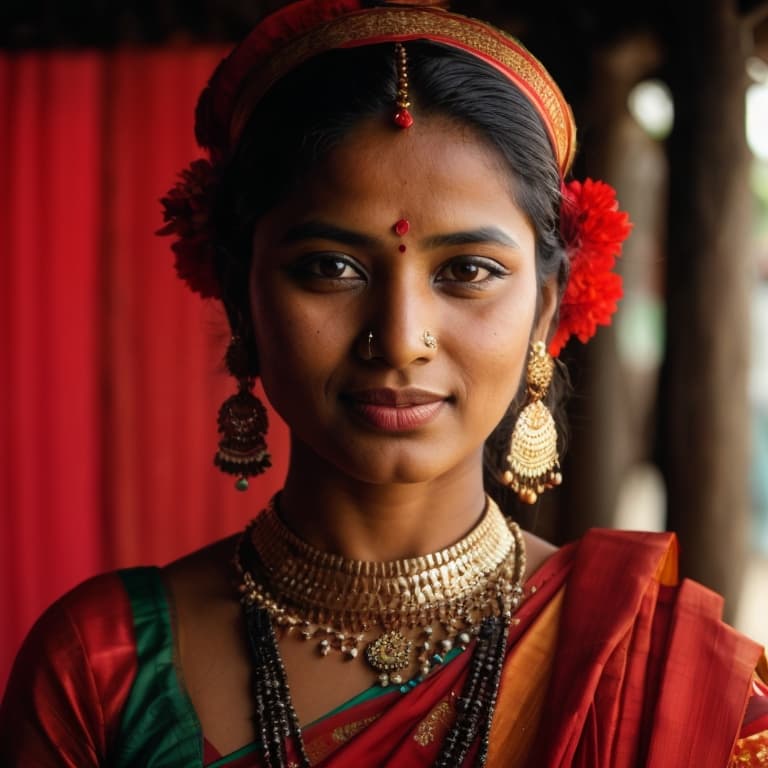
Chutiya Erotic
Assam (India)
Sino-Tibetan / Sal / Deori
Hinduism
Deori
Southern Asia
About Chutiya People
The Chutiya are a Tibeto-Burman people of upper Assam, concentrated along the Brahmaputra valley and its northern tributaries — the Subansiri, the Disang, the Dibang. Before the Ahom kingdom absorbed their territory in 1523, they ran a kingdom of their own from the eastern foothills, with a capital at Sadiya and a writ that stretched across what is now Lakhimpur, Dhemaji, Tinsukia, and parts of Arunachal Pradesh. That kingdom is the reason the Chutiya remain a distinct community rather than a footnote: the Ahom conquest scattered them, deported priestly and artisan lineages westward, and folded large parts of the population into Assamese-speaking peasant society, but the memory of pre-Ahom sovereignty has stayed live for five hundred years and still drives demands for Scheduled Tribe recognition today.
Linguistically the picture is complicated. Most Chutiya now speak Assamese as a first language and have for generations. The ancestral tongue survives among the Deori — the priestly branch — who preserve Deori-Chutiya, a Sal-branch language related to Bodo, Garo, and the Kachari group rather than to Assamese, and who function in many ways as the linguistic and ritual reservoir for the wider community. Within Deori itself there are sub-divisions (Dibongiya, Tengaponiya, Borgoya, Patorgoya), historically endogamous and tied to particular clan deities.
Religiously the Chutiya are Hindu, but the Hinduism is its own thing. The principal deity is Kechai-khaiti — the goddess in her older, blood-accepting form, served by Deori priests and historically associated with buffalo sacrifice at temples like Tamreswari near Sadiya. Vaishnavite reform from the sixteenth century onward smoothed parts of this over for the wider Chutiya population, but the older substrate did not disappear; it sits underneath, especially in Deori ritual practice, where Brahmanical and indigenous elements coexist without being fully reconciled. Bihu — particularly Bohag Bihu in April — is the central seasonal festival, observed across Assam but with Chutiya inflections in song and dance.
Materially the community is agrarian, rice-growing, riverine; weaving on the loin loom remains a household craft, and Chutiya cuisine leans on river fish, herbs, and fermented foods common to the broader Brahmaputra valley. The contemporary politics of Chutiya identity — recognition, language revival, claims on pre-Ahom history — is one of the more active ethnic-rights conversations in present-day Assam.
Typical Chutiya Phenotypes
Reference for AI generation — hair, eyes, skin, facial structure, build
The Chutiya are a Tibeto-Burman people of upper Assam, and their phenotype reflects that Sal-branch ancestry layered over centuries of admixture with neighboring Indo-Aryan Assamese populations along the Brahmaputra valley. The result sits visibly between mainland Northeast Indian and East/Southeast Asian profiles — closer to the latter than most plains-Assamese groups, but rarely as uniformly East Asian as the higher-altitude Tibeto-Burmans of Arunachal.
Hair is almost always black or very dark brown, straight to gently wavy, with a fine to medium shaft. Curl is uncommon; the heavy, glossy straightness associated with East Asian hair is the dominant pattern, though slightly looser textures appear where Assamese admixture is stronger. Greying tends to come late.
Eyes range from dark brown to near-black, with a noticeable but not universal epicanthic fold — present in maybe half to two-thirds of individuals, often softer and partial rather than the full single-lid morphology seen further northeast. Palpebral fissures sit slightly upslanted. True hazel or lighter eyes are rare.
Skin tones cluster in Fitzpatrick III–IV, a wheatish to light-brown range with warm yellow-olive undertones rather than the red-brown undertones common in plains South Asia. Sun-exposed forearms and faces tan to a deeper amber without burning easily.
Facial structure trends toward moderately high, broad cheekbones; a relatively low and medium-wide nasal bridge with a rounded tip and moderate alar flare; and lips of medium fullness — neither the thin lip line of further-east populations nor the fuller lips common in Indo-Aryan Assam. Jaws are typically rounded rather than sharply angular, giving softer overall facial geometry.
Build is compact and lean. Average male stature sits around 5'4"–5'7", female around 4'11"–5'2", with slender wrists, narrow shoulders relative to hip, and low tendency toward heavy musculature. The Deori sub-branch, more endogamous and ritually conservative, retains the East-Asian-leaning features — flatter mid-face, stronger fold, lighter wheatish skin — somewhat more consistently than the wider Chutiya population.
Data depth
0/100Coverage of image-grounded phenotype observations · drives AI generation diversity
- Sample size
- 0/40· 0 images
- Image quality
- 0/30· 0% high
- Confidence
- 0/20
- Source diversity
- 0/10
- ·No image observations yet
Explore phenotype categories
Structured taxonomy with peer-reviewed scales · 22 anatomical categories





Generate Chutiya AI Content
Use this ethnicity's phenotype data to create AI-generated content with accurate physical traits and cultural context.
Open Creator Studio