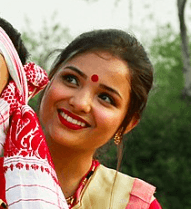
Ahom Erotic
Assam (India)
Kra–Dai / Tai / Ahom
Hinduism
Southern Asia
About Ahom People
The Ahom are the descendants of a Tai-speaking warrior elite who crossed the Patkai range from upper Burma in 1228 and built a kingdom that ruled the Brahmaputra valley for nearly six hundred years — longer than the Mughals lasted in Delhi, and longer than most Indian dynasties of any kind. That continuity is the single most important thing to understand about them. The Ahom state absorbed wave after wave of Mughal invasion in the seventeenth century, most famously at the battle of Saraighat in 1671, where a vastly outnumbered Ahom navy under Lachit Borphukan stopped the empire's eastward push on the Brahmaputra itself. Lachit is still a household name in Assam in a way that few medieval generals are anywhere.
The original Ahom language belongs to the Kra–Dai family, related distantly to Thai, Lao, and Shan rather than to anything else spoken in India. Over the centuries the ruling class shifted to Assamese, an Indo-Aryan tongue, and today Ahom survives mainly as a liturgical and ceremonial language preserved in palm-leaf manuscripts called buranjis — chronicles the court kept obsessively, generation after generation, and which now form one of the most detailed indigenous historical records in South Asia. A revival movement is teaching the script and language again, but fluent everyday speakers are vanishing.
Religion among the Ahom is layered rather than singular. The court formally Hinduized in stages from the seventeenth century onward, adopting Vaishnavite traditions through Assam's powerful satra monasteries, and most Ahom today identify as Hindu. But the older Tai religion — ancestor veneration, the priestly Mohan and Deodhai lineages, rituals tied to the founding king Sukaphaa — never disappeared. Ceremonies like Me-Dam-Me-Phi, the offering to the ancestors held every spring, remain central to community identity and are observed publicly across Assam.
The Ahom are concentrated in the upper districts of Assam — Sivasagar, Dibrugarh, Charaideo, Jorhat, Golaghat — where the old capitals and royal burial mounds (the maidams, recently inscribed as a UNESCO World Heritage site) still anchor the landscape. Politically the community has spent the past few decades pressing for Scheduled Tribe status, a long-running dispute that turns on how a former ruling caste should be classified in modern India. It is a strange position to occupy: the architects of Assam's medieval state, now arguing for protections designed for the marginalized.
Typical Ahom Phenotypes
Reference for AI generation — hair, eyes, skin, facial structure, build
The Ahom phenotype reflects a Tai migration that landed in the Brahmaputra valley in the 13th century and then absorbed centuries of intermarriage with surrounding Assamese, Bodo-Kachari, and other Indo-Tibetan populations. The result is a distinctly transitional look: structurally East/Southeast Asian features softened and warmed by South Asian admixture, with no single uniform appearance across the community.
Hair is almost universally black or very dark brown, straight to gently wavy, with the thick, coarse shaft typical of Tai-origin populations. Premature greying patterns are unremarkable. Eye color sits in dark brown to near-black; lighter browns appear but are uncommon. The eyelid morphology is the most consistent Tai marker — a partial to full epicanthic fold is common, though usually less pronounced than in mainland Southeast Asian or East Asian groups, and palpebral fissures tend to be moderately almond-shaped rather than sharply slanted.
Skin tones cluster in Fitzpatrick III–IV, with warm yellow or olive undertones rather than the red-brown undertones more typical of mainland Indian populations. Lighter wheat-toned complexions are well represented, particularly in older priestly and royal lineages, while sun-exposed agricultural communities trend deeper. Facial structure favors moderate-to-high zygomatic prominence (visible cheekbones), a relatively flat midface, a nose with a low-to-medium bridge and moderate alar width, and lips of medium fullness — neither the thin lips of Northeast Asian groups nor the fuller lips common further south in India.
Build runs compact and lean. Stature averages are modest — adult men typically 5'4"–5'7", women 4'11"–5'3" — with narrow shoulders, slim wrists and ankles, and a tendency toward wiry rather than heavy musculature. The signature Ahom face, seen in figures from Lachit Borphukan to modern political descendants like Tarun Gogoi, is the visible Tai cheekbone-and-eye structure carried on warm South Asian coloring — the phenotype that visually distinguishes Ahom from both their Bengali neighbors to the west and their Naga and Mizo neighbors to the east.
Data depth
56/100Coverage of image-grounded phenotype observations · drives AI generation diversity
- Sample size
- 39/40· 48 images
- Image quality
- 17/30· 33% high
- Confidence
- 0/20· mean 0.18
- Source diversity
- 0/10· wikipedia
- ·Low overall confidence
- ·Wikipedia-only source — not population-representative
Observed Distribution — Image Sample
Empirical observations from analyzed photographs · supplementary signal, not population truth
Sample: 48 images analyzed (48 wikipedia). Quality: 16 high, 24 medium, 5 low, 3 very_low. Avg analyzer confidence: 0.18.
Skin tone (Fitzpatrick): III (2%), IV (17%), V (6%), unclear (75%)
Hair color: gray/white (17%), black (13%), unclear (71%)
Hair texture: straight (21%), covered (10%), unclear (69%)
Eye color: dark brown (23%), unclear (77%)
Epicanthic fold: 15% present, 8% absent, 77% unclear
Caveats: Low average analyzer confidence — many photos partially obscured or historical. Sample is 100% Wikipedia notable people — skews toward male, public-life, and modern figures, not population-representative.
Last aggregated: May 7, 2026
Explore phenotype categories
Structured taxonomy with peer-reviewed scales · 22 anatomical categories
Notable Ahom People
56 reference figures — sourced from Wikipedia
- Sukaphaa — 1st Ahom Maharaja
- Suteuphaa — 2nd Ahom Maharaja
- Subinphaa — 3rd Ahom Maharaja
- Tyao Sukhangphaa — 4th Ahom Maharaja
- Sukhrangphaa — 5th Ahom Maharaja
- Sutuphaa — 6th Ahom Maharaja
- Tyao Khamthi — 7th Ahom Maharaja
- Sudangphaa (Bamuni Konwar) — 8th Ahom Maharaja
- Sujangphaa — 9th Ahom Maharaja
- Suphakphaa — 10th Ahom Maharaja
- Susenphaa — 11th Ahom Maharaja
- Suhenphaa — 12th Ahom Maharaja
- Supimphaa — 13th Ahom Maharaja
- Suhungmung (Swarganarayan) — 14th Ahom Maharaja
- Suklenmung (Garhgayan Raja) — 15th Ahom Maharaja
- Sukhamphaa (Khura Raja) — 16th Ahom Maharaja
- Susengphaa (Pratap Singha) — 17th Ahom Maharaja
- Suramphaa (Jayaditya Singha) — 18th Ahom Maharaja
- Sutingphaa (Noriya Raja) — 19th Ahom Maharaja
- Sutamla (Jayadhwaj Singha) — 20th Ahom Maharaja
- Supangmung (Chakradhwaj Singha) — 21st Ahom Maharaja
- Sunyatphaa (Udayaditya Singha) — 22nd Ahom Maharaja
- Suklamphaa (Ramadhwaj Singha) — 23rd Ahom Maharaja
- Suhung — 24th Ahom Maharaja
- Gobar Raja — 25th Ahom Maharaja
- Sujinphaa (Arjun Konwar) — 26th Ahom Maharaja
- Sudoiphaa — 27th Ahom Maharaja
- Sulikphaa (Ratnadhwaj Singha) — 28th Ahom Maharaja
- Supatphaa (Gadadhar Singha) — 29th Ahom Maharaja
- Sukhrungphaa (Rudra Singha) — 30th Ahom Maharaja
- Sutanphaa (Siba Singha) — 31st Ahom Maharaja
- Sunenphaa (Pramatta Singha) — 32nd Ahom Maharaja
- Suremphaa (Rajeswar Singha) — 33rd Ahom Maharaja
- Sunyeophaa (Lakshmi Singha) — 34th Ahom Maharaja
- Suhitpangphaa (Gaurinath Singha) — 35th Ahom Maharaja
- Suklingphaa (Kamaleswar Singha) — 36th Ahom Maharaja
- Sudingphaa (Chandrakanta Singha) — 37th Ahom Maharaja
- Purandar Singha — 38th Ahom Maharaja
- Jogeswar Singha — 39th Ahom Maharaja
- Krishna Kanta Handique — Sanskrit scholar, indologist, philanthropist, educationist, recipient of Padm…
- Hiteswar Saikia — 10th Chief Minister of Assam
- Tarun Gogoi — 13th Chief Minister of Assam
- Gomdhar Konwar — Ahom prince and early freedom fighter
- Devanand Konwar — Former Governor of Tripura, Bihar, and West Bengal
- Kushal Konwar — Freedom fighter, died during the Quit India Movement
- Gaurav Gogoi — Deputy Leader of the Opposition in the Lok Sabha
- Lachit Borphukan — Commander of the Ahom Army, victor of the Battle of Saraighat (1671)
- Homen Borgohain — Writer and journalist
- Jahnu Barua — Film director
- Padmanath Gohain Baruah — First president of Asam Sahitya Sabha
- Jatindra Nath Duwara — Poet and author
- Dip Gogoi — Politician from Assam
- Lila Gogoi — Historian and author
- Ranjan Gogoi — 46th Chief Justice of India
- Hiren Gohain — Scholar and political commentator
- Akhil Gogoi — Social activist and politician



Generate Ahom AI Content
Use this ethnicity's phenotype data to create AI-generated content with accurate physical traits and cultural context.
Open Creator Studio