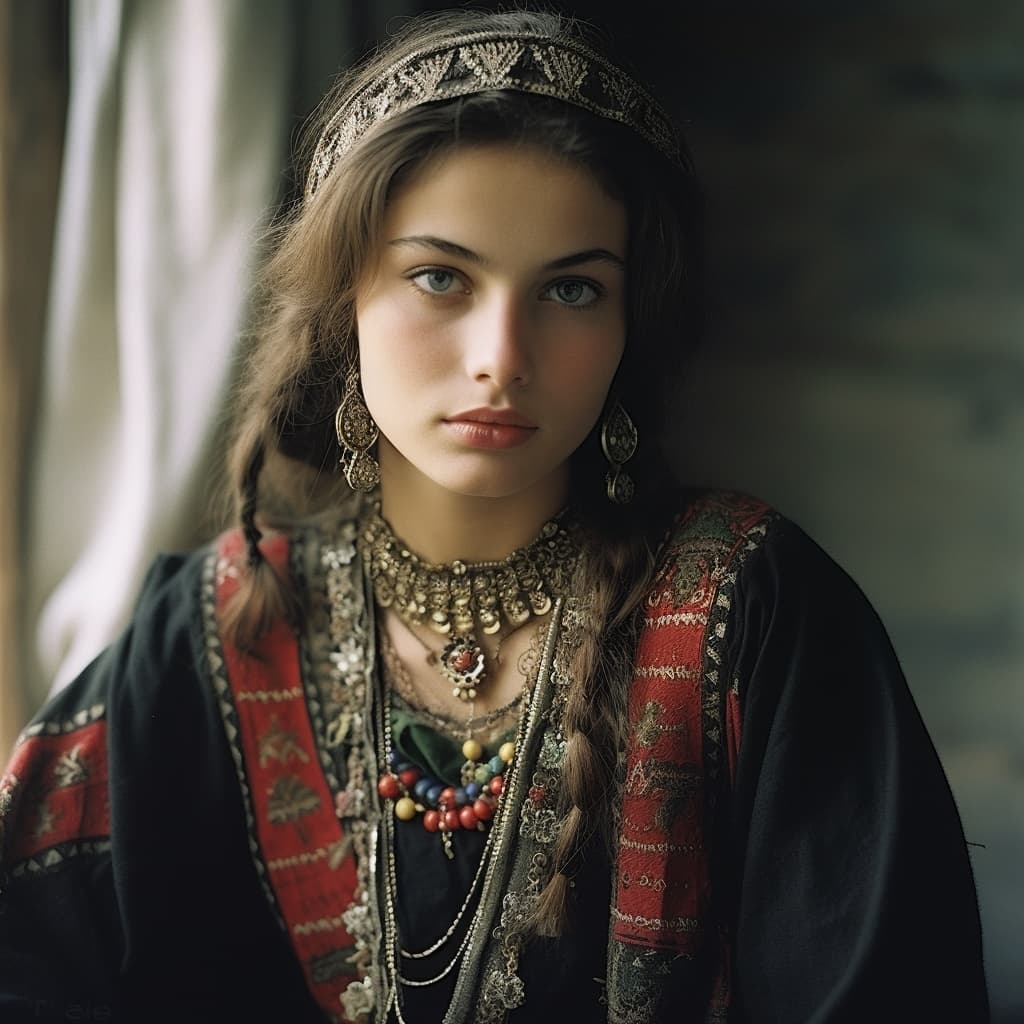
Ossetians Erotic
South Ossetia, North Ossetia-Alania (Russia)
Indo-European / Iranian / Ossetian
Christianity / Eastern Orthodoxy
Iron, Digor
Central Asia
About Ossetians People
The Ossetians are the last living link to the Alans, a Sarmatian people who rode out of the Eurasian steppe and were, by the early medieval period, one of the dominant powers of the North Caucasus. Most of their cousins — Scythians, Sarmatians, Alans further west — were absorbed, scattered, or annihilated; the Ossetians held on in the high valleys on both sides of the central Caucasus range, and their language survived. That alone makes them unusual. Ossetian is an Iranian language, a distant relative of Persian and Pashto, marooned in a region otherwise dominated by Caucasian and Turkic tongues. It splits into two main dialects, Iron in the east and Digor in the west, and these correspond to the two principal sub-groups of the people themselves.
Their homeland straddles the main ridge of the Caucasus. North Ossetia-Alania, a republic within the Russian Federation, sits on the lower northern slopes, opening onto the steppe; South Ossetia, a breakaway region of Georgia recognized by only a handful of states, occupies the steeper southern face. The 2008 war between Russia and Georgia was fought largely over this line, and the political fracture has hardened since — North and South Ossetians today live under different governments, different currencies, and different access to the wider world, despite a shared language and shared kin networks across the mountains.
Most Ossetians are Eastern Orthodox Christians, a legacy of medieval Alania's contact with Byzantium and later with Georgia, but Christianity here sits on top of an older Iranian-pagan substrate that has never quite gone away. Sacred groves, mountain shrines, and feast days for figures like Wastyrdzhi — a folk saint who absorbed traits of an older warrior deity and is forbidden to women's lips — operate alongside the church calendar rather than in opposition to it. A Muslim minority, mostly Digor, reflects later Kabardian and Ottoman influence in the western valleys.
The Ossetians are also the people from whom the world inherited the Nart sagas, a cycle of heroic tales shared in variants across the Caucasus but with deepest roots here. Scholars have traced motifs in the Narts — the cup that rises to the lips of the truthful, the warrior brotherhood, the cauldron of rebirth — to the same Indo-Iranian world that shaped the Arthurian and Grail traditions. It is not a small claim, and the Ossetians themselves are quietly aware of it.
Typical Ossetians Phenotypes
Reference for AI generation — hair, eyes, skin, facial structure, build
Ossetians are an Iranian-speaking population in the Caucasus, descended largely from the medieval Alans, and their phenotype reflects that lineage — broadly Caucasoid with a Caucasus mountain cast rather than a Persian or Slavic one. The build is the most immediately distinctive thing: this is a population that produces a remarkable density of elite wrestlers and combat athletes, and the typical adult male frame skews toward thick-boned, broad-shouldered, short-to-medium stature with a low center of gravity and dense musculature through the trapezius, neck, and forearms. Women tend toward an hourglass build with substantial hip-to-waist contrast and a tendency toward fuller figures with age.
Hair is overwhelmingly dark — chestnut to near-black, with a meaningful minority of medium and dark brown. Texture runs straight to loosely wavy; tight curls are uncommon. Beard growth in men is heavy and dense, often with strong jaw and cheek coverage. Eye color is mostly brown in its full range from amber-hazel to near-black, but a noticeable minority — perhaps one in five — carry green, gray, or blue, more often among Digor speakers in the western highlands than among the Iron majority east and south. Eyes are deep-set under a defined brow ridge, with no epicanthic fold.
Skin sits in Fitzpatrick II–III, fair to light olive with warm undertones, tanning readily in summer to a deeper bronze before paling again in winter. Facial structure is the other anchor of the look: a strong, often slightly convex nose with a high bridge and narrow alar base, prominent cheekbones, a square jaw, and lips of moderate fullness. Foreheads are typically broad and the overall facial outline rectangular rather than rounded.
The two main branches differ subtly. Iron Ossetians tend toward darker hair and eyes and slightly broader faces; Digor speakers in the west show somewhat higher rates of light eyes and lighter hair, a residue of older Caucasus highland substrate.
Data depth
78/100Coverage of image-grounded phenotype observations · drives AI generation diversity
- Sample size
- 33/40· 33 images
- Image quality
- 30/30· 64% high
- Confidence
- 15/20· mean 0.78
- Source diversity
- 0/10· wikipedia
- ·Wikipedia-only source — not population-representative
Observed Distribution — Image Sample
Empirical observations from analyzed photographs · supplementary signal, not population truth
Sample: 33 images analyzed (33 wikipedia). Quality: 21 high, 8 medium, 2 low, 2 very_low. Avg analyzer confidence: 0.78.
Skin tone (Fitzpatrick): II (33%), III (55%), IV (9%), unclear (3%)
Hair color: black (48%), gray/white (36%), dark brown (6%), other (3%), blonde (3%), unclear (3%)
Hair texture: straight (73%), wavy (6%), curly (3%), bald (3%), shaved (6%), covered (9%)
Eye color: dark brown (64%), blue (12%), brown (6%), hazel (3%), unclear (15%)
Epicanthic fold: 3% present, 88% absent, 3% partial, 6% unclear
Caveats: Sample is 100% Wikipedia notable people — skews toward male, public-life, and modern figures, not population-representative.
Last aggregated: May 7, 2026
Explore phenotype categories
Structured taxonomy with peer-reviewed scales · 22 anatomical categories
Notable Ossetians People
89 reference figures — sourced from Wikipedia
- Valery Gergiev — General director and artistic director of the Mariinsky Theatre, former chief…
- Tugan Sokhiev — Russian conductor.
- Elbert Tuganov — Azerbaijani-Estonian animator and film director.
- Gaito Gazdanov — Russian émigré writer of Ossetian descent
- Kosta Khetagurov — Ossetian national poet
- Arsen Kotsoev — one of the founders of Ossetic prose
- Vladimir Gagloyev — Ossetian writer, playwright and publicist
- Manana Chitishvili — Georgian poet and academic
- Elbadzuko Britayev — founder of Ossetian traditional theatre
- Vitaly Kaloyev — Russian former architect and convicted murderer
- Vladimir Salbiyev — former Russian professional footballer
- Vladimir Gabulov — goalkeeper
- Ruslan Bolov — Russian professional football player
- Stanislav Cherchesov — football manager of the Kazakhstan national team
- Khetag Khosonov — Russian football player
- Shota Bibilov — professional footballer
- Artur Yelbayev — Russian former professional football player
- Zaza Eloshvili — Georgian footballer
- Artur Pagayev — association football coach
- Soslan Ramonov — freestyle wrestler, 2016 Olympics gold medalist
- Ruslan Karaev — professional kickboxer
- Murat Gassiev — Russian former unified cruiserweight world champion
- Khetag Gazyumov — retired Russian and Azerbaijani freestyle wrestler, Olympic medalist
- Zelym Kotsoiev — Ukrainian-Azerbaijani judoka, 2024 Summer olympics gold medalist
- Amiran Kardanov — Russian and Greek Freestyle wrestler, 2000 Olympics bronze medalist
- Taimuraz Tigiev — Russian-Kazakhstani wrestler, 2008 Summer Olympics silver medalist
- Arsen Fadzaev — former Soviet wrestler, 1988 and 1992 Olympics gold medalist
- Makharbek Khadartsev — former Soviet wrestler, 1988 and 1992 Olympics gold medalist
- Zaurbek Sokhiev — Russian-Ossetian male freestyle wrestler
- Artur Taymazov — Uzbek-Russian wrestler and politician, 2004 Olympics gold medalist
- Soslan Tigiev — Russian-Uzbekistani wrestler
- Ibragim Aldatov — Ukrainian freestyle wrestler
- Dzhambolat Tedeyev — Russian-Ukrainian former wrestler
- Elbrus Tedeyev — Ukrainian wrestler, 2004 Olympics gold medalist
- Mirabi Valiyev — Ukrainian former wrestler
- Zaza Zazirov — former Ukrainian wrestler, 1996 Olympics bronze medalist
- Khadzhimurat Gatsalov — Russian wrestler, 2004 Olympics gold medalist
- Aslanbek Alborov — Russian former freestyle wrestler
- Vladislav Baitcaev — Russian freestyle wrestler
- Zaur Makiev — Russian former freestyle wrestler
- Artur Naifonov — Russian freestyle wrestler, 2020 Olympics bronze medalist
- Zaurbek Sidakov — Russian freestyle wrestler, 2020 Olympics gold medalist
- Diana Avsaragova — Russian mixed martial artist
- Tajmuraz Salkazanov — Slovak naturalized freestyle wrestler
- Azamat Tuskaev — Russian freestyle wrestler
- Hakurozan Yūta — former sumo wrestler
- Alan Karaev — Russian sumo wrestler
- Rohō Yukio — former sumo wrestler. The highest rank he achieved was komusubi
- Wakanohō Toshinori — retired Russian sumo wrestler. His highest rank was maegashira 1
- Timur Taymazov — former Ossetian-Ukrainian weightlifter, 1996 Olympics gold medalist
- Arsen Kasabiev — Polish-Georgian weightlifter, 2008 Olympics silver medalist
- Alan Naniyev — Russian born Azerbaijani male weightlifter
- Tima Turieva — Russian weightlifter
- Vladislav Mirzoev — Russian pair skater
- Zarina Gizikova — Russian retired individual rhythmic gymnast
- Masha Gordon — British businesswoman, explorer and mountain climber
- Chermen Kobesov — Russian para-athlete
- Elizaveta Shanaeva — Russian competitive ice dancer.
- Mykola Bagrayev — Ukrainian businessman and social activist
- Igor Kesaev — owner and president of the Mercury Group
- Taimuraz Bolloyev — CEO of Baltika Breweries
- Isabel Magkoeva — Russian political activist
- Znaur Gassiev — South Ossetian politician, who was one of the leaders of the South Ossetian i…
- David Soslan — Alanian prince, consort of Queen Tamar
- Durgulel the Great — Alanian king of the 11th century, under whom Alania reached its economic and …
- Western Ukrainian Republic — Kanukov Dzhambulat – Colonel of the Aviation of the Western Ukrainian Republic.
- Dmitry Sanakoyev — former Ministry of Defence of South Ossetia, Prime Minister of South Ossetia,…
- Lyudvig Chibirov — 1st President of South Ossetia
- Eduard Kokoity — 2nd President of South Ossetia
- Leonid Tibilov — 4th President of South Ossetia
- Anatoly Bibilov — 5th President of South Ossetia
- Alan Gagloyev — current President of South Ossetia
- Sergey Khabalov — Imperial Russian Army general
- Issa Pliyev — Soviet military commander
- Kantemir Tsalikov — Red Army major general who held division and corps command during World War II
- Akhsarbek Abaev — Red Army Sergeant and Hero of the Soviet Union
- Emir Saad — Ossetian Islamist militant
- Sergey Guriyev — economist, dean and a professor of economics at the London Business School, f…
- Grigori Tokaty — Soviet rocket scientist and politician
- Vasily Abaev — Soviet linguist
- Magomet Isayev — linguist and Esperantist
- Alan Badoev — Ukrainian movie director
- Svetlana Adyrkhaeva — Soviet and Russian ballerina
- Zemfira Tsakhilovna — Soviet and Russian actress and teacher
- Maharbek Tuganov — Ossetian painter
- Zlata Chochieva — Russian pianist
- Alan Khadzaragov — Russian musician and rapper
- Elena Tsallagova — Russian operatic soprano
- Veronika Dudarova — Soviet and Russian conductor, the first woman to succeed as conductor of symp…
Generate Ossetians AI Content
Use this ethnicity's phenotype data to create AI-generated content with accurate physical traits and cultural context.
Open Creator Studio