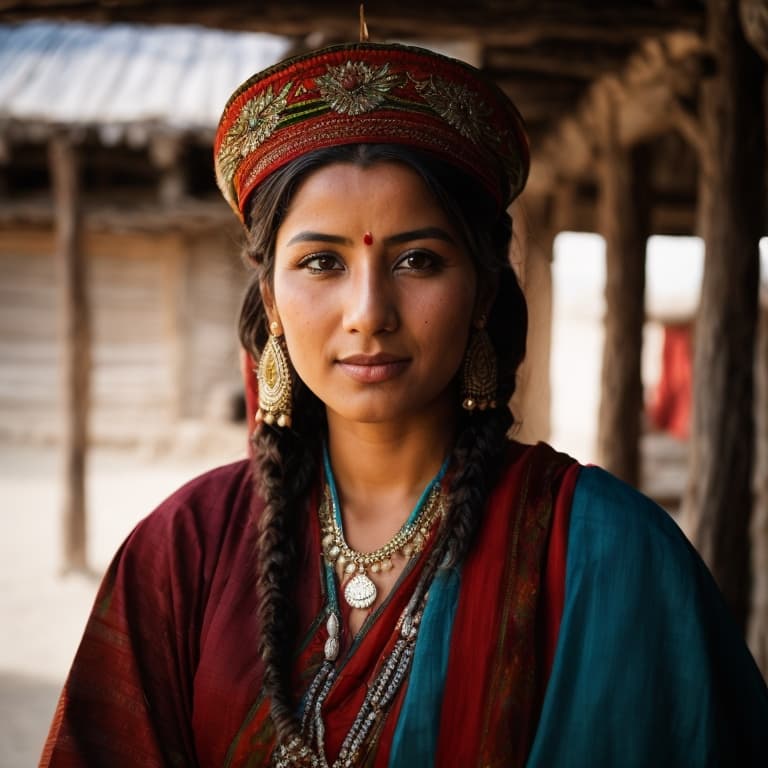
Burusho Erotic
Gilgit-Baltistan (Pakistan)
Burushaski
Islam / Shia Islam
Central Asia
About Burusho People
The Burusho live in the high valleys of Hunza, Nagar, and Yasin in Pakistan's Gilgit-Baltistan, where the Karakoram throws up some of the most vertical terrain on the planet. They are best known to linguists for one stubborn fact: their language, Burushaski, has no demonstrated relatives. It sits among Indo-Aryan, Iranian, Tibetan, and Turkic neighbors and resembles none of them. Every serious attempt to link it to another family — Caucasian, Yeniseian, Dravidian, even Basque — has failed to convince the field. For a population of perhaps 100,000 people wedged between three of the world's great language groups, this is unusual, and it is the single most cited piece of evidence for the theory that the Burusho are descendants of a pre-Indo-European population that was elsewhere overwritten.
Religious life splits them along valley lines. Hunza is overwhelmingly Ismaili, followers of the Aga Khan, whose network of schools and development programs has reshaped the valley over the past half-century — Hunza's literacy rates, women's education in particular, are conspicuously high for the region. Nagar, just across the river, is Twelver Shia and more conservative in tone; the contrast between the two banks is sharp enough that locals will point it out before you ask. Yasin and the smaller Burusho pockets are mixed. The Ismaili presence is recent in historical terms — the conversion took hold in the nineteenth century — and replaced an earlier layer of Shia and, before that, pre-Islamic practice whose traces still surface in seasonal observances and folk belief.
Until 1974, Hunza and Nagar were princely states, ruled by hereditary mirs who answered to nobody in particular for most of their history; the kingdoms were absorbed into Pakistan only when Zulfikar Ali Bhutto abolished them. The terrain enforced this isolation. The Karakoram Highway, punched through to China in the 1970s and 80s, ended it. Subsistence has long meant terraced apricot, mulberry, and wheat cultivation on irrigated slopes — water diverted from glacier melt through channels that are themselves engineering inheritances, maintained by communal labor. The Burusho also acquired, over the twentieth century, a slightly mythologized reputation in the West for longevity and health, much of it inflated by mid-century travel writers; the underlying picture is more ordinary, but the diet and the altitude and the walking are real enough.
Typical Burusho Phenotypes
Reference for AI generation — hair, eyes, skin, facial structure, build
The Burusho of the Hunza, Nagar, and Yasin valleys are a small isolate population whose phenotype reads as a cline between Central Asian and South Asian features, often with a surprising European-leaning cast. Hair is typically dark brown to black and predominantly straight or loosely wavy, fine in texture rather than coarse. Light hair is more common here than almost anywhere else in the broader region — chestnut, auburn, and outright blond are seen at low but visible frequencies, and graying tends to come late, contributing to the long-publicized (and often overstated) reputation for longevity.
Eye color follows the same pattern. Dark brown predominates, but light hazel, green, and pale blue eyes appear at frequencies that stand out against neighboring Punjabi or Kashmiri populations. Eyelids are usually open and almond-shaped without a developed epicanthic fold, though a subtle inner fold occurs in a minority and is more frequent in Nagar than in Hunza proper. Skin runs Fitzpatrick II to IV — fair, often pink-undertoned at high altitude, weathering quickly to a ruddy tan on the cheeks and nose from intense UV and dry wind. Genuinely olive and light-brown tones are common in the lower valleys.
Facial structure is angular: a relatively narrow, high-bridged nose with a moderate to slightly aquiline profile, defined cheekbones, a squared jaw in men, and lips of medium fullness. The overall face is longer and less round than most East and Central Asian neighbors. Build is lean and wiry, with documented physical endurance from terraced agriculture and altitude. Stature is moderate — men commonly 165–175 cm, women 150–160 cm — with low typical body fat and broad shoulders relative to hip width.
Sub-group variation is subtle but real: Hunza Burusho skew slightly lighter in pigmentation, Nagar trend marginally darker and more East-Asian-influenced in eye shape, and Yasin valley speakers show the clearest South Asian admixture, including a higher rate of darker skin and fully straight black hair.
Data depth
0/100Coverage of image-grounded phenotype observations · drives AI generation diversity
- Sample size
- 0/40· 0 images
- Image quality
- 0/30· 0% high
- Confidence
- 0/20
- Source diversity
- 0/10
- ·No image observations yet
Explore phenotype categories
Structured taxonomy with peer-reviewed scales · 22 anatomical categories






Generate Burusho AI Content
Use this ethnicity's phenotype data to create AI-generated content with accurate physical traits and cultural context.
Open Creator Studio