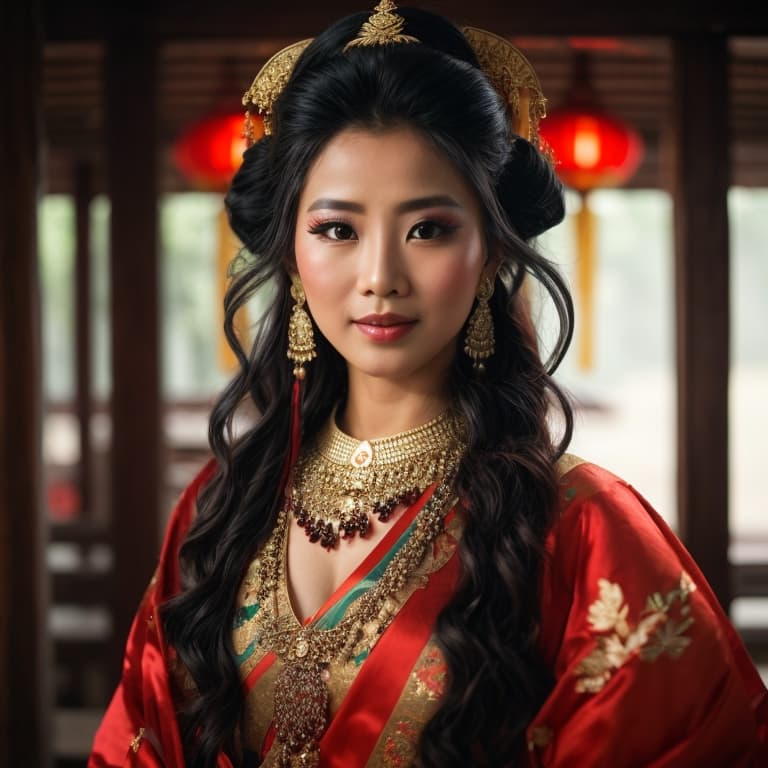
Bai Erotic
Dali Bai Autonomous Prefecture (China)
Sino-Tibetan / Bai
Buddhism
Central Asia
About Bai People
The Bai are concentrated around Erhai Lake in western Yunnan, with Dali — the old capital of the Nanzhao and Dali kingdoms — as their cultural anchor. Those two states, which ran from the eighth to the thirteenth centuries until Kublai Khan's armies absorbed them, are the historical fact that matters most for understanding the Bai today: they were not a frontier people absorbed into China but the ruling population of a sophisticated independent kingdom that traded across what is now Myanmar, Tibet, and Sichuan. That memory still shapes how Dali presents itself.
Their language is a puzzle linguists have been arguing about for a century. Bai is Sino-Tibetan, but where exactly it sits within the family is contested — the vocabulary carries an unusually heavy Chinese loan layer going back to Old and Middle Chinese, dense enough that some scholars have wanted to classify it as Sinitic outright, while others place it on its own branch closer to Tibeto-Burman. Whatever the verdict, the practical result is a language that sounds tonal and Chinese-adjacent to outsiders but reads as distinctly its own to speakers. There are three main dialect clusters — Jianchuan, Dali, and Bijiang — and they are not always mutually intelligible.
Religious life is layered rather than singular. Mahayana Buddhism arrived early and stuck, but it sits on top of an older indigenous practice called Benzhu worship — the veneration of village patron deities, each settlement having its own. A Benzhu can be a deified historical figure, a local hero, a mountain spirit, occasionally a Buddhist or Daoist figure absorbed into the system. Each village holds its own festival cycle for its patron, and these continue alongside, not in place of, Buddhist observance.
Bai architecture is unusually distinctive: whitewashed walls, grey tile roofs with upturned eaves, and elaborate painted gables — a domestic style refined enough that wealthier households once commissioned named master builders the way one might commission a portrait. Tie-dye from Zhoucheng, using indigo on cotton, is a recognized craft tradition rather than a tourist confection, though tourism has certainly reshaped its economics. The annual Sanyuejie — the Third Month Fair at the foot of Cangshan — is a thousand-year-old market and horse fair that still draws traders from across the southwestern highlands, and remains one of the better windows into Bai social life as the Bai themselves practice it.
Typical Bai Phenotypes
Reference for AI generation — hair, eyes, skin, facial structure, build
The Bai are a Yunnan highland population concentrated around Lake Erhai, and their phenotype reads as a softened, slightly more gracile variant of southwestern Han with discernible Tibeto-Burman undercurrents from long contact with Yi and Naxi neighbors. Hair is uniformly black to blue-black, coarse-shafted, and almost always straight or with the faintest body wave; graying tends to come late and silver rather than salt-and-pepper. Natural light or red-toned hair is essentially absent.
Eyes range from dark brown to near-black, with a moderate to strong epicanthic fold present in the great majority — though the fold tends to be lighter than in northern Han or Manchu populations, and double eyelids occur at noticeably higher frequency than the East Asian average, a trait visible in performers like Yang Chaoyue and Yang Rong. Eye shape is typically almond, set fairly level, with low-to-moderate orbital projection.
Skin sits in the Fitzpatrick III–IV range, with warm ivory and pale-golden undertones in the Erhai basin core and deeper olive-tan tones among Bai communities at lower elevations or with more outdoor agricultural exposure. The complexion is generally even, and the cheek flush characteristic of high-altitude Tibetan populations is muted but present in highland subgroups.
Facial structure is the most distinctive feature: a softer, rounder midface than northern Han, with high but not sharply angular cheekbones, a relatively narrow nasal bridge that is straighter and slightly higher-set than the regional average, and modest alar width. Lips are medium in fullness, often with a well-defined cupid's bow. Jawlines tend toward oval rather than square.
Build is slender and small-framed. Adult women commonly fall between 155–162 cm and men between 165–172 cm, with low average body fat and a tendency toward narrow shoulders and long, fine-boned hands. Plain-dwelling Dali Bai trend taller and rounder-faced than the more wiry Jianchuan and Lanping highland branches further north.
Data depth
54/100Coverage of image-grounded phenotype observations · drives AI generation diversity
- Sample size
- 15/40· 7 images
- Image quality
- 29/30· 57% high
- Confidence
- 10/20· mean 0.67
- Source diversity
- 0/10· wikipedia
- ·Small sample (n<10)
- ·Wikipedia-only source — not population-representative
Observed Distribution — Image Sample
Empirical observations from analyzed photographs · supplementary signal, not population truth
Sample: 7 images analyzed (7 wikipedia). Quality: 4 high, 2 medium, 1 low, 0 very_low. Avg analyzer confidence: 0.67.
Skin tone (Fitzpatrick): II (14%), III (43%), IV (29%), unclear (14%)
Hair color: black (71%), dark brown (14%), unclear (14%)
Hair texture: straight (71%), wavy (14%), covered (14%)
Eye color: dark brown (86%), unclear (14%)
Epicanthic fold: 86% present, 0% absent, 14% unclear
Caveats: Sample size 7 is small — observed distribution should be treated as suggestive, not definitive. Sample is 100% Wikipedia notable people — skews toward male, public-life, and modern figures, not population-representative.
Last aggregated: May 7, 2026
Explore phenotype categories
Structured taxonomy with peer-reviewed scales · 22 anatomical categories
Notable Bai People
16 reference figures — sourced from Wikipedia
- Duan Siping — 段思平) – founder of the Dali Kingdom
- Shen Yiqin — 谌贻琴) – President of the All-China Women's Federation and a state counsellor o…
- Wang Xiji — 王希季) is an aerospace engineer, designer of the Long March 1 rocket
- Xu Lin — 徐琳) is a linguist and one of the two founders of modern grammar of Bai language
- Yang Chaoyue — 杨超越) - actress, pop music singer, former member of Rocket Girls 101
- Yang Liping — 杨丽萍) – dancer
- Yang Rong — 楊蓉) – actress
- Yang Yuntao — 楊雲濤) – dancer
- Zhang Le Jin Qiu — 张乐进求) – legendary ancestor of the Bai
- Zhang Lizhu — 张丽珠) – gynecologist
- Zhang Jiebao — 张结宝) was a famous bandit leader, active in the 1920s in northwestern Yunnan
- Zhao Shiming — 赵式铭) – scholar, the first one who studied the Bai language the most systemati…
- Zhao Yansun — 赵衍荪) – linguist, one of two founders of modern grammar of Bai language
- Zhou Baozhong — 周保中) – military general, who led the battles against the Japanese invasion in…
- Fiona Ma — 馬世雲) – American politician
- Dianxi Xiaoge — 滇西小哥) – KOL (key opinion leader), content creator, YouTuber
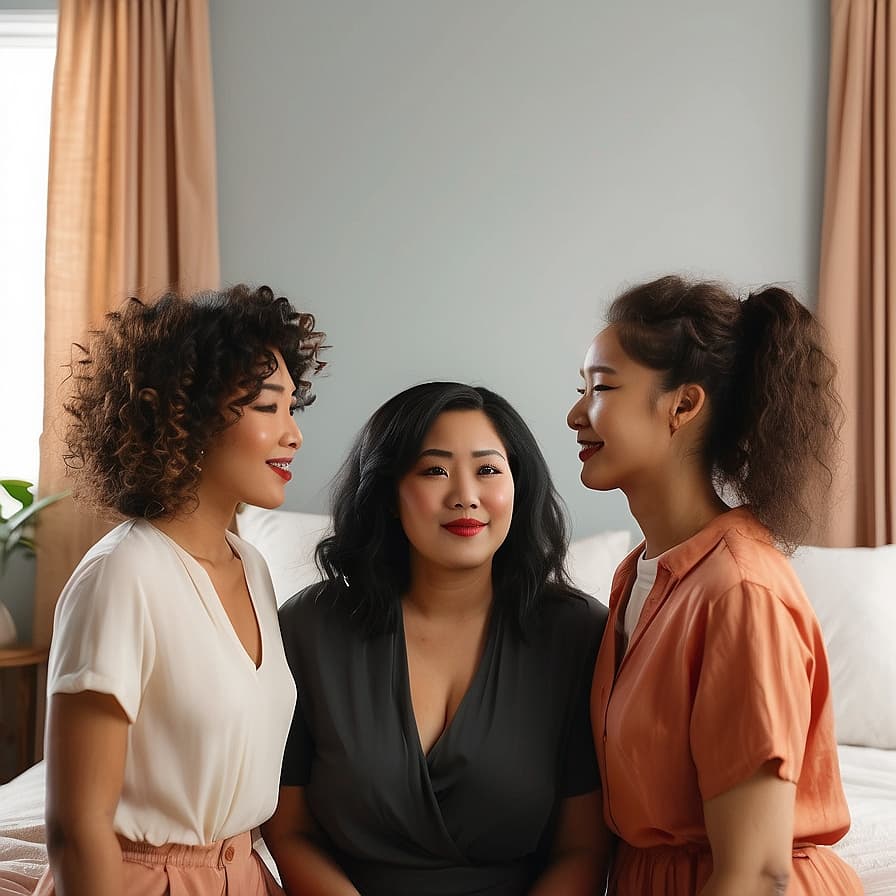
Generate Bai AI Content
Use this ethnicity's phenotype data to create AI-generated content with accurate physical traits and cultural context.
Open Creator Studio