Minangkabau Erotic
Minangkabau Highlands (Indonesia)
Austronesian / Malayic / Malay / Minangkabau
Islam / Sunni Islam
Aneuk Jamee
Southeast Asia
About Minangkabau People
The Minangkabau are the world's largest matrilineal society, and they are also devout Sunni Muslims. That combination is the thing to sit with first, because it shaped almost everything else about how they live. Ancestral land, houses, and family names pass from mother to daughter. A man marries into his wife's household and, in the older arrangement, returns to his sisters' home as the figure of authority over his nieces and nephews. Islam arrived in the highlands of West Sumatra in the sixteenth century and settled in alongside this older order rather than overwriting it — the local saying is that custom rests on Islamic law, and Islamic law rests on the Qur'an, the two propping each other up. The early nineteenth century tested that balance during the Padri War, when a reformist faction tried to bring the society into line with stricter scriptural practice and the Dutch eventually intervened on the side of the traditional chiefs.
The homeland is the volcanic uplands around Bukittinggi and Padang Panjang — terraced rice fields, cool air, sharp ridges, the three peaks of Merapi, Singgalang, and Sago anchoring the cultural geography. Minangkabau is its own language within the Malayic branch, close enough to standard Malay and Indonesian that speakers move between them easily, distinct enough that outsiders don't simply pick it up. The signature building is the rumah gadang, the long communal house with roof points that sweep up like buffalo horns; the name of the people is usually translated as "victorious buffalo," from a legendary contest with a Javanese kingdom decided by a calf with a knife on its forehead.
What sets the Minangkabau apart in Indonesia is merantau — the institution of leaving. Young men, with no claim to the ancestral land, are expected to go: to Padang, to Jakarta, across the strait to Malaysia, historically as far as the Negeri Sembilan region where their cousins settled centuries ago. They build careers, send money home, and return for ceremonies. The diaspora is why Padang food — rendang, gulai, the cluster of small dishes set out together at a nasi padang restaurant — is the most widely available regional cuisine in Indonesia and Malaysia. The Aneuk Jamee on the west coast of Aceh are descendants of an earlier wave of these migrants who never came back.
Typical Minangkabau Phenotypes
Reference for AI generation — hair, eyes, skin, facial structure, build
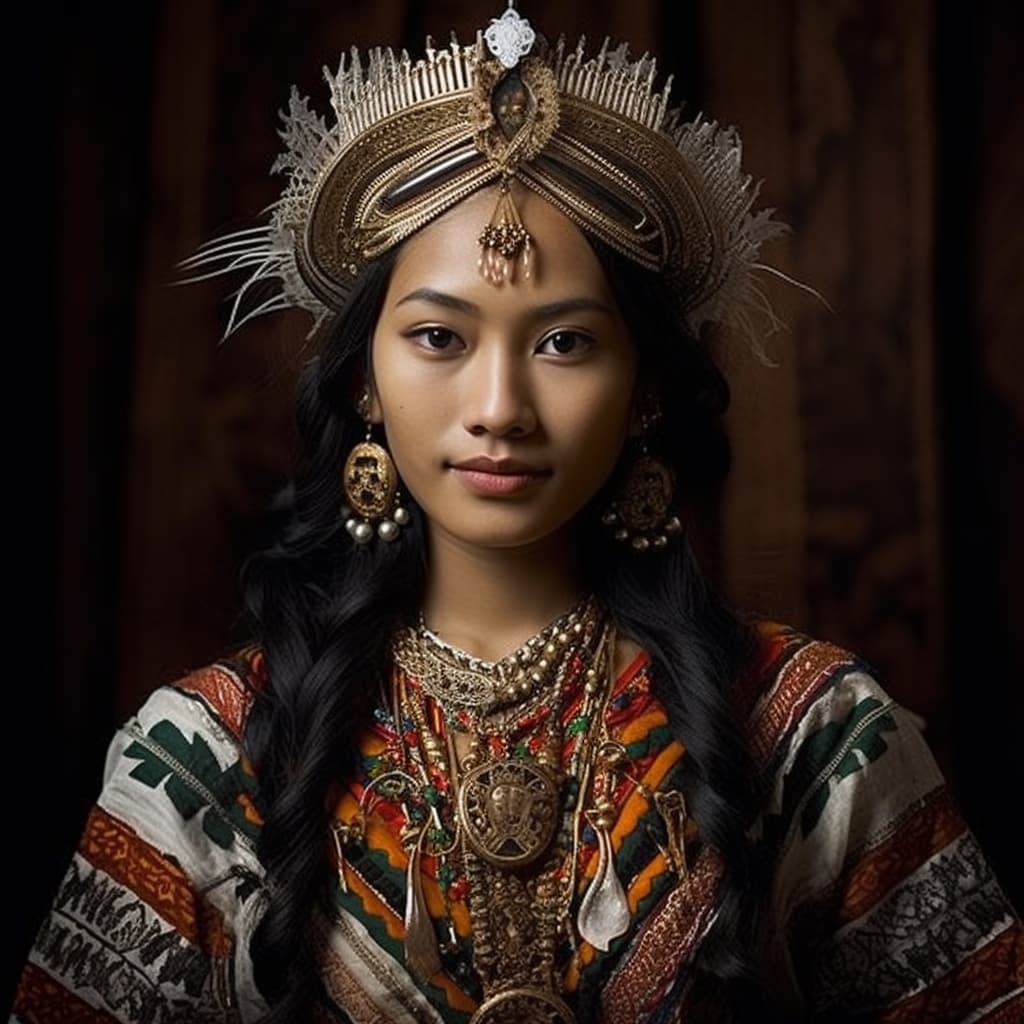
The Minangkabau phenotype sits in the Austronesian Southeast Asian range, but skews lighter and finer-featured than coastal Sumatran or Javanese populations — a product of long isolation in the cool volcanic highlands around Bukittinggi and Padang Panjang. Hair is overwhelmingly black to very dark brown, predominantly straight to gently wavy, with a fine-to-medium shaft. True curl is rare; loose wave appears more often in the Aneuk Jamee branch on the Aceh coast, where intermarriage with coastal Acehnese and Malay populations introduces slightly thicker, wavier hair textures. Premature greying is uncommon before middle age.
Eyes run dark brown to near-black, with a moderate epicanthic fold that is near-universal but typically softer than in northern East Asian populations — the eye opening reads almond-shaped rather than narrow, with a visible double lid in a substantial minority. Skin tone clusters in Fitzpatrick III–IV: a warm light-to-medium brown with distinct yellow-olive undertones, paler in the highland interior and noticeably more sun-bronzed along the Mentawai-facing coast. Sutan Amrull and Whulandary Herman sit at the lighter, more refined end of this range and are useful anchors.
Facial structure is the most distinctive register. Noses tend to be small to medium with a low-to-moderate bridge and a rounded, slightly broad tip — narrower alar width than Melanesian or eastern Indonesian profiles, but flatter than mainland Southeast Asian. Lips are medium-full with a defined cupid's bow; cheekbones are high and laterally set, giving a heart-shaped or softly diamond face with a tapered, often pointed chin. Jawlines read fine rather than heavy.
Build is gracile and short by global standards — adult men commonly 162–170 cm, women 150–158 cm — with narrow shoulders, slim wrists and ankles, and a tendency toward lean musculature in youth that softens centrally with age. Body hair is sparse across the chest, back, and limbs, and beards grow thin and patchy even in older men.
Data depth
79/100Coverage of image-grounded phenotype observations · drives AI generation diversity
- Sample size
- 40/40· 51 images
- Image quality
- 24/30· 47% high
- Confidence
- 15/20· mean 0.74
- Source diversity
- 0/10· wikipedia
- ·Wikipedia-only source — not population-representative
Observed Distribution — Image Sample
Empirical observations from analyzed photographs · supplementary signal, not population truth
Sample: 51 images analyzed (51 wikipedia). Quality: 24 high, 16 medium, 9 low, 2 very_low. Avg analyzer confidence: 0.74.
Skin tone (Fitzpatrick): III (8%), IV (76%), V (12%), unclear (4%)
Hair color: black (63%), gray/white (24%), other (2%), unclear (12%)
Hair texture: straight (63%), wavy (8%), curly (2%), coily (2%), bald (2%), shaved (2%), covered (22%)
Eye color: dark brown (88%), brown (2%), unclear (10%)
Epicanthic fold: 76% present, 16% absent, 8% unclear
Caveats: Sample is 100% Wikipedia notable people — skews toward male, public-life, and modern figures, not population-representative.
Last aggregated: May 7, 2026
Explore phenotype categories
Structured taxonomy with peer-reviewed scales · 22 anatomical categories
Notable Minangkabau People
100 reference figures — sourced from Wikipedia
- Arbi Sanit — political scientist
- Arifin Bey — social scientist
- Azyumardi Azra — social religion scientist, rector
- Deliar Noer — political scientist
- Dewi Fortuna Anwar — political scientist
- Ismail Mohammad Ali — governor of Bank Negara Malaysia
- James Mahmud Rice — sociologist
- Moeslim Taher — rector and owner Jayabaya University
- Riri Fitri Sari — computer scientist
- Rustam Sani — political scientist
- Said Djauharsjah Jenie — technology scientist
- Sheikh Muszaphar Shukor — Astronaut, Malaysian orthopaedic surgeon
- Syahril Sabirin — governor of Bank Indonesia
- Syahrir — economist
- Werry Darta Taifur — economist
- Yurdi Yasmi — forestry scientist
- Zakiah Daradjat — Islamic psychologist
- Amrus Natalsya — realism painter, wood sculpture
- Huriah Adam — dancer, dance choreographer
- Iwan Tirta — batik designer
- Sutan Amrull — American make-up artist
- Whulandary Herman — model, Puteri Indonesia 2012-2013, Top 16 Miss Universe 2013
- Aero Sutan Aswar — Indonesian jet skier
- Alan Martha — Indonesian football athlete
- Ananda Mikola — Indonesian race car driver
- Aqsa Sutan Aswar — Indonesian jet skier
- Bona Septano — Indonesian badminton athlete
- Defia Rosmaniar — Indonesian taekwondo athlete
- Denny Sumargo — Indonesian basketball athlete
- Gitra Yuda Furton — Indonesian football athlete
- Hari Novian Caniago — Indonesian basketball athlete
- Hengky Ardiles — Indonesian football athlete
- Indra Sjafri — Indonesian football athlete
- Irsyad Maulana — Indonesian football athlete
- Jandia Eka Putra — Indonesian football athlete
- Jafri Sastra — Indonesian football coach
- Leo Guntara — Indonesian football athlete
- Markis Kido — Indonesian badminton athlete
- Aidil Zafuan — Malaysian football athlete
- Zaquan Adha — Malaysian football athlete
- Moreno Suprapto — Indonesian race car driver
- Muhammad Fauzan Jamal — Indonesian football athlete
- Nasrul Koto — Indonesian football athlete
- Nil Maizar — Indonesian football coach and former football player
- Novrianto — Indonesian football athlete
- Novri Setiawan — Indonesian football athlete
- Oktavianus — Indonesian football athlete
- Pia Zebadiah Bernadet — Indonesian badminton athlete
- Raphael Maitimo — Indonesian football athlete
- Rommy Diaz Putra — Indonesian football athlete
- Rully Desrian — Indonesian football athlete
- Silvi Antarini — Indonesian badminton athlete
- Sutan Anwar — Indonesian football athlete
- Syamsir Alam — Indonesian football athlete
- Teja Paku Alam — Indonesian football athlete
- Tommy Pranata — Indonesian football athlete
- Tri Rahmad Priadi — Indonesian football athlete
- Usman Diarra — Indonesian football athlete
- Yaspi Boby — Indonesian sprinter
- Yeyen Tumena — Indonesian football athlete
- Zahra Muzdalifah — Indonesian football athlete
- Abdul Muis — Indonesian novelist, famous novel: Salah Asuhan
- Afrizal Malna — Indonesian writer
- Ahmad Fuadi — Indonesian novelist, famous novel: Negeri 5 Menara
- Alfian Sa'at — Singaporean writer
- Ali Akbar Navis — Indonesian author, famous novel: Kemarau
- Gus tf Sakai — Indonesian writer
- Hamka — Islamic scholar, Indonesian novelist, famous novels: Merantau ke Deli, Tengge…
- Idrus — Indonesian author, famous story: "Dari Ave Maria ke Jalan Lain ke Roma"
- Karim Halim — Indonesian author
- Marah Roesli — Indonesian novelist, famous novel: Siti Nurbaya
- Marina Mahathir — Malaysian novelist
- Motinggo Busye — Indonesian novelist, famous novel: Malam Jahanam
- Nur Sutan Iskandar — Indonesian novelist, famous novel: Hulubalang Raja
- Saadah Alim — Indonesian author
- Sariamin Ismail — Indonesian novelist, famous novel: Kalau Tak Untung
- Sutan Takdir Alisjahbana — Indonesian novelist, famous novel: Layar Terkembang
- Tulis Sutan Sati — Indonesian novelist, famous novel: Sengsara Membawa Nikmat
- Wisran Hadi — Indonesian novelist
- Zainal Abidin Ahmad — Malaysian writer and language experts
- Zuber Usman — Indonesian writer
- Abdul Latief — owner of ALatief Corporation
- Ahmad Sahroni — owner of fuel shipping company
- Basrizal Koto — owner of Basko Group, Indonesia
- Handry Satriago — CEO of General Electric Indonesia
- Hasnul Suhaimi — CEO of Excelcomindo Pratama
- Hasyim Ning — Indonesian car assembly businessman
- Joesoef Isak — founder of Hasta Mitra publishing house
- Kamarudin Meranun — Chairman of AirAsia and CEO of the Tune Group
- Mohamed Taib bin Haji Abdul Samad — tycoon in the early history of Kuala Lumpur
- Mokhzani Mahathir — owner of Kencana Capital Sdn. Bhd
- Nadiem Makarim — founder and CEO of Go-Jek and Indonesian government minister
- Nasimuddin Amin — Malaysian car assembly businessman
- Rinaldi Firmansyah — CEO of Telekomunikasi Indonesia
- Tunku Imran — owner of Antah Holdings, Malaysia
- Tunku Naquiyuddin — owner of Antah Holdings, Malaysia
- Tunku Tan Sri Abdullah — owner of Melewar Group, Malaysia
- Guruh Sukarnoputra — choreographer and songwriter
- Saiful Bahri — composer and songwriter
- Wandly Yazid — composer






Generate Minangkabau AI Content
Use this ethnicity's phenotype data to create AI-generated content with accurate physical traits and cultural context.
Open Creator Studio