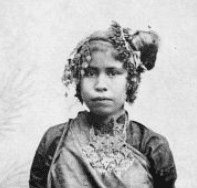
Acehnese Erotic
Aceh (Indonesia)
Austronesian / Chamic / Acehnese
Islam / Sunni Islam
Aneuk Jamee
Southeast Asia
About Acehnese People
The Acehnese occupy the northern tip of Sumatra, the part of Indonesia that juts toward the Andaman Sea and faces the Indian Ocean rather than the rest of the archipelago. That geography matters: Aceh was a port-of-call for Arab, Indian, Persian, and Chinese traders centuries before the Dutch arrived, and it became the first place in Southeast Asia to convert seriously to Islam. The Sultanate of Aceh, at its seventeenth-century peak under Iskandar Muda, was a regional power that fielded a navy, minted its own coinage, and corresponded with the Ottomans. None of this is incidental to how the Acehnese see themselves now. The province is the only one in Indonesia to formally apply Sharia law, and the local identity has long been built around a sense of being more devoutly, and more independently, Muslim than the rest of the country.
Their language is Acehnese, which sits on a slightly odd branch of the Austronesian family — the Chamic group, whose closest relatives are spoken not on Sumatra but across the water in Cambodia and Vietnam, descendants of the old kingdom of Champa. So Acehnese is genealogically more cousin to Cham than to Indonesian or Malay, even though it has absorbed enormous amounts of Malay, Arabic, and Sanskrit vocabulary through trade and religion. The Aneuk Jamee, a smaller sub-group along the western coast, descend from Minangkabau migrants and speak a Malayic language instead, and they form a culturally distinct enclave within Aceh proper.
The modern history is heavy. A thirty-year separatist insurgency by the Free Aceh Movement ended only after the 2004 Indian Ocean tsunami devastated the coast — the catastrophe killed something like 170,000 people in Aceh alone and pushed both sides into a peace deal the following year. That sequence, war then disaster then autonomy, shapes a lot of contemporary Acehnese life: a generation grew up in conflict, then rebuilt their towns from concrete slabs, then negotiated a degree of self-government no other Indonesian province enjoys. Customs reflect the layering. The traditional Saman dance, performed seated in tight rows with rapid hand-clapping and chest-slapping, is recognizable across Indonesia and abroad; coffee culture in the highland town of Takengon is a serious local institution; and the rumoh Aceh, the elevated wooden longhouse on stilts, still appears in villages even as concrete has replaced most of them.
Typical Acehnese Phenotypes
Reference for AI generation — hair, eyes, skin, facial structure, build
The Acehnese phenotype reflects Aceh's position as a coastal trading hub at the northern tip of Sumatra — a Southeast Asian Austronesian foundation layered with South Asian, Arab, and Ottoman-Turkish ancestry from centuries of maritime contact. The result is visibly distinct from the Javanese or Sundanese majority of Indonesia: features tend to be sharper, more angular, with a higher frequency of West Asian and South Asian admixture than elsewhere in the archipelago.
Hair is almost universally black or very dark brown, typically straight to gently wavy. A loose wave is common; tight curls are rare but appear in individuals with stronger South Asian ancestry. Eyes run from dark brown to near-black, with the epicanthic fold present but often softer or partial — many Acehnese have a more open, almond-shaped eye than the fuller fold seen in mainland East Asian populations. Lighter brown eyes occasionally surface in coastal families with Arab or Indo-European ancestry.
Skin tone spans Fitzpatrick III through V — light olive to medium brown, with warm gold and bronze undertones. Coastal and inland populations sit toward the deeper end; urban and mixed-ancestry Acehnese often present noticeably lighter, as visible in actresses like Cut Tari and Beby Tsabina. Facial structure is the group's most distinctive feature: nose bridges are higher and narrower than the regional norm, with moderate alar width; lips are medium-full rather than thin or heavily everted; cheekbones sit high but with softer modeling than East Asian populations, and jawlines are often defined.
Build is typically slender to athletic, with stature in the 158–168 cm range for women and 165–175 cm for men — slightly taller on average than coastal Javanese. The Aneuk Jamee subgroup of southwestern Aceh, descended from Minangkabau settlers, tends toward a softer, rounder facial structure and more uniformly Malay features, with the high-bridged nose appearing less frequently than in core Acehnese populations.
Data depth
54/100Coverage of image-grounded phenotype observations · drives AI generation diversity
- Sample size
- 28/40· 22 images
- Image quality
- 16/30· 32% high
- Confidence
- 10/20· mean 0.60
- Source diversity
- 0/10· wikipedia
- ·Modest sample (n<25)
- ·Wikipedia-only source — not population-representative
Observed Distribution — Image Sample
Empirical observations from analyzed photographs · supplementary signal, not population truth
Sample: 22 images analyzed (22 wikipedia). Quality: 7 high, 13 medium, 2 low, 0 very_low. Avg analyzer confidence: 0.60.
Skin tone (Fitzpatrick): III (18%), IV (64%), unclear (18%)
Hair color: black (36%), gray/white (36%), light/medium brown (5%), other (5%), unclear (18%)
Hair texture: straight (36%), wavy (5%), bald (5%), covered (55%)
Eye color: dark brown (77%), other (5%), brown (5%), unclear (14%)
Epicanthic fold: 45% present, 14% absent, 41% unclear
Caveats: Sample size 22 is modest — secondary patterns may not be reliable. Sample is 100% Wikipedia notable people — skews toward male, public-life, and modern figures, not population-representative.
Last aggregated: May 7, 2026
Explore phenotype categories
Structured taxonomy with peer-reviewed scales · 22 anatomical categories
Notable Acehnese People
33 reference figures — sourced from Wikipedia
- Dina Astita — tsunami survivor
- Teuku Jacob — paleoanthropologist
- Calvin Verdonk — footballer, Indonesian national team, 1/2 Acehnese
- Ismed Sofyan — football athlete
- Jalwandi — football
- Martunis Sarbini — footballer, former Sporting CP player
- Surya Paloh — owner of Metro TV
- P. Ramlee — Malaysian film director
- Qory Sandioriva — Puteri Indonesia 2010, Miss Universe Indonesia 2010, film actress, model
- Bulan Sofya — film actress
- Ratu Sofya — film actress
- Beby Tsabina — Indonesian film actress, model and singer
- Enzy Storia — artist, presenter, singer and model
- Cut Tari — soap opera actress and model
- Ade Paloh — Singer, Frontman of Indonesian Band “Sore”
- Alauddin al Qahhar — a sultan of Aceh Sultanate
- Ali Mughayat Syah — a sultan of Aceh Sultanate
- Iskandar Muda — a sultan of Aceh Sultanate
- Iskandar Thani — a sultan of Aceh Sultanate
- Ratu Zainatuddin of Aceh — a sultana of Aceh Sultanate
- Salahuddin of Aceh — a sultan of Aceh Sultanate
- Ratu Safiatuddin Taj ul-Alam — a sultana of Aceh Sultanate
- Daud Bereueh — military Governor of Aceh
- Hasan di Tiro — founder of the Free Aceh Movement
- Abdoe'lxarim M. S. — 1901–60) former Communist Party notable and Boven-Digoel internee
- Azwar Abubakar — former governor of Aceh, former Minister for Administrative Reform
- Hasballah M. Saad — former Minister of Law and Human Rights
- Irwandi Yusuf — former governor of Aceh (2007–2012)
- Jusman Syafii Djamal — former Minister of Transportation
- Muhammad Nazar — former vice governor of Aceh (2007–2012)
- Mustafa Abubakar — former acting governor of Aceh (2006), former state minister of state enterpr…
- Tengku Adnan Tengku Mansor — current Malaysian Minister of the Federal Territories and former minister of …
- Zaini Abdullah — current governor of Aceh





Generate Acehnese AI Content
Use this ethnicity's phenotype data to create AI-generated content with accurate physical traits and cultural context.
Open Creator Studio