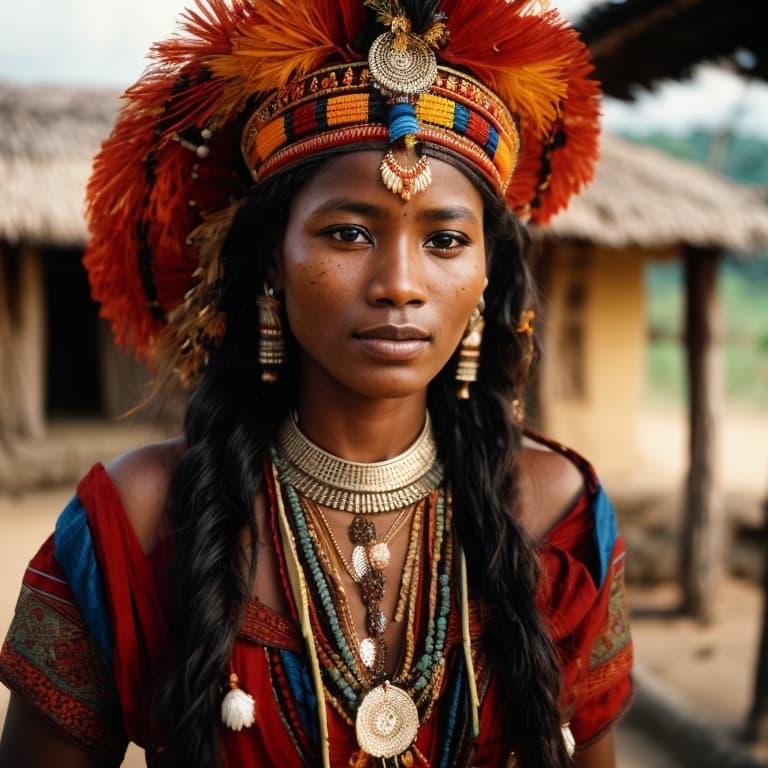
Atoni Erotic
West Timor (Indonesia), Oecusse (East Timor)
Austronesian / Timoric / Uab Meto
Christianity
Amarasi
Southeast Asia
About Atoni People
The Atoni are the largest indigenous people of West Timor, with a substantial community in the Oecusse enclave that sits, anomalously, on the East Timorese side of the border. They call themselves Atoin Meto — "the dry-land people" — and the name fits the country: a hot, rain-poor interior of limestone ridges, eucalypt savanna, and dry riverbeds that fill briefly in the wet season and then go quiet for months. Subsistence runs on maize rather than rice, supplemented by tubers, beans, and small livestock, and the agricultural calendar still shapes the rhythm of village life in a way that has not been entirely overwritten by clocks and wage work.
Their language, Uab Meto (also called Dawan), belongs to the Timoric branch of Austronesian and is spoken across a chain of dialects rather than as a single uniform tongue — the Amarasi in the southwest, for instance, are recognizably their own. Pre-colonial Atoni society was organized into a patchwork of small princedoms, each centered on a ritual lord whose authority was less administrative than cosmological; political power and ceremonial power were deliberately split between paired figures, an arrangement anthropologists have spent a great deal of ink trying to explain. The traditional house, the ume kbubu, is the most visible expression of that worldview: a beehive of thatch reaching nearly to the ground, smoke-blackened inside, with the hearth as the moral and practical center of the household.
Most Atoni today are Christian — Protestant in the bulk of West Timor, Catholic in Oecusse and parts of the south — the legacy of Dutch and Portuguese mission work layered over an older indigenous religion that has not entirely receded. Ancestors, agricultural spirits, and the ritual obligations attached to specific stones, springs, and trees still figure in how people mark births, marriages, and deaths, often alongside church observance rather than in opposition to it. Tais weaving — the dense, geometric ikat textiles produced on backstrap looms — remains a serious craft, with motifs that signal clan, region, and occasion to anyone who knows how to read them. The twentieth century was hard: Japanese occupation, the violence around Indonesian incorporation, and the long shadow of the East Timor conflict all touched Atoni territory, and Oecusse in particular still carries the marks of that history.
Typical Atoni Phenotypes
Reference for AI generation — hair, eyes, skin, facial structure, build
The Atoni (Dawan) of mountainous West Timor sit on a phenotypic seam between Austronesian and Melanesian/Papuan ancestries, and the visible result is a population that doesn't read as cleanly Southeast Asian the way coastal Indonesians do. The dominant signature is darker skin than most Indonesian groups — Fitzpatrick IV to V is typical, with deep brown undertones rather than the olive-yellow cast common further west — paired with hair and facial bones that often pull toward the Papuan side of the island.
Hair is almost universally black or near-black, and texture is the most variable feature: ranges from straight or loosely wavy in more Austronesian-leaning families to pronounced wave and tight curl in highland communities, where Type 3 and even Type 4a coils appear at frequencies you don't see in Java or Bali. Eyes are dark brown to near-black; the epicanthic fold is present but generally lighter and less complete than in mainland East Asian populations, and many Atoni read with a more open, almond-rounded eye shape rather than a strongly hooded lid.
Facial structure tends toward broader noses with a lower bridge and wider alar base, fuller lips than in most Malay populations, and a relatively strong, square jaw with moderate cheekbone projection. Brow ridges are often more defined in men than the regional average. Stature is on the shorter end — adult men commonly 160–168 cm, women 150–158 cm — with wiry, lean builds shaped by highland subsistence farming; muscular density in the legs and shoulders is characteristic, and obesity is rare in traditional villages.
The Amarasi branch, occupying lower-elevation country toward the south coast, tends to show somewhat lighter skin and straighter hair on average than the upland Atoni Pah Meto core, reflecting more sustained Austronesian and coastal admixture. Even so, the underlying facial architecture — broad nose, full lips, defined jaw — carries across both groups.
Data depth
0/100Coverage of image-grounded phenotype observations · drives AI generation diversity
- Sample size
- 0/40· 0 images
- Image quality
- 0/30· 0% high
- Confidence
- 0/20
- Source diversity
- 0/10
- ·No image observations yet
Explore phenotype categories
Structured taxonomy with peer-reviewed scales · 22 anatomical categories




Generate Atoni AI Content
Use this ethnicity's phenotype data to create AI-generated content with accurate physical traits and cultural context.
Open Creator Studio