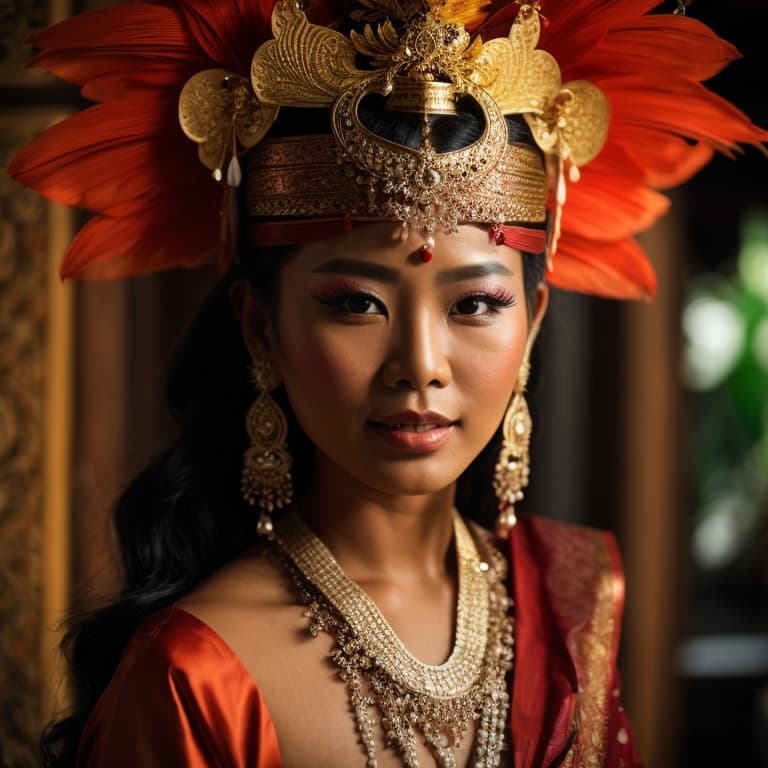
Balinese Erotic
Bali (Indonesia)
Austronesian / Balinese
Hinduism
Bali Aga
Southeast Asia
About Balinese People
The Balinese are the rare Indonesian people for whom Hinduism, not Islam, is the organizing fact of life — and the rarer case still where that Hinduism has fused so thoroughly with older animist and ancestral practice that it functions as its own tradition. Agama Hindu Dharma shapes the calendar, the architecture, the layout of villages, and the small daily offerings — the canang sari of palm-leaf, flowers, and rice — set out on doorsteps and dashboards each morning. The island sits just east of Java, separated by a narrow strait, and that strait has done a lot of historical work: when Islam swept through the Majapahit court in the fifteenth and sixteenth centuries, much of the Hindu-Javanese aristocracy, priesthood, and literary tradition relocated across it. What looks today like a uniquely Balinese culture is partly the residue of that migration, settled onto an island that already had its own indigenous population and its own gods.
That older population still exists. The Bali Aga — "original Balinese" — live mostly in mountain villages like Tenganan and Trunyan, and they kept their distance from the courtly Hindu-Javanese reorganization that reshaped the lowlands. Their customs diverge sharply from the dominant Balinese mainstream: different marriage rules, different burial practices (Trunyan famously lays its dead out in the open under a sacred tree rather than cremating them), different village governance based on a council of elders rather than the caste-inflected hierarchy that arrived with the Majapahit refugees. The rest of Balinese society inherited a softened four-tier caste system, more about ritual roles and naming conventions now than about social mobility.
The Balinese language is Austronesian, related to Javanese and to the broader Malayo-Polynesian family that runs from Madagascar to Easter Island, but it carries a register system — distinct vocabularies for speaking up, down, or laterally across social rank — that the speaker has to navigate every conversation. Most Balinese also speak Indonesian as a public lingua franca. The other defining feature is the banjar, the neighborhood association every adult belongs to, which organizes weddings, cremations, temple festivals, and disputes. The cremation in particular — ngaben — is the cultural set-piece outsiders notice: elaborate, costly, often delayed for years until a family can afford to send the soul off properly.
Typical Balinese Phenotypes
Reference for AI generation — hair, eyes, skin, facial structure, build
Balinese phenotype sits at the southern edge of the Austronesian expansion, with a measurable Papuan-related substrate that distinguishes it from Javanese or peninsular Malay neighbors. Hair is near-universally black, dense, and straight to gently wavy; coarser wave and occasional loose curl appear more often in Bali Aga villages of the central highlands, where pre-Hindu Austronesian lineages persisted with less Javanese admixture. Premature greying is uncommon before middle age.
Eyes are dark brown to near-black. The epicanthic fold is present in most of the population but typically softer and less pronounced than in mainland East Asian groups — the lid often shows a partial crease rather than a flat monolid, and palpebral fissures tend toward almond rather than narrow. Eye openings are moderate, with a gentle outer canthal tilt.
Skin spans Fitzpatrick III to V, generally a warm golden-brown with olive or coppery undertones rather than the yellower cast common further north in Asia. Coastal and farming populations sit darker; aristocratic and inland Ubud-area lineages often run a shade lighter. Bali Aga individuals frequently sit at the darker end with warmer red-brown undertones, reflecting older Austro-Melanesian admixture.
Facial structure is rounded to softly oval, with moderate cheekbone projection and a relatively short, broad nose — bridges are low to medium, alar bases moderately wide, tips rounded. Lips are medium-full, often with a defined cupid's bow. Jaws are tapered rather than square, and chins are small to moderate.
Build is compact and slight by global standards. Adult male stature averages roughly 162–165 cm and female 152–155 cm, among the shorter ranges in Southeast Asia. Frames are narrow-shouldered with fine wrists and ankles; musculature is wiry rather than bulky, and women carry weight gracefully through the hips with slim torsos. Bali Aga populations of villages like Tenganan and Trunyan show visibly broader noses, fuller lips, and darker skin than the Hindu-Javanese majority, reflecting the island's older indigenous layer.
Data depth
0/100Coverage of image-grounded phenotype observations · drives AI generation diversity
- Sample size
- 0/40· 0 images
- Image quality
- 0/30· 0% high
- Confidence
- 0/20
- Source diversity
- 0/10
- ·No image observations yet
Explore phenotype categories
Structured taxonomy with peer-reviewed scales · 22 anatomical categories






Generate Balinese AI Content
Use this ethnicity's phenotype data to create AI-generated content with accurate physical traits and cultural context.
Open Creator Studio