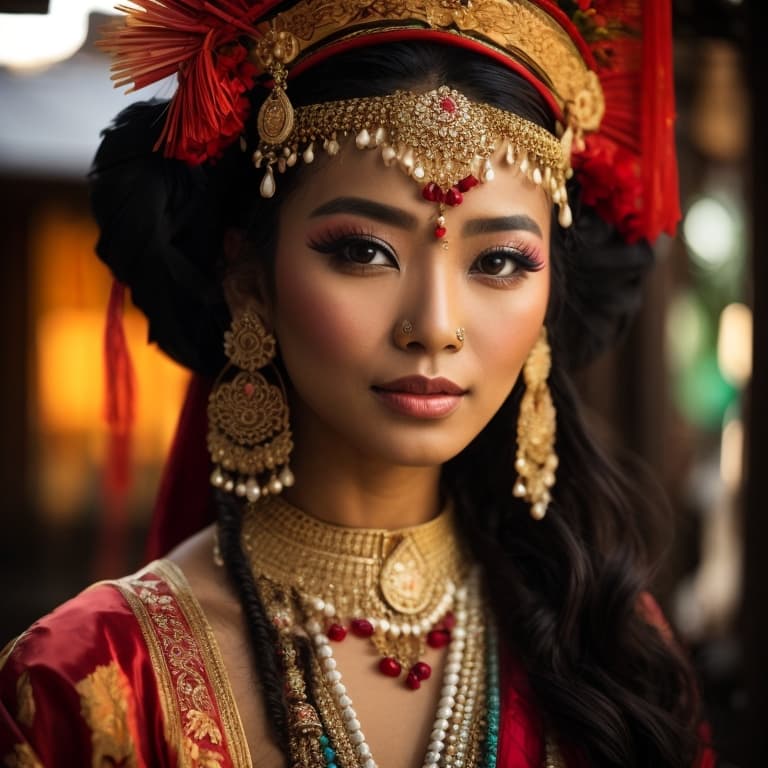
Bahnar Erotic
Central Highlands (Vietnam)
Austroasiatic / Bahnar
Animism
Southeast Asia
About Bahnar People
The Bahnar are highlanders of Vietnam's central plateau, settled across Gia Lai, Kon Tum, and Bình Định provinces in a band of rolling country between the Annamite range and the coastal lowlands. They speak a Mon-Khmer language of the Bahnaric branch — Austroasiatic, the same broader family as Vietnamese and Khmer, but a distant cousin to both. Their nearest linguistic relatives are the Sedang, Jarai, and other upland peoples of the same plateau, and the dialect map of the highlands is dense enough that Bahnar speakers from villages a day's walk apart can sound notably different to each other.
The defining unit of Bahnar life is the village, and the defining structure of the village is the rông — the communal house, raised on stilts with a steeply pitched thatch roof that can rise twenty meters or more. It is where the men of the village sleep when unmarried, where elders convene, where guests are received, where disputes are heard. A village without a rông is not really a village. Households around it are also stilted, arranged with a looser logic than lowland Vietnamese settlements, and the surrounding land is worked in swidden cycles for upland rice, cassava, and maize.
Religion among the Bahnar is animist in the working sense rather than the textbook one: the world is populated by yang, spirits attached to specific places, objects, ancestors, and natural forces, and the rhythm of the agricultural year is marked by sacrifices — chickens, pigs, and at major occasions a buffalo — meant to keep those relationships in good order. French Catholic missionaries reached the highlands in the mid-nineteenth century and a meaningful Bahnar Catholic population took root, particularly around Kon Tum, but the older cosmology has not been displaced so much as layered with the new one. Gong ensembles, played at funerals and seasonal ceremonies, belong to the same regional gong culture UNESCO recognized across the Central Highlands; the instruments and the way they are tuned in sets carry social meaning beyond the music itself.
Bahnar history in the twentieth century was shaped hard by the wars fought across their homeland — French, then American, then the post-1975 reorganization of highland land tenure under collectivization and later coffee and rubber expansion. The community today is several hundred thousand strong, bilingual in Vietnamese for most practical purposes, and visibly negotiating which parts of village life travel into the cash economy and which do not.
Typical Bahnar Phenotypes
Reference for AI generation — hair, eyes, skin, facial structure, build
The Bahnar are an Austroasiatic-speaking highland people of Vietnam's Central Highlands — Gia Lai, Kon Tum, and Bình Định provinces — and their phenotype reflects that older Mon-Khmer substrate rather than the Sinitic-influenced lowland Kinh majority. The result is a look that reads as visibly distinct from coastal Vietnamese: shorter, broader, more tropical-Southeast-Asian in proportion, with facial features that sit closer to other Mon-Khmer highlanders (Sedang, Mnong, Jarai neighbors) than to Hanoi or Saigon Kinh.
Hair is uniformly black to blue-black, thick, and most often straight to gently wavy; a loose wave is more common here than among East Asian populations further north, and a small minority show a soft natural curl. Texture is coarse, with high density. Graying tends to come late. Eyes are dark brown to near-black, with the epicanthic fold present but typically softer and less pronounced than in Northeast Asian populations — many Bahnar have a partial or low-set fold, giving a slightly rounder, more open eye shape than Kinh Vietnamese. Eyelashes are dense and straight.
Skin tone runs warm and golden-brown, Fitzpatrick III to IV, with strong yellow-olive undertones; outdoor agricultural life pushes a lot of adults toward deep IV with reddish sun-weathering across the cheekbones, nose, and forearms. Tone is noticeably darker on average than lowland Kinh, closer to Cambodian Khmer or Lao Theung.
Facial structure tends toward broad, rounded faces with wide cheekbones, a relatively flat midface, and a short nose with a low bridge and moderately wide alar base — the nose is the most consistently Mon-Khmer feature. Lips are medium-full, often with a pronounced cupid's bow; jaws are squared rather than tapered.
Build is short and compact. Adult men commonly fall around 158–165 cm and women 148–155 cm, with sturdy shoulders, short limbs relative to torso, and naturally lean musculature from upland farming. Siu Black, the singer, is a recognizable anchor for the broader, fuller-featured end of the spectrum.
Data depth
11/100Coverage of image-grounded phenotype observations · drives AI generation diversity
- Sample size
- 6/40· 2 images
- Image quality
- 0/30· 0% high
- Confidence
- 5/20· mean 0.41
- Source diversity
- 0/10· wikipedia
- ·No image observations yet
- ·Low overall confidence
- ·Wikipedia-only source — not population-representative
Explore phenotype categories
Structured taxonomy with peer-reviewed scales · 22 anatomical categories
Notable Bahnar People
2 reference figures — sourced from Wikipedia
- Nguyễn Nhạc — Ya Dok, a heroine, the wife of Nguyễn Nhạc
- Siu Black — popular singer






Generate Bahnar AI Content
Use this ethnicity's phenotype data to create AI-generated content with accurate physical traits and cultural context.
Open Creator Studio