
Betawis Erotic
Jakarta (Indonesia)
Austronesian / Malayic / Malay / Betawian
Islam / Sunni Islam
Southeast Asia
About Betawis People
The Betawi are the people of Jakarta — not the migrants who flooded in during the twentieth century, but the older population that took shape inside the city itself, mostly during the Dutch colonial period. They are a creole people in the strict sense: their ancestry braids together Malay, Sundanese, Javanese, Balinese, Bugis, Ambonese, Arab, Chinese, and Portuguese-Eurasian lines, all collected in and around Batavia as the VOC moved labor and traders through its port. By the late nineteenth century this mixed urban population had cohered into something distinct enough to name itself orang Betawi, after Batavia.
Their language, Betawi Malay, reflects the same history. It sits inside the Malayic branch of Austronesian but carries heavy loans from Hokkien, Javanese, Sundanese, Arabic, Portuguese, and Dutch — a port dialect, casual and fast, distinct from the standardized Indonesian that grew out of more formal Riau Malay. Older Betawi speech is recognizable across Indonesia from films and television, and a great deal of Jakarta's slang has filtered outward into national youth speech.
Religion is overwhelmingly Sunni Islam, and in the Betawi case Islam is also a marker of the community's coherence — the colonial-era Betawi formed partly around the kampung mosque and the figure of the local guru ngaji. Religious practice runs through life-cycle events that still mark someone as Betawi: the elaborate wedding procession with its palang pintu, the rhyming verbal duel a groom must win at the bride's gate before he is allowed to enter; the khataman at the close of Quranic study; circumcision festivities marked by music.
The cultural signatures are urban and specific. Lenong is Betawi folk theatre, comedic and improvisational, traditionally accompanied by gambang kromong — a hybrid ensemble built on Chinese melodic instruments fused with Malay percussion, audibly the sound of a port. Ondel-ondel, the tall paired puppet figures of bridegroom and bride, originated as guardian effigies and now appear at openings and festivals. The cuisine is similarly layered: soto Betawi with coconut milk and beef offal, kerak telor cooked over coals at street stalls, nasi uduk.
The Betawi are increasingly a minority in their own city — pushed out by land prices and migration from across the archipelago — and much of the contemporary cultural work around Betawi identity has the character of deliberate preservation rather than ambient continuity.
Typical Betawis Phenotypes
Reference for AI generation — hair, eyes, skin, facial structure, build
The Betawi phenotype is a Jakarta creole — the visible signature of four centuries of port-city mixing between Sundanese and Javanese settlers, Malay traders, southern Chinese (especially Hokkien Fujianese), Arabs from Hadhramaut, South Asians, and smaller currents of Portuguese-Eurasian and African heritage from the colonial Batavia era. The result is a population that reads as core Southeast Asian but carries unusually frequent traces of East Asian and West/South Asian features even within a single family.
Hair is overwhelmingly black to very dark brown, predominantly straight to slightly wavy, with medium-to-coarse strand thickness typical of insular Southeast Asia. Tighter waves and looser curls turn up in individuals with stronger Arab or South Asian admixture; the very straight, fine, blue-black hair common among those with heavier Hokkien input is a recognizable variant.
Eye color sits in the dark-brown to near-black range. Epicanthic folds are common but not universal — frequently partial or mild rather than the fully developed fold seen in northern East Asian groups. Lid shape ranges from clearly monolid in the more Sinitic-leaning to wider, more open almond shapes with a defined crease in those leaning Malay, Arab, or Indian. Iko Uwais shows a fairly characteristic Betawi-Sundanese eye morphology.
Skin tones cluster around Fitzpatrick III–IV — warm golden-brown to medium olive-brown — with lighter III appearing in stronger Sino-Betawi lineages and deeper IV–V where South Asian or eastern-archipelago ancestry is present. Undertones lean yellow-olive rather than red.
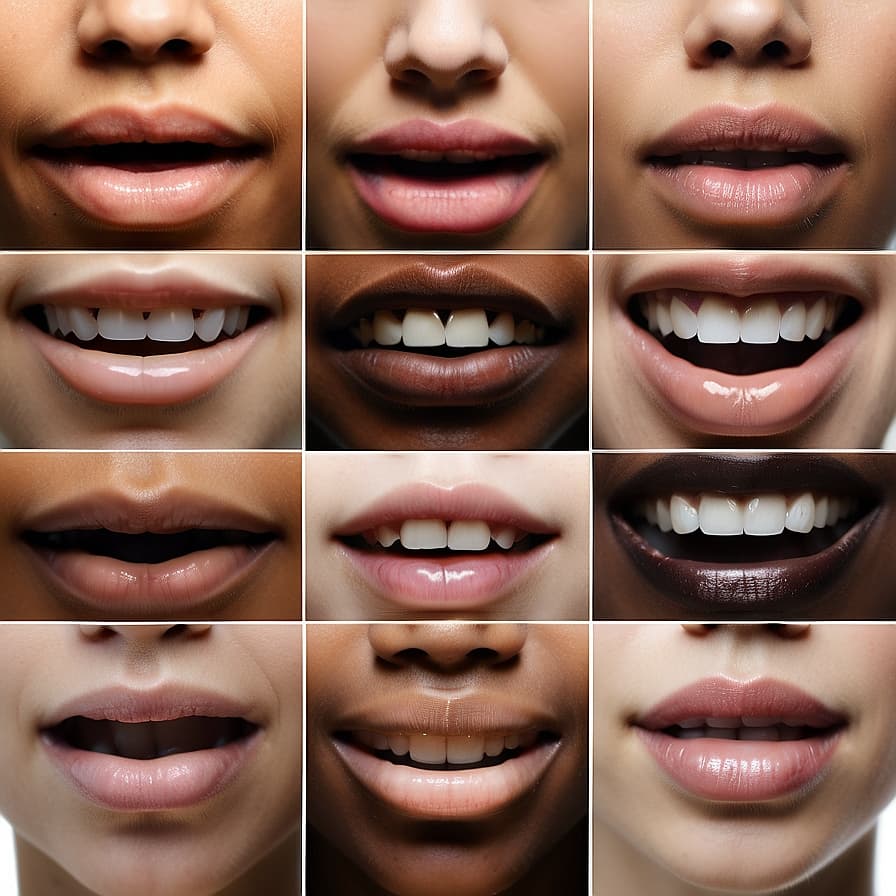
Faces tend toward moderately broad with softly rounded jawlines and full cheeks; pronounced cheekbones are less common than among northern Asian populations. Noses are typically short with a low-to-medium bridge and moderately wide alae, though taller, narrower, more aquiline noses appear in the Arab-descended segment. Lips run medium-full, often with a defined cupid's bow.
Build is generally short to medium — roughly 155–162 cm for women, 162–170 cm for men — with compact, neotenous proportions, narrow shoulders, and a tendency toward soft body composition rather than lean angularity.
Data depth
55/100Coverage of image-grounded phenotype observations · drives AI generation diversity
- Sample size
- 20/40· 10 images
- Image quality
- 20/30· 40% high
- Confidence
- 15/20· mean 0.76
- Source diversity
- 0/10· wikipedia
- ·Modest sample (n<25)
- ·Wikipedia-only source — not population-representative
Observed Distribution — Image Sample
Empirical observations from analyzed photographs · supplementary signal, not population truth
Sample: 10 images analyzed (10 wikipedia). Quality: 4 high, 3 medium, 3 low, 0 very_low. Avg analyzer confidence: 0.76.
Skin tone (Fitzpatrick): III (10%), IV (80%), V (10%)
Hair color: black (80%), gray/white (20%)
Hair texture: straight (60%), covered (40%)
Eye color: dark brown (100%)
Epicanthic fold: 80% present, 20% absent, 0% unclear
Caveats: Sample size 10 is modest — secondary patterns may not be reliable. Sample is 100% Wikipedia notable people — skews toward male, public-life, and modern figures, not population-representative.
Last aggregated: May 7, 2026
Explore phenotype categories
Structured taxonomy with peer-reviewed scales · 22 anatomical categories
Notable Betawis People
17 reference figures — sourced from Wikipedia
- Fujian — A large group of Chinese workers who had fled to Dutch Formosa because of the…
- Si Pitung — legendary bandit
- Mohammad Husni Thamrin — National Hero of Indonesia
- Benyamin Sueb — legendary comedian, singer and actor
- Imam Syafei — military figure and former special minister of security
- Ismail Marzuki — composer and musician
- Fauzi Bowo — governor of Jakarta 2007–2012
- Zainuddin M. Z. — Islamic nationwide preacher and politician
- Suryadharma Ali — politician
- Mpok Nori — comedian
- Julia Perez — actress and singer
- Surya Saputra — actor, singer and model
- Iko Uwais — actor, martial artist and stuntman
- Aiman Witjaksono — journalist and news anchor
- Asmirandah Zantman — actress and singer
- Francesca Gabriella Dewi Rezer — actress, presenter and model
- Batavia — now Jakarta)

Generate Betawis AI Content
Use this ethnicity's phenotype data to create AI-generated content with accurate physical traits and cultural context.
Open Creator Studio