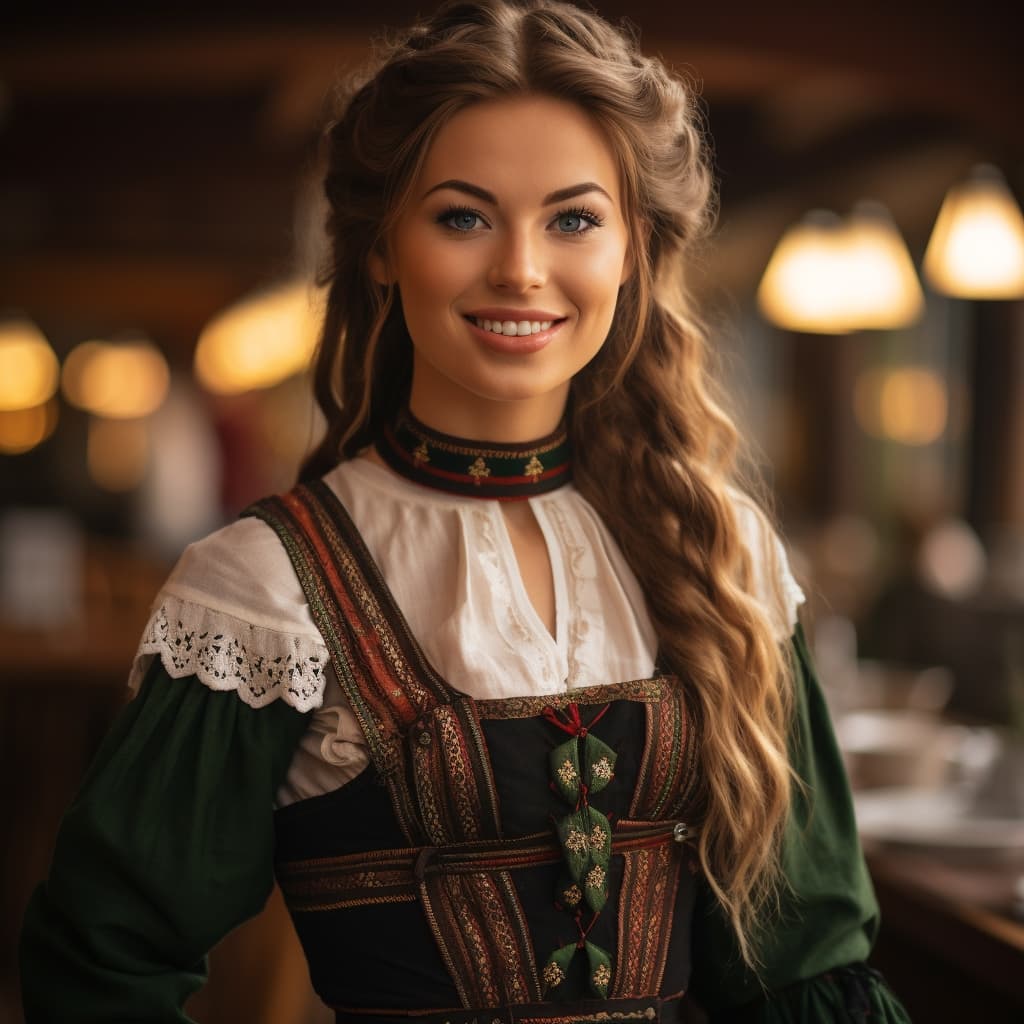
Irish Erotic
Ireland (Republic of Ireland, United Kingdom)
Indo-European / Celtic / Irish
Christianity / Catholicism
Irish Travellers, Ulster Irish, along with significant populations in the United States, Australia, Canada, Argentina, Mexico and New Zealand
Western Europe
About Irish People
The Irish are a Celtic people whose identity has been forged less by isolation than by a long argument with the larger island next door. Ireland sits at the western edge of Europe, a green, rain-shaped place of low mountains, peat bog, and a coastline that turned its inhabitants into emigrants on a scale few populations have matched. Today there are roughly five million people on the island who would call themselves Irish; outside it, by some counts, ten times that number claim Irish descent — in Boston and Buenos Aires, in Liverpool, Sydney, and the silver-mining towns of northern Mexico. That diaspora is not a footnote to Irishness. It is part of the definition.
The Irish language, Gaeilge, belongs to the Goidelic branch of Celtic — closer to Scottish Gaelic and Manx than to Welsh — and it survived centuries of English administrative pressure mostly along the Atlantic coast, in the western Gaeltacht districts where it is still spoken as a daily tongue. Most Irish people today grow up with English as a first language and Irish as a school subject they may or may not have warmed to; the language's status is more emotional than functional, which is its own kind of survival.
Catholicism has been the dominant religious affiliation since long before the Reformation, and for most of the twentieth century the Church wielded a quiet, total authority over schooling, hospitals, and the rhythm of family life. That authority cracked in living memory — the abuse revelations of the 1990s and 2000s, the legalization of divorce in 1995, the same-sex marriage referendum of 2015, and the repeal of the Eighth Amendment in 2018 mark a society that has changed faster, on these matters, than almost any of its European neighbors. The result is a population that is still culturally Catholic in its holidays and funerals while being broadly secular in its politics.
Within the island, distinctions matter. Ulster Irish — the Catholic, nationalist population of the north — share a province with a Protestant unionist community and a border that was contested in arms within living memory. Irish Travellers, recognized as a distinct ethnic minority since 2017, have their own language (Shelta), a nomadic heritage now mostly settled, and a relationship with the wider Irish public that remains uneasy. To speak of "the Irish" in the singular is convenient and only partly true.
Typical Irish Phenotypes
Reference for AI generation — hair, eyes, skin, facial structure, build
The Irish phenotype is shaped by long isolation on Europe's western edge, producing one of the lightest-skinned populations on Earth alongside an unusually high frequency of red and dark hair on the same island. Hair runs the full Celtic range: deep brown to near-black is actually the most common natural color, with mid-brown and dark blonde frequent, and Ireland holding roughly 10% natural redheads — second only to Scotland and far above the global ~1–2%. Texture is typically straight to gently wavy, often fine, and prone to silver-grey rather than yellowing white with age.
Eyes skew light: blue and blue-grey are the single most common, green is disproportionately frequent compared to most of Europe, and hazel is widespread; pure brown exists but is the minority. Eyelids are open with no epicanthic fold, often deep-set under a defined brow, and lashes can be strikingly dark even on the fairest faces — the "black Irish" pattern of dark hair, pale skin, and light eyes seen in actors like Pierce Brosnan and Aidan Gillen.
Skin sits firmly at Fitzpatrick I–II: porcelain to ivory with cool pink or neutral undertones, freckling readily, burning before tanning, and frequently showing translucency over the temples and décolletage. Rosacea-prone flushing across cheeks and nose is common.
Facial structure tends toward a longer mid-face with a straight or gently aquiline nose, narrow alar base, and a defined jaw. Lips are usually moderate — fuller than English averages, less full than Mediterranean. Cheekbones are present but not high or wide; chins are often slightly pointed. Build is medium-tall, with adult men averaging around 178 cm, lean to mesomorphic frames, and broader shoulders relative to hips than southern European norms.
Subgroup variation is real. Ulster Irish lean blonder and slightly fairer, reflecting Scottish admixture. Irish Travellers are a genetically distinct endogamous population and tend toward darker hair, slightly warmer skin, and more compact stature than the settled Irish average.
Data depth
84/100Coverage of image-grounded phenotype observations · drives AI generation diversity
- Sample size
- 39/40· 49 images
- Image quality
- 30/30· 61% high
- Confidence
- 15/20· mean 0.78
- Source diversity
- 0/10· wikipedia
- ·Wikipedia-only source — not population-representative
Observed Distribution — Image Sample
Empirical observations from analyzed photographs · supplementary signal, not population truth
Sample: 49 images analyzed (49 wikipedia). Quality: 30 high, 14 medium, 5 low, 0 very_low. Avg analyzer confidence: 0.78.
Skin tone (Fitzpatrick): I (2%), II (90%), III (6%), unclear (2%)
Hair color: black (31%), gray/white (31%), light/medium brown (18%), dark brown (8%), blonde (8%), red/auburn (2%), brown (2%)
Hair texture: straight (43%), wavy (45%), curly (10%), covered (2%)
Eye color: blue (41%), hazel (18%), dark brown (16%), green (4%), brown (2%), unclear (18%)
Epicanthic fold: 0% present, 98% absent, 2% unclear
Caveats: Sample is 100% Wikipedia notable people — skews toward male, public-life, and modern figures, not population-representative.
Last aggregated: May 7, 2026
Explore phenotype categories
Structured taxonomy with peer-reviewed scales · 22 anatomical categories
Notable Irish People
100 reference figures — sourced from Wikipedia
- James Hoban — designer of the White House
- Sara Allgood — actress
- Jonas Armstrong — actor, star of the BBC series Robin Hood
- Caitríona Balfe — actress
- Patrick Bergin — film actor
- Sarah Bolger — actress, played Princess Mary Tudor in The Tudors; Spiderwick Chronicles; Pri…
- Stephen Boyd — film actor
- Kenneth Branagh — actor on stage, film and TV, Harry Potter films
- Brid Brennan — actress
- George Brent — Hollywood actor
- Shane Brolly — actor, Underworld
- Pierce Brosnan — actor, best known as James Bond from 1994 to 2005
- Gabriel Byrne — TV and film actor
- Todd Carty — TV, stage and film actor and director
- Elaine Cassidy — film actress
- Tony Clarkin — actor of stage, TV, radio, film; voiceover artist
- Kerry Condon — actress
- D'Arcy Corrigan — Hollywood actor
- Nicola Coughlan — actress
- Catherine Cusack — stage and TV actor; daughter of Cyril Cusack
- Cyril Cusack — actor of stage, film and TV (born in South Africa)
- Niamh Cusack — TV actress; daughter of Cyril Cusack
- Sinéad Cusack — stage, film and TV actress; daughter of Cyril Cusack; married to Jeremy Irons
- Sorcha Cusack — film and TV actress; daughter of Cyril Cusack
- Daniel Day-Lewis — English-born Oscar winner
- Alison Doody — actress, best known for her role in Indiana Jones and the Last Crusade
- Richard Dormer — actor, playwright, known for roles in Game of Thrones and Fortitude
- Jamie Dornan — actor and model; played the Huntsman in Once Upon a Time; best known for role…
- Roma Downey — actor, best known for her role as Monica in the TV series Touched by an Angel
- Maria Doyle Kennedy — actress and singer
- Ada Dyas — actress
- Hilton Edwards — co-founder of the Gate Theatre, born in UK
- Colin Farrell — Hollywood actor
- Michael Fassbender — Hollywood actor, born in West Germany
- Barry Fitzgerald — Abbey Theatre actor turned Hollywood star
- Geraldine Fitzgerald — actress
- Fionnula Flanagan — actress
- Brenda Fricker — Oscar winner
- Bronagh Gallagher — actress
- Michael Gambon — theatre, TV and film actor, Harry Potter films
- Charles K. Gerrard — Hollywood actor
- Douglas Gerrard — Hollywood actor
- Aidan Gillen — actor, The Wire, Game of Thrones, Queer as Folk
- Brendan Gleeson — actor, Harry Potter films
- Louisa Harland — actress
- Richard Harris — actor, Harry Potter films
- Forrester Harvey — Hollywood actor
- Amy Joyce Hastings — actress
- Amy Huberman — actress
- Saoirse-Monica Jackson — actress
- Valene Kane — actress, The Fading Light
- J. M. Kerrigan — Abbey actor
- Joanne King — actress
- Dervla Kirwan — actress, Ballykissangel, Goodnight Sweetheart
- Evanna Lynch — actress, Harry Potter films
- Joe Lynch — TV actor
- Susan Lynch — actress
- Micheál Mac Liammhóir — co-founder of the Gate Theatre, born in UK
- Eoin Macken — actor, Merlin
- Gerard McCarthy — actor, Hollyoaks
- F. J. McCormick — Abbey actor
- Damian McGinty — TV actor Glee
- Patrick McGoohan — actor and creator of The Prisoner
- Barry McGovern — stage, film and TV actor
- Katie McGrath — film and TV actress
- Colm Meaney — Hollywood actor
- Jonathan Rhys Meyers — film and TV actor
- Charles Mitchel — actor and newsreader
- Damien Molony — stage and television actor
- Colin Morgan — actor of stage, film and TV, best known for being the lead in Merlin
- Edward Mulhare — actor; played Captain Daniel Gregg in The Ghost and Mrs. Muir; Knight Rider
- Devon Murray — actor, Seamus Finnigan in the Harry Potter films
- Jim Norton — character actor
- Jamie-Lee O'Donnell — actress
- Colin O'Donoghue — actor, member of The Enemies; best known for playing Captain Hook in Once Upo…
- Chris O'Dowd — actor and comedian
- Ardal O'Hanlon — actor and comedian
- Joan O'Hara — actress
- Maureen O'Hara — actress
- Maureen O'Sullivan — actor; mother of Mia Farrow
- Peter O'Toole — Oscar winner
- Paul Ronan — actor, The Devil's Own; father of Saoirse Ronan
- Saoirse Ronan — actress
- Andrew Scott — film, stage and television actor
- Fiona Shaw — actress, Harry Potter films
- Arthur Shields — actor; younger brother of Barry Fitzgerald
- Niall Tóibín — actor and comedian
- Stuart Townsend — actor and boxer
- Aidan Turner — actor, played John Mitchell in the BBC's Being Human and Kili in The Hobbit: …
- Darina Allen — TV personality and chef
- Myrtle Allen — chef, teacher and writer
- Rachel Allen — celebrity chef
- Neven Maguire — celebrity chef
- Seán William McLoughlin — YouTube personality (under the name Jacksepticeye), musician, game commentator
- Dermot Morgan — comedian, actor, radio personality
- Jarlath Regan — comedian, journalist, interviewer, author, cartoonist
- Mario Rosenstock — comedian, impressionist, actor, musician
- Iain Archer — singer-songwriter and producer
- Michael William Balfe — opera composer
- Gerald Barry — composer, member of Aosdána






Generate Irish AI Content
Use this ethnicity's phenotype data to create AI-generated content with accurate physical traits and cultural context.
Open Creator Studio