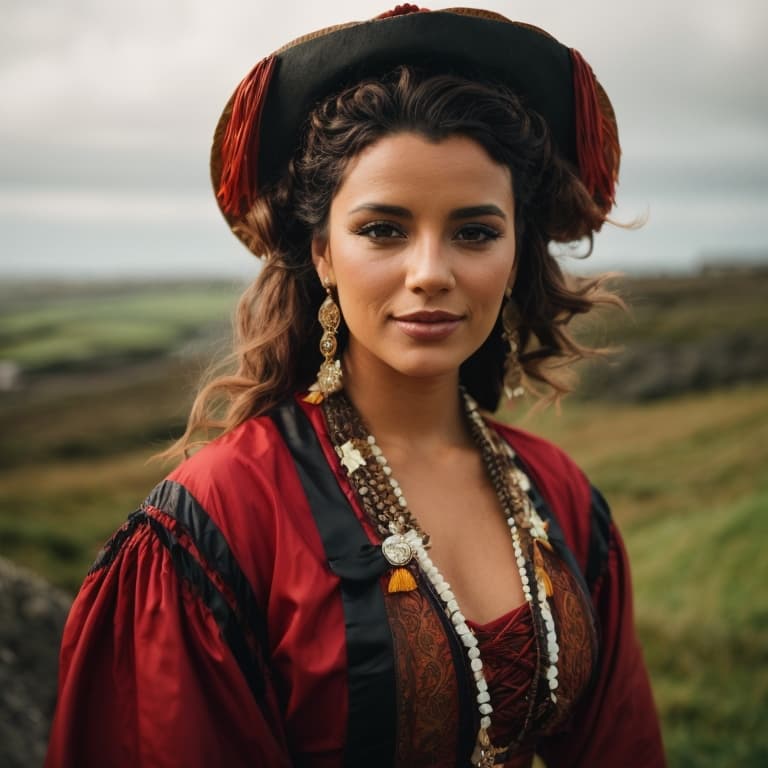
Cornish Erotic
Cornwall (United Kingdom)
Indo-European / Celtic / Cornish
Christianity
Significant populations in the United States and Australia
Western Europe
About Cornish People
The Cornish are a Brythonic Celtic people rooted in the southwestern peninsula of Britain — the long granite finger of land that ends at Land's End, hemmed in by the Atlantic on three sides and walled off from England, historically and psychologically, by the River Tamar. That geography matters. Cornwall has spent most of its recorded history as a place apart: too poor to be absorbed comfortably, too distinct to disappear, and too exposed to the sea to think of itself as inland English. The Cornish were recognized as a national minority under the Council of Europe's framework convention in 2014, which formalized what the people themselves had long insisted — that Kernow is not simply a county.
The Cornish language, Kernewek, belongs to the Brythonic branch of Celtic, alongside Welsh and Breton, and is far closer to the latter than to anything spoken in modern England. It contracted steadily under English pressure and is conventionally said to have lost its last traditional speakers in the late eighteenth century, with Dolly Pentreath of Mousehole the figure most often named. The twentieth-century revival, driven by amateurs and language enthusiasts, has produced a small but real community of speakers and learners, and the language now appears on bilingual signage, in place names, and in a modest body of new literature. It is an unusual case of a language that came back from functional extinction — not fully restored, but no longer gone.
Religion in Cornwall is Christian, but with a particular grain. The medieval Celtic saints — Piran, Petroc, Ia, Buryan — left their names scattered across parishes in a density unusual even by British standards, and many of those parish identities still hold. The eighteenth-century Methodist revival took deeper root here than almost anywhere else in England, and the tin and copper miners who carried Wesleyan chapels into their working lives also carried them abroad. Cornish mining diasporas reached the lead districts of Wisconsin, the copper belts of Michigan and South Australia, and the deep-level mines of South Africa, often founding entire towns. The pasty, the brass band, the male voice choir, and a stubborn attachment to St. Piran's flag travelled with them.
What identifies the Cornish as a group is less any single custom than the accumulation: a Celtic language pulled back from the dead, a Methodist chapel culture grafted onto older saints, a mining heritage scattered across continents, and a flat refusal to be understood as merely English.
Typical Cornish Phenotypes
Reference for AI generation — hair, eyes, skin, facial structure, build
The Cornish phenotype sits at the western edge of the Atlantic-fringe Celtic gradient, and what's structurally distinctive is the pairing of relatively dark hair with very fair, often ruddy skin — a combination geneticists have flagged as enriched in southwestern Britain compared to England proper. Hair runs predominantly mid-to-dark brown, frequently with a warm chestnut or near-black cast; true blonds are a minority, mostly clustered among children who darken in adolescence. Auburn and outright red occur at meaningful rates — not at Scottish or Irish levels, but well above the English average — and grey-streaking tends to arrive early. Texture is overwhelmingly straight to gently wavy; tight curl is rare.
Eyes are usually blue, blue-grey, or hazel, with a notable strain of pale grey-green that crops up along the south coast. Brown eyes appear but are the minority. Eyelids are deep-set, no epicanthic fold, often with a heavy upper crease that gives the gaze a slightly hooded quality in older men.
Skin is Fitzpatrick I–II: pale, pink-to-rose undertone, freckles readily, burns before it tans, and develops the broken capillaries and high-color cheeks associated with maritime weather exposure. A subset shows a cooler, almost porcelain cast.
Facial structure tends toward a long oval or rectangular face with a straight, narrow nose — usually a high, thin bridge and modest alar width. Lips are medium, the lower fuller than the upper. Cheekbones read as moderate rather than prominent, and jaws are often square in men, with the slightly cleft or dimpled chin (think Luke Cowan-Dickie) recurring frequently enough to be locally recognized.
Build is medium-tall by historical British standards, with average male stature around 175–178 cm; frames lean wiry and broad-shouldered, a body composition shaped by generations of mining and fishing labor. Diaspora populations in the United States and Australia retain the same coloring and bone structure, though taller and heavier on average through better nutrition.
Data depth
60/100Coverage of image-grounded phenotype observations · drives AI generation diversity
- Sample size
- 40/40· 58 images
- Image quality
- 15/30· 29% high
- Confidence
- 5/20· mean 0.54
- Source diversity
- 0/10· wikipedia
- ·Low overall confidence
- ·Mostly low-quality source images
- ·Wikipedia-only source — not population-representative
Observed Distribution — Image Sample
Empirical observations from analyzed photographs · supplementary signal, not population truth
Sample: 58 images analyzed (58 wikipedia). Quality: 17 high, 29 medium, 9 low, 3 very_low. Avg analyzer confidence: 0.54.
Skin tone (Fitzpatrick): II (78%), III (3%), VI (2%), unclear (17%)
Hair color: gray/white (55%), black (17%), light/medium brown (7%), blonde (3%), dark brown (3%), brown (2%), red/auburn (2%), unclear (10%)
Hair texture: straight (40%), wavy (36%), curly (9%), coily (2%), covered (7%), unclear (7%)
Eye color: blue (24%), dark brown (14%), brown (10%), hazel (7%), unclear (45%)
Epicanthic fold: 0% present, 81% absent, 19% unclear
Caveats: Quality skews toward older or low-resolution photos; phenotype detail may be lossy. Low average analyzer confidence — many photos partially obscured or historical. Sample is 100% Wikipedia notable people — skews toward male, public-life, and modern figures, not population-representative.
Last aggregated: May 7, 2026
Explore phenotype categories
Structured taxonomy with peer-reviewed scales · 22 anatomical categories
Notable Cornish People
100 reference figures — sourced from Wikipedia
- John Couch Adams — 1819–1892), co-discoverer of the planet Neptune
- Michael Adams — born 1971), chess grandmaster
- Donald Adamson — Dr. Donald Adamson (born 1939), historian and Fellow of the Royal Society of …
- Ralph Allen — entrepreneur and philanthropist
- Jack Andrew — rugby player, Cornish Pirates prop forward
- Paul Andrew — born 1989), rugby player, brother of Jack Andrew, Cornish Pirates prop forward
- Michael An Gof — Michael Joseph) (died 1497), leader of the Cornish rebellion of 1497
- John Arnold — 1736–1799), watchmaker and pioneer of the marine chronometer
- Humphrey Arundell — c. 1513–1550), leader of the Cornish Rebellion of 1549
- Thomas Arundell of Wardour Castle — c. 1502–1552), administrator and alleged conspirator, executed 1552
- Candy Atherton — 1955–2017), MP for Falmouth and Camborne
- Steve Baker — born 1971), Conservative politician, Minister of State for Northern Ireland, …
- Morwenna Banks — born 1961), comedian and actress
- Jonah Barrington — born 1941), squash player
- Basset family — the Basset family, landowners and tin mining entrepreneurs who owned Tehidy C…
- Tom Bawcock — legendary[citation needed] fisherman from Mousehole
- Robert Beheathland — born before 1587 in St Endellion, Cornwall, was an English gentleman who arri…
- John Betjeman — 1906–1984), British Poet Laureate
- William Bickford — 1774–1834), inventor of the safety fuse
- Lamorna Birch — 1869–1955), artist and member of the Newlyn School
- William Bligh — 1754–1817), captain of the ship Bounty
- Max Bodilly — born 1994), rugby player, London Welsh full-back/centre
- Thomas Bedford Bolitho — 1835–1915), banker and industrialist
- Thomasine, Lady Percival — Thomasine Bonaventure), paid to repair a bridge and founded a school
- Thomas Bond — 1765–1837), topographer from Looe
- Arthur Boscawen — 1862–1939), Anglican priest and horticulturist
- Edward Boscawen — Admiral Edward Boscawen (1711–1761), a naval commander in the Royal Navy know…
- John Boson — 1655–1730), Nicholas Boson (1624–1708), and Thomas Boson (1635–1719), 18th-ce…
- Maria Branwell — 1783–1821), mother of the Brontë sisters
- James Silk Buckingham — 1786–1855), author, journalist and traveller
- Barry Bucknell — 1912–2003), the original DIY TV presenter, who lived at St Mawes
- W. J. Burley — 1914–2002), author of the Wycliffe series of crime novels
- Richard Carew — 1555–1620), translator and antiquary
- Elizabeth Carne — 1817–1873), geologist
- James Carne — 1906–1986), recipient of the Victoria Cross, Lieutenant Colonel of the 1st Gl…
- Joseph Carne — 1782–1858), geologist, industrialist and Fellow of the Royal Society
- John Carter — 1738–1803), smuggler known as the "King of Prussia", who operated from Prussi…
- Charles Causley — 1917–2003), poet
- Ollie Chenoweth — born 1992), retired professional football goalkeeper
- Jack Clemo — 1916–1994), blind poet and novelist
- William Clift — 1775–1849), naturalist and Fellow of the Royal Society
- Joseph Henry Collins — 1841–1916), mining engineer, mineralogist and geologist
- Myrna Combellack — academic researcher and writer of Cornish history
- Constantine of Cornwall — Cornish ruler and saint
- William Cookworthy — 1705–1780), discoverer of china clay (kaolinite) in Cornwall
- Saint Corentin — missionary to Brittany
- Corineus — the legendary founder of Cornwall in Geoffrey of Monmouth's Historia Regum Br…
- Jonathan Couch — Dr Jonathan Couch (1789–1870), naturalist and physician
- Richard Quiller Couch — 1816–1863), naturalist
- Luke Cowan-Dickie — born 1993), rugby player Exeter Chiefs and England hooker
- John Kevin Curtice — born 1953), political scientist
- Nick Darke — 1948–2005), playwright
- Frederick Hamilton Davey — 1868–1915), botanist
- Grenville Davey — 1961–2022), artist, Turner Prize winner in 1992
- Humphry Davy — Sir Humphry Davy (1778–1829), scientist, inventor and president of the Royal …
- Jamie Day — born 1986), footballer
- Anne Dowriche — before 1560 – after 1613), historian, poet and protestant writer
- Samuel Drew — 1765–1833), Methodist theologian
- Daphne du Maurier — 1907–1989), novelist
- Edwin Dunkin — 1821–1898), president of the Royal Astronomical Society and the Royal Institu…
- Herbert Dyer — 1898–1974), coppersmith
- Richard Edmonds — 1801–1886), geologist and antiquary
- John Passmore Edwards — 1823–1911), Chartist and philanthropist
- Joseph Antonio Emidy — 1775–1835), black composer who lived in Truro
- Enys family of Enys in Cornwall — includes many landowners, MPs and public officials
- Matthew Etherington — born 1981), professional footballer who played in two FA Cup finals with two …
- John Pascoe Fawkner — 1792–1869), early Australian pioneer, businessman and politician of Melbourne…
- Bob Fitzsimmons — 1863–1917), world champion bare-knuckle fighter
- Thomas Flamank — died 1497), leader of the Cornish Rebellion of 1497
- Mick Fleetwood — born 1947), drummer
- Samuel Foote — 1720–1777), dramatist
- Stanhope Forbes — 1857–1947), artist and member of the Newlyn School
- Anna Maria Fox — benefactor to Falmouth
- Robert Were Fox the Elder — 1754–1818), Quaker and businessman
- Robert Were Fox — 1789–1877), geologist
- Richard Gaisford — born 1972), Good Morning Britain chief correspondent who trained at Universit…
- Susan Elizabeth Gay — 1845–1918), chronicler of Falmouth
- Robert Geffrye — Sir Robert Geffrye, Lord Mayor of London
- Richard Gendall — 1924–2017), linguist and musician
- Ken George — born 1947), scholar and Cornish nationalist
- Davies Gilbert — 1767–1839), applied mathematician and technocrat, president of the Royal Society
- Helen Glover — born 1986), Olympic gold medal-winning rower
- William Golding — 1911–1993), novelist
- Julia Goldsworthy — born 1978), former Liberal Democrat Member of Parliament for Falmouth and Cam…
- Gorlois — mythical Duke of Cornwall
- Pete Goss — born 1961), sailor now living in Torpoint
- Andrew Graham — born 1942), Master of Balliol College, Oxford, 2001-2011
- Winston Graham — 1908–2003), novelist, author of the Poldark series
- William Gregor — 1761–1817), clergyman and scientist, discoverer of titanium
- Francis Gregory — 1904-?) was a champion Cornish wrestler in the 1920s and 1930s who won the he…
- Pascoe Grenfell — 1761–1838), businessman and politician
- Richard Grenville — 1542–1591), Navy officer
- Cornish wrestler — Captain Thomas Gundry (1818–1888) was a champion Cornish wrestler in the 1830…
- Goldsworthy Gurney — 1793–1875), inventor of limelight
- St Austell — Philip Hancock of St Austell was the World Cornish Wrestling champion in 1884…
- James Hawes — television director, re-launched Doctor Who
- Robert Stephen Hawker — 1803–1875), Anglican priest and poet, Vicar of Morwenstow
- John Hawkins — 1761–1841), geologist and traveller
- Harrison Hayter — 1825–1898), civil engineer
- Tim Heald — 1944–2016), author and journalist
Generate Cornish AI Content
Use this ethnicity's phenotype data to create AI-generated content with accurate physical traits and cultural context.
Open Creator Studio