Flemings Erotic
Flanders (Belgium), French Flanders
Indo-European / Germanic / Dutch
Christianity / Catholicism
Western Europe
About Flemings People
The Flemings are the Dutch-speaking people of the northern half of Belgium, concentrated in the five provinces of Flanders and spilling, in dwindling numbers, across the border into the French arrondissement of Dunkirk. What sets them apart is less a single ancestry than a sustained linguistic stubbornness: for over a century they have organised their politics, schools, universities and broadcasters around the defence of Dutch against the cultural pull of French, and that long contest has shaped almost everything else about how they see themselves. The result is a population that often defines itself first by what it speaks, and only secondarily by the country it shares with the Walloons to the south.
Their language is a regional standard of Dutch, mutually intelligible with the Dutch of the Netherlands but carrying its own cadence, vocabulary and a richer set of dialects — West Flemish, in particular, can leave a Dutch speaker from Amsterdam visibly working. The dialects survive better here than in most of the Netherlands; a grandmother in Bruges and a teenager in Antwerp may sound like inhabitants of different language regions even when both can switch to standard Dutch on demand. French loanwords and turns of phrase are common in the south of Flanders, especially in Brussels' Flemish periphery, and form a quiet record of the centuries when French was the language of advancement.
Catholicism is the historical religion and is still the dominant one by census, but practice has thinned dramatically over two generations. The church's footprint, however, remains everywhere: in the procession of the Holy Blood at Bruges, in the giants paraded through Aalst and Dendermonde at carnival, in the beguinages and the Trappist breweries that turned monastic discipline into some of the most respected beers in the world. Flemish identity carries a strong civic tradition out of the medieval cloth towns — Ghent, Bruges, Ypres, Antwerp — whose wealth funded the painters from Van Eyck to Rubens and whose guild politics still echo in a regional habit of mistrusting central authority.
Geographically the homeland is flat, dense, and worked: a coastal plain rising into low hills, broken by canals and motorways, with one of the highest population densities in Europe. The Flemings have lived in this small, contested corner long enough that war cemeteries from Ypres, the polders behind the dunes, and the spires of belfry towns all read, to them, as ordinary scenery rather than heritage.
Typical Flemings Phenotypes
Reference for AI generation — hair, eyes, skin, facial structure, build
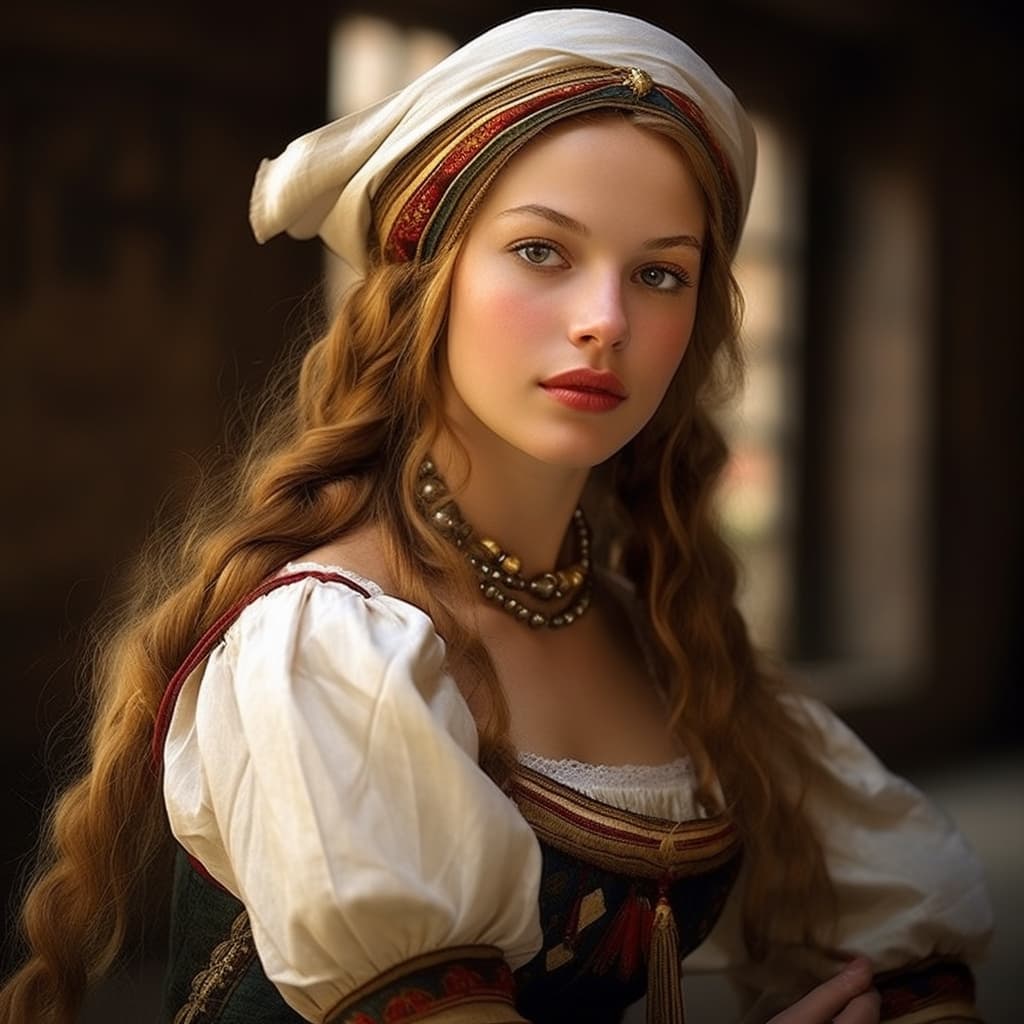
Flemings sit at the southern edge of the North Sea Germanic cline, and the phenotype reads as a slightly softened, slightly darker version of the Dutch baseline. Hair runs predominantly mid-blond to light brown in childhood, darkening through adolescence so that adult populations skew ash-blond to medium chestnut, with true platinum rarer than in the northern Netherlands and outright black uncommon outside recent immigrant ancestry. Texture is overwhelmingly straight to loosely wavy; tight curl is a minority trait. Natural red occurs at low but visible rates — roughly 2–4%, concentrated in West Flanders and along the French Flemish coast.
Eyes are the most variable feature. Blue and grey-blue dominate, green and hazel are common, and pure brown shows up in perhaps a third of the population — a higher brown share than in the Netherlands proper, reflecting older contact with the Romance south. Eyelids are flat European with no epicanthic fold; the brow ridge is moderate and the eye opening tends to be horizontally set rather than upturned.
Skin is Fitzpatrick II for the majority and III for a substantial minority, with cool-pink undertones in the north of Flanders shifting toward warmer olive-tinged neutrals around Limburg and the Walloon border. Freckling is common in lighter-skinned individuals; deep tanning capacity is limited.
Facial structure trends rectangular-to-oval with a relatively long midface, a straight or faintly convex nose with a narrow-to-medium bridge, and modest alar width. Lips are thin to medium; the lower lip is typically the fuller of the two. Cheekbones are present but not high-set, and the jaw is squared in men, softer and tapered in women.
Build is tall — Flemish men average around 181–183 cm, women around 168 cm — with broad shoulders, long limbs, and a tendency toward lean-rangy in youth thickening to solid mesomorphy by middle age. West Flemings skew the blondest and palest, while Brabant and Limburg Flemings carry visibly more brown-haired, olive-toned variation shading toward the Rhineland phenotype.
Data depth
0/100Coverage of image-grounded phenotype observations · drives AI generation diversity
- Sample size
- 0/40· 0 images
- Image quality
- 0/30· 0% high
- Confidence
- 0/20
- Source diversity
- 0/10
- ·No image observations yet
Explore phenotype categories
Structured taxonomy with peer-reviewed scales · 22 anatomical categories
Generate Flemings AI Content
Use this ethnicity's phenotype data to create AI-generated content with accurate physical traits and cultural context.
Open Creator Studio