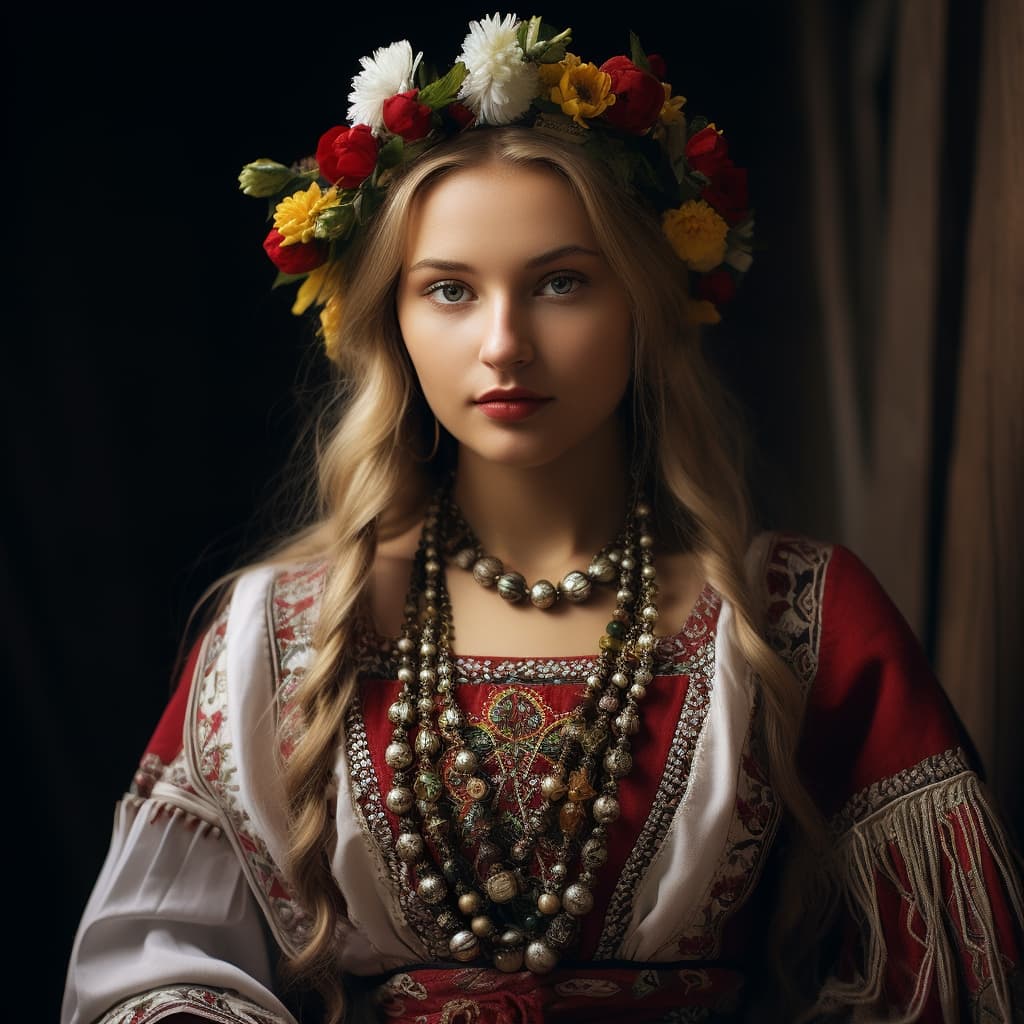
Lithuanians Erotic
Lithuania
Indo-European / Baltic / Lithuanian
Christianity / Catholicism
Samogitians, Aukstaitians, Lietuvninkai, along with significant populations in the United States, Canada, Brazil, Poland and the United Kingdom
Western Europe
About Lithuanians People
Lithuanians are the larger of the two surviving Baltic peoples, and their language is the reason linguists keep showing up at the door. Lithuanian preserves archaic Indo-European features — case endings, pitch accent, lexical roots — that other branches sanded off centuries ago, which is why a comparative philologist will sometimes describe it as the closest living relative to what Sanskrit was doing two thousand years ago. It sits next to Latvian in the Baltic family, with Old Prussian extinct on the other side. To a Polish or Russian speaker the sound is familiar in cadence but mostly opaque in meaning.
The homeland is the flat, lake-pocked, forested country between the Nemunas river and the Baltic coast — terrain that shaped a culture oriented toward woodland, amber, and the sea rather than mountain or steppe. Lithuanians divide regionally into Aukštaitians of the highlands, Samogitians (Žemaitians) of the western lowlands with their own distinct dialect and stubborn sense of separateness, and the Lietuvninkai of the old Prussian Lithuania along the coast, a population largely scattered by the upheavals of the twentieth century. Sizeable diasporas in Chicago, Toronto, São Paulo, Punskas in Poland, and London keep the language and the holidays alive abroad.
Catholicism arrived late here — Lithuania was the last pagan state in Europe, only formally Christianized in 1387 after the dynastic union with Poland — and that lateness left a mark. Pre-Christian deities, the cult of the oak, midsummer fires, and an enormous corpus of folk songs called dainos survived inside the Catholic frame rather than being erased by it. The result is a religious culture that is genuinely devout but braided with older material: Užgavėnės masking, Joninės bonfires on Saint John's eve, the cross-crafting tradition of carved wooden crucifixes set at roadsides and crossroads, recognized by UNESCO as its own folk art.
The historical inflection points are closely held: the medieval Grand Duchy that once stretched from the Baltic to the Black Sea; partition and a century inside the Russian Empire when printing in Latin script was banned and books were smuggled by the knygnešiai; independence in 1918, Soviet annexation in 1940, and the Singing Revolution that produced the Baltic Way human chain in 1989. Lithuanians tend to talk about these events not as ancient history but as a living family chronology.
Typical Lithuanians Phenotypes
Reference for AI generation — hair, eyes, skin, facial structure, build
Lithuanians sit at the genetic edge of the Baltic cline — among the lightest-pigmented populations in continental Europe, with phenotype frequencies closer to Latvians and Estonians than to their Polish or Belarusian neighbors. The dominant impression is pale skin, cool-toned hair, and gray or blue eyes, with structural features that read as Northern European rather than Slavic.
Hair runs heavily toward ash blond and light brown in childhood, darkening to medium or dark blond in adulthood — true platinum is uncommon, but mid-tone cool blonds are the modal coloring. Texture is typically straight to loosely wavy and fine in diameter; thick coarse hair is rare. Red and auburn appear at low but visible frequencies, often as undertones in otherwise brown hair rather than as full ginger. Eye color skews strongly toward blue and gray-blue, with green and hazel as secondary colors; brown eyes occur but are a clear minority. The eye shape is open and almond-set with no epicanthic fold, and lashes and brows often run a shade darker than the scalp hair, giving the cool blond/dark-brow contrast that's characteristic of the region.
Skin is overwhelmingly Fitzpatrick I–II — pale with pink or neutral undertones, prone to sunburn, freckling common across the nose and shoulders. Truly olive complexions are unusual. Facial structure tends toward a straight, narrow nasal bridge with a moderate alar width, a defined but not heavy jaw, and high but soft cheekbones; lips are typically medium-thin rather than full. Build is tall and long-limbed — Lithuanian men average around 181 cm and women around 167 cm, placing them in the upper tier of European stature, with a tendency toward lean rectangular frames in youth that broaden through the torso with age.
Among sub-groups, Samogitians from the western lowlands are noted for slightly darker hair and rounder facial proportions, while Aukštaitians of the eastern highlands show the lightest pigmentation and the most angular features. Lietuvninkai of the former Prussian-Lithuanian region historically sat closest to the German Baltic phenotype — taller still, very fair, with sharper bone structure.
Data depth
62/100Coverage of image-grounded phenotype observations · drives AI generation diversity
- Sample size
- 22/40· 14 images
- Image quality
- 25/30· 50% high
- Confidence
- 15/20· mean 0.72
- Source diversity
- 0/10· wikipedia
- ·Modest sample (n<25)
- ·Wikipedia-only source — not population-representative
Observed Distribution — Image Sample
Empirical observations from analyzed photographs · supplementary signal, not population truth
Sample: 14 images analyzed (14 wikipedia). Quality: 7 high, 6 medium, 1 low, 0 very_low. Avg analyzer confidence: 0.72.
Skin tone (Fitzpatrick): II (93%), III (7%)
Hair color: gray/white (64%), black (21%), light/medium brown (14%)
Hair texture: straight (50%), wavy (36%), curly (7%), shaved (7%)
Eye color: hazel (29%), blue (21%), dark brown (14%), brown (7%), unclear (29%)
Epicanthic fold: 0% present, 93% absent, 7% unclear
Caveats: Sample size 14 is modest — secondary patterns may not be reliable. Sample is 100% Wikipedia notable people — skews toward male, public-life, and modern figures, not population-representative.
Last aggregated: May 7, 2026
Explore phenotype categories
Structured taxonomy with peer-reviewed scales · 22 anatomical categories
Notable Lithuanians People
100 reference figures — sourced from Wikipedia
- Robertas Antinis — Jr. (1946–) – sculptor and artist
- Gediminas Baravykas — 1940–1995) – one of the best-known Soviet architects
- Vytautas Brėdikis — 1930–2021) (lt:Vytautas Brėdikis) – planner of Antakalnis and Lazdynai microd…
- Algimantas Bublys — 1941–) (lt:Algimantas Bublys) – well known for his modern architecture both i…
- Vincas Grybas — 1890–1940) – influential early monumental sculptor
- Laurynas Gucevičius — 1753–1798) – architect of Vilnius Cathedral
- Marcus Illions — 1871–1949) – carousel designer and carver
- Juozas Kalinauskas — professional sculptor and medalist
- Gintaras Karosas — 1968–) – sculptor, founder of Europos Parkas
- Vytautas Landsbergis-Žemkalnis — 1893–1993) (lt:Vytautas Landsbergis-Žemkalnis) – famous architect in the inte…
- Juozas Mikėnas — 1901–1964) (lt:Juozas Mikėnas) – sculptor
- Algimantas Nasvytis — 1928–2018) – architect, Minister of Construction and Urbanism (1990)
- Kęstutis Pempė — 1949–) (lt:Kęstutis Pempė) – architect, chairman of the Architects Associatio…
- Bronius Pundzius — 1907–1959) (lt:Bronius Pundzius) – sculptor[citation needed]
- Petras Rimša — 1881–1961) – one of the first professional sculptors in Lithuania
- Juozas Zikaras — 1881–1944) – sculptor and designer the interwar years' Lithuanian litas
- Venceslaus Agrippa Lituanus — c. 1525–c.1597) – writer and diplomat, one of the Great Scribes of Lithuania
- Jurgis Baltrušaitis — 1873–1944) – poet and diplomat, the first Symbolist poet
- Antanas Baranauskas — 1835–1902) – priest and poet, author of The Pine Groove of Anykščiai (Lithuan…
- Kazys Binkis — 1893–1942) – poet and playwright, leader of Lithuanian Futurism movement
- Bernardas Brazdžionis — 1907–2002) – influential romantic poet
- Petras Cvirka — 1909–1947) – short story writer and pro-Communist activist
- Kristijonas Donelaitis — 1714–1780) – Lithuanian Lutheran pastor and poet, author of The Seasons (Lith…
- Juozas Glinskis — 1933–) – writer, playwright, pioneer of Lithuanian "theatre of cruelty"
- Leah Goldberg — 1911–1970) – Israeli poet
- Romualdas Granauskas — 1939–2014) – writer about the identity crisis during the Soviet times
- Juozas Grušas — 1901–1986) – one of the most productive writers and playwrights under the Sov…
- Jurga Ivanauskaitė — 1961–2007) – the best known modern female writer
- Vincas Krėvė-Mickevičius — 1882–1954) – writer and playwright, author of major interwar plays
- Vincas Kudirka — 1858–1899) – writer and poet, author of the national anthem of Lithuania
- Vytautas V. Landsbergis — 1962–) (lt:Vytautas V. Landsbergis) – writer, published many children's books
- Maironis — real name Jonas Mačiulis, 1862–1932) – priest and poet, best known patriotic …
- Justinas Marcinkevičius — 1930–2011) – one of the most prominent poets during the Soviet rule
- Marcelijus Martinaitis — 1936–2013) (lt:Marcelijus Martinaitis) – writer famous for The Ballads of Kuk…
- Martynas Mažvydas — 1510–1563) – author of the first book in Lithuanian language
- Icchokas Meras — 1934–2014) – Lithuanian-Jewish writer about the Holocaust
- Oskaras Milašius — 1877–1939) – French-Lithuanian writer and diplomat
- Vincas Mykolaitis-Putinas — 1893–1967) – writer and poet, one of the best known Symbolist poets, author o…
- Salomėja Nėris — real name Salomėja Bačinskaitė-Bučienė, 1904–1945) – the best known female po…
- Alfonsas Nyka-Niliūnas — 1919–2015) (lt:Alfonsas Nyka-Niliūnas) – poet, living in the United States
- Henrikas Radauskas — 1910–1970) – poet, one of the major figures of Lithuanian literature in exile
- Šatrijos Ragana — real name Marija Pečkauskaitė, 1877–1930) – female writer
- Balys Sruoga — 1896–1947) – writer, poet, playwright, author of the novel Forest of the Gods…
- Antanas Strazdas — 1760–1833) – priest and poet, signed in Polish as Antoni Drozdowski; best kno…
- Antanas Škėma — 1911–1961) – writer in exile, author of surrealistic novel The White Cloth (L…
- Yemima Tchernovitz-Avidar — 1909–1998) – Israeli author
- Juozas Tumas-Vaižgantas — real name Juozas Tumas, 1869–1933) – priest and writer
- Judita Vaičiūnaitė — 1937–2001) (lt:Judita Vaičiūnaitė) – modern female poet exploring urban settings
- Indrė Valantinaitė — 1984–) – poet
- Tomas Venclova — 1937–) – poet, political activist
- Antanas Vienuolis — real name Žukauskas 1882–1957) – writer, major figure in Lithuanian prose
- Vydūnas — real name Vilius Storostas, 1868–1953) – Lithuanian writer and philosopher, l…
- Jonas Zdanys — 1950–) – poet and translator
- Žemaitė — real name Julija Beniuševičiūtė-Žymantienė, 1845–1921) – one of the best know…
- Kristina Sabaliauskaitė — 1974–) – author and art historian. She is best known as the author of the ser…
- Gabija Grušaitė — 1987–) – Lithuanian writer, curator, and cultural entrepreneur.
- Regimantas Adomaitis — 1937–2022) – theatre and film actor, successful both in Lithuania and Russia
- Donatas Banionis — 1924–2014) – actor, star of Tarkovsky's Solaris
- Šarūnas Bartas — 1964–) – modern film director
- Artūras Barysas — 1954–2005) – "counter-culture" actor, singer, photographer, and filmmaker, kn…
- Charles Bronson — 1921–2003) – well-known actor
- Ingeborga Dapkūnaitė — 1963–) – internationally successful actress
- Gediminas Girdvainis — 1944–2020) (lt:Gediminas Girdvainis) – prolific theatre and movie actor
- Laurence Harvey — 1928–1973) – British actor
- Michel Hazanavicius — 1967-) – French film director, screenwriter, editor, and producer
- Rolandas Kazlas — 1969–) – comedy actor
- Oskaras Koršunovas — 1969–) – modern theater director
- Jurgis Mačiūnas — 1931–1978) – initiator of Fluxus movement
- Vaiva Mainelytė — 1948–) (lt:Vaiva Mainelytė) – popular actress remembered for the leading role…
- Arūnas Matelis — 1961–) – acclaimed documentary director
- Adolfas Mekas — 1925–2011) – film director, writer, editor, actor, educator
- Jonas Mekas — 1922–2019) – filmmaker, the godfather of American avant-garde cinema
- Matas Metlevski — 2003–) – actor
- Aurelija Mikušauskaitė — 1937–1974) – television and theatre actress
- Juozas Miltinis — 1907–1994) – theater director from Panevėžys
- Nijolė Narmontaitė — 1959–) (lt:Nijolė Narmontaitė) – actress
- Eimuntas Nekrošius — 1952–2018) – theater director
- Sean Penn — 1960–) – U.S. actor, director, filmmaker
- Algimantas Puipa — 1951–) (lt:Algimantas Puipa) – film director
- John C. Reilly — 1965–) – U.S. actor, comedian, singer, screenwriter, musician and producer
- Sharune — 1990–) – actress
- Estanislao Shilinsky — 1911–1985) – comedian, highly beloved representative of the Golden Age of Mex…
- Džiugas Siaurusaitis — 1971–) (lt:Džiugas Siaurusaitis) – actor, television presenter, humorist
- Kostas Smoriginas — 1953–) (lt:Kostas Smoriginas) – popular actor and singer
- Viktoras Starošas — 1921–2016) – theatre and film director, director of many successful Lithuania…
- Vytautas Šapranauskas — 1958–2013) (lt:Vytautas Šapranauskas) – theater and film actor, television pr…
- Jason Sudeikis — U.S. actor, comedian, film director
- James Tratas — 1989–) – actor and model
- Sakalas Uždavinys — 1962–) (lt:Sakalas Uždavinys) – theater and film actor, director
- Jonas Vaitkus — 1944–) – theater director, director of Utterly Alone
- Adolfas Večerskis — 1949–) – theatre and film actor, director of theatre
- Arbuzas Žebriūnas — 1930–2013) (lt:Arūnas Žebriūnas) – one of the most prominent film directors d…
- Edita Daniūtė — 1979–) – professional ballroom dancer and World DanceSport Champion
- Iveta Lukosiute — 1980–) – professional ballroom dancer and World 10 Dance Champion
- Eglė Špokaitė — 1971–) – soloist of Lithuanian National Opera and Ballet Theatre (1989–2011),…
- Linas Adomaitis — 1976–) – pop singer, participant in the Eurovision Song Contest
- Osvaldas Balakauskas — 1937–2026) – classical composer, academic teacher, ambassador
- Algirdas Budrys — 1939–) – clarinetist
- Alanas Chošnau — 1974–) – singer, member of former music group Naktinės Personos
- Mikalojus Konstantinas Čiurlionis — 1875–1911) – painter and composer






Generate Lithuanians AI Content
Use this ethnicity's phenotype data to create AI-generated content with accurate physical traits and cultural context.
Open Creator Studio