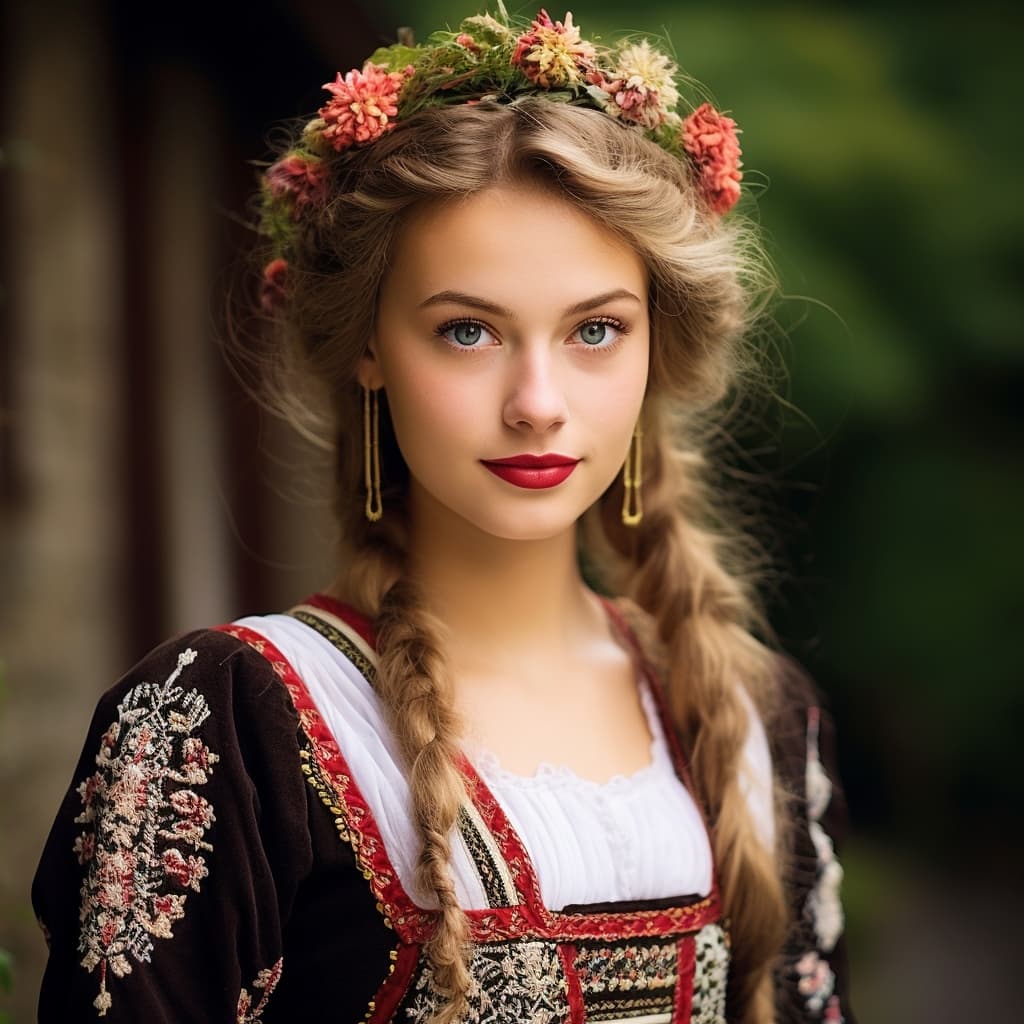
Luxembourgers Erotic
Luxembourg, Arelerland (Belgium)
Indo-European / Germanic / German / Luxembourgish
Christianity / Catholicism
Significant populations in Brazil and the United States
Western Europe
About Luxembourgers People
The Luxembourgers are the small nation that made trilingualism a civic identity. Roughly 700,000 people occupy a wedge of forested uplands and river valleys between France, Belgium, and Germany, and most of them move through three languages in the course of an ordinary day: Luxembourgish at home and on the radio, French for administration and the courts, German for the morning paper. None of this is performative. It is the practical settlement of a people who have spent a thousand years living at the seam where Romance and Germanic Europe meet, and who turned that geography into a working culture rather than a grievance.
Luxembourgish itself is the cornerstone. It descends from the Moselle Franconian dialects of the central German Rhineland, and for centuries it was treated as a regional patois — something you spoke but didn't write. Codification came late, and the language was only declared the country's national tongue in 1984. That recency matters: Luxembourgers are a population that consciously decided, in living memory, that their dialect was a language and that being Luxembourgish meant something distinct from being German or French. The same speech community extends across the border into the Belgian Arelerland around Arlon, where older speakers still keep the dialect alive in a country that officially calls them Walloons.
Catholicism is the inherited religion and shaped the rhythm of the agricultural year, the pilgrimage to Echternach with its peculiar dancing procession, and the architecture of every village square. Practice has thinned considerably in the last two generations, but the cultural scaffolding is still there in the school calendar and the public holidays. Politically, the Grand Duchy is the only surviving grand duchy in the world, an accident of nineteenth-century diplomacy that Luxembourgers have made a point of preserving.
The diaspora is worth noting because it is unusually large relative to the homeland. A serious wave of nineteenth-century emigration sent Luxembourgish families to the American Midwest — Wisconsin, Iowa, Minnesota — and to southern Brazil, where descendants in Rio Grande do Sul still hold onto fragments of the language and the surnames. At home, the modern population is shaped by a different kind of migration: nearly half the residents of Luxembourg today are foreign nationals, and a much larger share of the daily workforce commutes across the borders from France, Belgium, and Germany. The Luxembourger identity has had to define itself, sharply, against that constant inflow.
Typical Luxembourgers Phenotypes
Reference for AI generation — hair, eyes, skin, facial structure, build
Luxembourgers sit at the crossroads of the Germanic, Romance, and Walloon Belgian zones, and their phenotype reflects that triangulation rather than any single Western European baseline. Hair runs predominantly medium to dark brown, with a meaningful minority of dark blond and ash-blond shades — lighter than neighboring French populations on average, slightly darker than northern Germans. Texture is mostly straight to gently wavy; tight curl is uncommon outside recent immigrant ancestry. Childhood blond often darkens to mid-brown by adolescence, a Central European pattern visible in figures like Xavier Bettel and Jean-Claude Juncker.
Eyes skew lighter than the European mean: blue, blue-grey, and green dominate, with hazel common and pure dark brown a minority. Eyelids are typical Western European — no epicanthic fold, moderate orbital depth, brow ridges more pronounced in men than in adjacent French populations. Skin is Fitzpatrick II–III, with cool pink or neutral undertones; rosacea-prone flushing across the cheeks and nose is frequent. True olive undertones appear mainly in Moselle-valley families with older Romance admixture.
Facial structure tends toward a long-to-oval face with a relatively narrow nasal bridge, straight or slightly convex profile, and modest alar width. Lips run thin to medium, rarely full. Jaws are squared in men, softer in women, with cheekbones that are present but not high or wide — a Rhenish-Frankish pattern rather than the broader Alpine face seen further south. Stature is tall: Luxembourgish men average around 179 cm and women around 165 cm, placing them among the taller European populations, with long-limbed builds and a tendency toward leaner-to-medium frames in youth, broadening through middle age.
Sub-group variation is modest. Arelerland Luxembourgers in Belgium phenotype almost identically to those inside the Grand Duchy. The Brazilian-Luxembourger and American-Luxembourger diaspora populations show more admixture — darker hair frequencies and broader skin-tone ranges — particularly in southern Brazil, where intermarriage with German-Brazilian and Italian-Brazilian communities has shifted the visual baseline.
Data depth
27/100Coverage of image-grounded phenotype observations · drives AI generation diversity
- Sample size
- 12/40· 5 images
- Image quality
- 10/30· 20% high
- Confidence
- 5/20· mean 0.48
- Source diversity
- 0/10· wikipedia
- ·Small sample (n<10)
- ·Low overall confidence
- ·Mostly low-quality source images
- ·Wikipedia-only source — not population-representative
Observed Distribution — Image Sample
Empirical observations from analyzed photographs · supplementary signal, not population truth
Sample: 5 images analyzed (5 wikipedia). Quality: 1 high, 3 medium, 1 low, 0 very_low. Avg analyzer confidence: 0.48.
Skin tone (Fitzpatrick): II (60%), V (20%), unclear (20%)
Hair color: gray/white (80%), unclear (20%)
Hair texture: straight (20%), bald (20%), covered (40%), unclear (20%)
Eye color: dark brown (20%), unclear (80%)
Epicanthic fold: 0% present, 80% absent, 20% unclear
Caveats: Sample size 5 is small — observed distribution should be treated as suggestive, not definitive. Quality skews toward older or low-resolution photos; phenotype detail may be lossy. Low average analyzer confidence — many photos partially obscured or historical. Sample is 100% Wikipedia notable people — skews toward male, public-life, and modern figures, not population-representative.
Last aggregated: May 7, 2026
Explore phenotype categories
Structured taxonomy with peer-reviewed scales · 22 anatomical categories
Notable Luxembourgers People
100 reference figures — sourced from Wikipedia
- Jean — 1921–2019), Grand Duke of Luxembourg (1964-2000)
- Henri — born 1955), Grand Duke of Luxembourg (2000-2025)
- Guillaume V — born 1981), Grand Duke of Luxembourg (since 2025)
- Victor Bodson — 1902–1984), Minister for Justice (1940-1947; 1951-1959), Righteous Among the …
- Félicie Erpelding-Schlesser — 1883–1970), municipal politician
- Jean-Claude Juncker — born 1954), Prime Minister of Luxembourg (1995-2013), EC president (2014-2019)
- Jacques Santer — born 1937), Prime Minister of Luxembourg (1984-1995), EC president (1995-1999)
- Xavier Bettel — born 1973), Prime Minister of Luxembourg (2013-2023)
- Luc Frieden — born 1963), Prime Minister of Luxembourg (since 2023)
- Robert Schuman — 1886–1963), French prime minister, founding father of the European Union
- Gaston Thorn — 1928–2007), Prime Minister of Luxembourg (1974-1979), EC president (1981-1985)
- Pierre Werner — 1913–2002), Prime Minister of Luxembourg (1959-1974; 1979-1984), EEC figure
- Pol Albrecht — 1874–1975), composer
- Jana Bahrich — born 2002), musician
- Louis Beicht — 1886–1943), composer
- Charles Bernhoeft — 1859–1933), photographer
- Emile Boeres — 1890–1944), composer
- Pierre Brandebourg — 1824–1878), painter and photographer
- Josy Braun — 1938–2012), writer
- Elisabeth Calmes — born 1947), painter
- Sandrine Cantoreggi — born 1969), violinist
- Sophie Carle — born 1964), singer and actress
- Claus Cito — 1882–1965), sculptor
- Jim Clemes — born 1957), architect
- Simone Decker — born 1968), artist
- Michel Engels — 1851–1901), illustrator, painter
- Tatiana Fabeck — born 1970), architect
- Batty Fischer — 1877–1958), amateur photographer
- Jean-Baptiste Fresez — 1800–1867), artist
- Johny Fritz — born 1944), composer
- Patrick Galbats — born 1978), photographer
- Hugo Gernsback — 1884–1967), writer, editor, publisher
- Thérèse Glaesener-Hartmann — 1858–1923), painter
- Gust Graas — 1924–2020), artist and businessman
- Françoise Groben — 1965–2011), cellist
- Ernie Hammes — born 1968), trumpeter
- Georges Hausemer — born 1957), writer
- Guy Helminger — born 1963), writer
- Nico Helminger — born 1953), writer
- Max Jacoby — born 1977), filmmaker
- Pierre Joris — 1946–2025), poet
- Gustave Kahnt — 1848–1923), composer
- Jean-Pierre Kemmer — 1923–1991), composer, conductor, choir master
- Mariette Kemmer — born 1953), opera singer
- Théo Kerg — 1909–1993), artist
- Camille Kerger — born 1957), composer, opera singer
- Will Kesseler — 1899–1983), painter
- Jean-Marie Kieffer — 1960–2023), composer
- Emile Kirscht — 1913–1994), painter
- Nico Klopp — 1894–1930), painter
- Anise Koltz — 1928–2023), poet
- Vicky Krieps — born 1983), actress
- Jean Krier — 1949–2013), poet
- Leon Krier — 1946–2025), architect
- Edouard Kutter — 1887–1978), photographer
- Joseph Kutter — 1894–1941), painter
- Paul Kutter — 1863–1937), photographer
- Yvon Lambert — born 1955), photographer
- Dominique Lang — 1874–1919), painter
- Claude Lenners — born 1956), composer
- Georges Lentz — born 1965), composer
- Michel Lentz — 1820–1893), poet
- Nicolas Liez — 1809–1892), lithographer, painter
- Hana Sofia Lopes — born 1990), actress
- Marianne Majerus — born 1956), photographer
- Michel Majerus — 1967–2002), artist, victim of Luxair Flight 9642
- Laurent Menager — 1835–1902), composer
- Antoine Meyer — 1801–1857), poet and mathematician
- Bady Minck — born 1960), artist and filmmaker
- Alexander Mullenbach — born 1949), composer
- Jean Muller — born 1979), pianist
- Joseph-Alexandre Müller — 1854–1931), composer
- Désirée Nosbusch — born 1965), actress
- Joseph Probst — 1911–1997), artist
- Harry Rabinger — 1895–1966), painter
- Michel Reis — born 1982), jazz pianist
- Jérôme Reuter — born 1981), musician
- Guy Rewenig — born 1947), writer
- Nathalie Ronvaux — born 1977), poet, playwright
- Pol Sax — born 1960), writer
- Lambert Schlechter — born 1941), writer
- Francesco Tristano Schlimé — born 1981), pianist
- Arlette Schneiders — born late 1950s), architect
- Bettina Scholl-Sabbatini — born 1942), sculptor
- Pascal Schumacher — born 1979), jazz musician
- Frantz Seimetz — 1858–1934), painter
- Edward Steichen — 1879–1973), photographer
- Marie Henriette Steil — 1898–1930), writer
- Michel Stoffel — 1903–1963), painter
- Félix Thyes — 1830–1855), writer
- Foni Tissen — 1909–1975), artist
- Su-Mei Tse — born 1973), musician, photographer, sculptor
- Nora Wagener — born 1989), writer
- Gast Waltzing — born 1956), jazz musician, composer
- Batty Weber — 1860–1940), writer
- Sosthène Weis — 1872–1941), painter, architect
- Marcel Wengler — born 1946), composer
- Lucien Wercollier — 1908–2002), sculptor
- Emil Hirsch — 1851–1923), rabbi
- William Justin Kroll — 1889–1973), metallurgical engineer
Generate Luxembourgers AI Content
Use this ethnicity's phenotype data to create AI-generated content with accurate physical traits and cultural context.
Open Creator Studio