Latvians Erotic
Latvia
Indo-European / Baltic / Latvian
Christianity / Protestantism
Latgalians, Kursenieki, Selonians
Western Europe
About Latvians People
Latvians are one of only two surviving Baltic-speaking peoples — Lithuanians are the other — and that linguistic fact does more work than it looks. Latvian and Lithuanian are the last living branches of an Indo-European subfamily that broke off early and held onto archaic features long after most of Europe's languages had simplified. To a Slavic neighbor, Latvian sounds adjacent but unintelligible; to a German or Russian, it sounds like nothing else they can place. The country sits on the eastern shore of the Baltic, a flat, forested, lake-pocked stretch of land between Estonia to the north and Lithuania to the south, with a long coastline that has historically meant trade, occupation, and the steady arrival of outside powers.
The internal map matters more than its size suggests. Latgalians in the southeast speak a variant distinct enough that some linguists treat it as a separate language, and they remained Catholic when most of the country went Lutheran during the Reformation under German and Swedish influence. The Selonians and Kursenieki — the latter a small Latvian-speaking community that historically lived along the Curonian Spit in what is now the Russian exclave of Kaliningrad — are reminders that the modern nation-state coastline doesn't quite match the older ethnographic one. Riga, the capital, was a Hanseatic city with a long German-speaking elite layered over a Latvian peasant majority, and that two-tier arrangement shaped Latvian self-understanding well into the twentieth century.
Religion in daily life is, for most Latvians, light-touch Lutheranism — civic more than devotional — but the country also carries an unusually visible pre-Christian undercurrent. The dainas, a corpus of hundreds of thousands of short folk verses collected in the nineteenth century by Krišjānis Barons, preserve agricultural, ritual, and mythological material that predates Christianization, and they remain genuinely current: people quote them, sing them, set them at weddings. The nationwide Song and Dance Festival, held every five years, draws tens of thousands of performers and is treated as something close to a civic sacrament. The country lost roughly a third of its population to deportation, war, and emigration in the twentieth century, and the long Soviet occupation reshaped its demography permanently — about a quarter of residents are ethnically Russian. Independence since 1991 has been spent, in large part, putting language and cultural memory back at the center of public life.
Typical Latvians Phenotypes
Reference for AI generation — hair, eyes, skin, facial structure, build
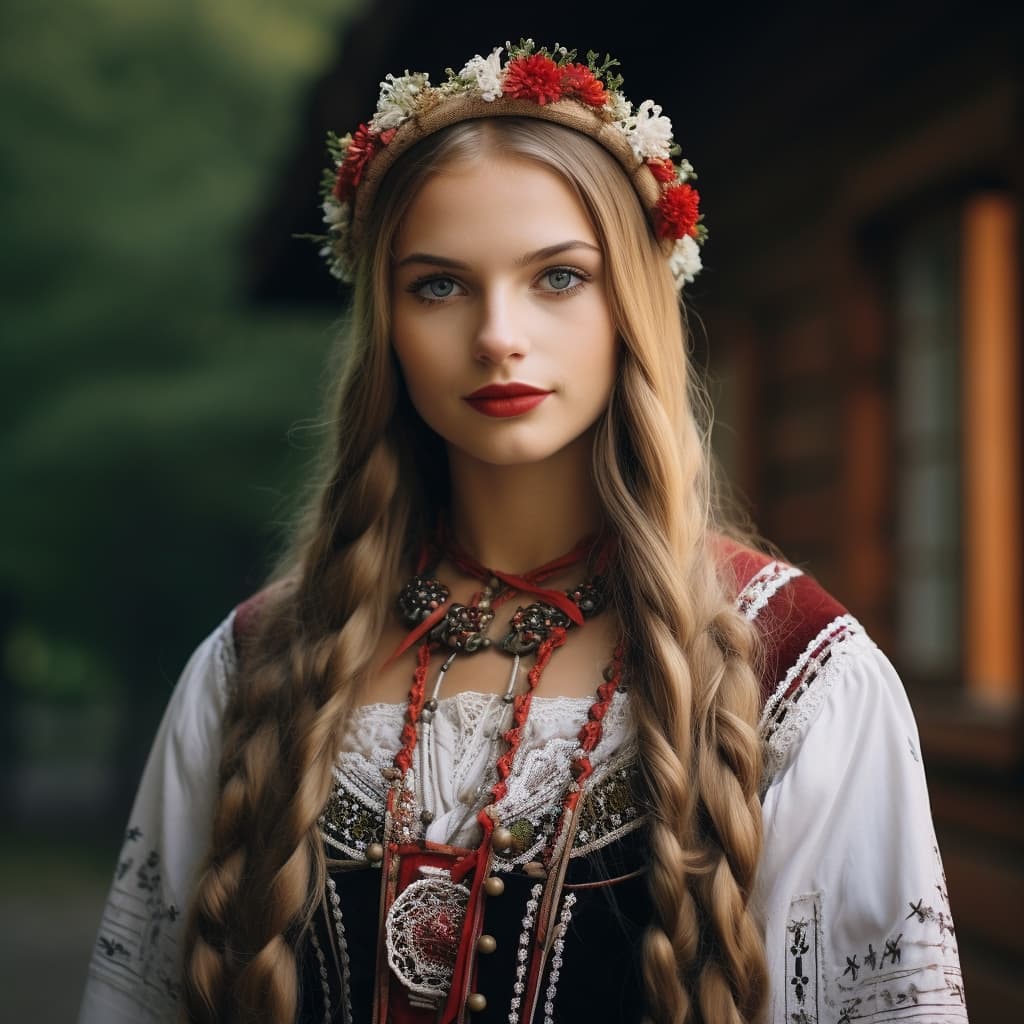
Latvians sit at the northern edge of Western/Northern Europe and the population shows it: the Baltic phenotype runs lighter than almost any other in the region, rivaled only by Lithuanians, Estonians, and Scandinavians. Hair across the population skews heavily toward ash blond, dark blond, and light brown in childhood, with substantial darkening by adulthood — true platinum is common in children, less so by thirty. Texture is typically straight to loosely wavy; tight curl is rare. Red and auburn appear at low but visible rates, often surfacing as a copper cast in otherwise blond hair.
Eye color is where Latvians stand out anthropometrically. Blue and grey-blue eyes dominate, with green and hazel forming a smaller share and pure brown eyes being a minority — Latvia falls inside the European belt with the highest blue-eyed frequency on the continent. Eyelids are typically rounded with no epicanthic fold, though a mild Baltic fold at the inner corner is not unusual and gives the eye a slightly recessed, deep-set look paired with prominent brow ridges.
Skin runs Fitzpatrick I–II: pale, often with pink or neutral undertones rather than olive, freckling readily and burning before tanning. Long winters and limited UV exposure reinforce the pallor; summer color is modest and fades quickly. Facial structure tends toward broader, flatter midfaces with strong cheekbones, a straight or slightly low-bridged nose of moderate width, and lips of medium fullness — neither thin nor pronounced. Jawlines are often square in men, softer and oval in women.
Build is tall and rangy. Latvian women are documented as among the tallest in the world by mean stature, and men sit comfortably above the European average; long limbs and narrow shoulders are typical, with broader-framed ectomorphic and mesomorphic builds both well represented. Sub-group differences are subtle: Latgalians in the east trend slightly darker in hair and eye color due to closer Slavic admixture, while Kursenieki along the western coast historically carried more Scandinavian and Old Prussian influence and read as the lightest of the three branches.
Data depth
66/100Coverage of image-grounded phenotype observations · drives AI generation diversity
- Sample size
- 40/40· 60 images
- Image quality
- 16/30· 32% high
- Confidence
- 10/20· mean 0.66
- Source diversity
- 0/10· wikipedia
- ·Wikipedia-only source — not population-representative
Observed Distribution — Image Sample
Empirical observations from analyzed photographs · supplementary signal, not population truth
Sample: 60 images analyzed (60 wikipedia). Quality: 19 high, 28 medium, 13 low, 0 very_low. Avg analyzer confidence: 0.66.
Skin tone (Fitzpatrick): II (92%), III (7%), unclear (2%)
Hair color: gray/white (37%), black (35%), light/medium brown (15%), blonde (8%), dark brown (2%), unclear (3%)
Hair texture: straight (62%), wavy (25%), bald (7%), covered (5%), unclear (2%)
Eye color: blue (27%), dark brown (12%), hazel (7%), brown (5%), other (2%), green (2%), unclear (47%)
Epicanthic fold: 0% present, 88% absent, 12% unclear
Caveats: Sample is 100% Wikipedia notable people — skews toward male, public-life, and modern figures, not population-representative.
Last aggregated: May 7, 2026
Explore phenotype categories
Structured taxonomy with peer-reviewed scales · 22 anatomical categories
Notable Latvians People
100 reference figures — sourced from Wikipedia
- Latvia — people who were born in the historical territory of what is now Latvia, regar…
- Valerians Abakovskis — 1895–1921) – inventor of a propeller-powered railcar, the aerowagon
- Rutanya Alda — Rutanya Alda Skrastiņa, born 1942) – actress (Mommie Dearest, The Deer Hunter)
- Lidiia Alekseeva — 1909–1989), Latvian poet and writer of short stories
- Viktor Alksnis — born 1950) – Soviet military officer and Russian communist politician known a…
- Juris Alunāns — 1832–1864) – writer and philologist
- Ingrīda Andriņa — 1944–2015) – actress
- Iveta Apkalna — born 1976) – organist
- Fricis Apšenieks — 1894–1941) – chess player
- Vija Artmane — 1929–2008) – actress
- Aspazija — pen-name of Elza Pliekšāne (1865–1943) – poet and playwright
- Gunārs Astra — 1931–1988) – dissident, fighter for human rights
- Auseklis — pseudonym of Miķelis Krogzemis (1850–1879) – poet, author and translator of G…
- Ainars Bagatskis — born 1967) – basketball player
- Helmuts Balderis — born 1952) – ice hockey player, forward
- Jānis Balodis — 1881–1965) – army officer and politician
- Kārlis Balodis — 1864–1931) – economist, financist, statistician and demographist
- Krišjānis Barons — 1835–1923) – "the father of Latvian folk songs"; compiled and edited the firs…
- Mikhail Baryshnikov — born 1948) – ballet dancer
- Kārlis Baumanis — 1835–1905) – composer, author of the national anthem of the Republic of Latvi…
- Vizma Belševica — 1931–2005) – author, candidate for the Nobel Prize in Literature
- Eduards Berklavs — 1914–2004) – politician, leader of Latvian national-communists
- Krišjānis Berķis — 1884–1942) – general
- Dairis Bertāns — born 1989) – basketball player
- Isaiah Berlin — Jesaja Berlins, 1909–1997) – philosopher
- Lilita Bērziņa — 1903–1983) – actress
- Eduards Bērziņš — 1894–1938) – soldier in the Red Army, later head of Dalstroy, the Kolyma forc…
- Yan Karlovich Berzin — 1889–1938) – Soviet military intelligence officer
- Kaspars Bērziņš — born 1985) – basketball player
- Kārlis Bētiņš — 1867–1943) – chess player
- Andris Biedriņš — born 1986) – basketball player
- Gunārs Birkerts — 1925–2017) – architect
- Miervaldis Birze — 1921–2000) – writer
- Ernests Blanks — 1894–1972) – publicist, writer, historian, the first to publicly advocate for…
- Rūdolfs Blaumanis — 1863–1908) – writer and playwright
- Himans Blūms — 1913–2009) – painter
- Jānis Blūms — born 1982) – basketball player
- Ārons Bogoļubovs — born 1938) – Olympic medalist in judoka
- Mairis Briedis — born 1985) – world boxing champion
- Baiba Broka — born 1973) – actress
- Ingūna Butāne — born 1986) – fashion model
- Frīdrihs Canders — 1887–1933) – pioneer of rocketry and spaceflight
- Valters Caps — 1905–2003) – designed first Minox 8 x 11 photo cameras
- Aleksandrs Cauņa — born 1988) – footballer
- Gustavs Celmiņš — 1899–1968) – fascist politician, leader of Pērkonkrusts movement
- Vija Celmins — born 1938) – American painter born in Latvia
- Tanhum Cohen-Mintz — 1939–2014) – Latvian-born Israeli basketball player
- Māris Čaklais — 1940–2003) – poet
- Aleksandrs Čaks — 1901–1950) – poet
- Jānis Čakste — 1859–1927) – first President of Latvia
- Roberts Dambītis — 1881–1957) – general and politician
- Jānis Dāliņš — 1904–1978) – athlete, race walker
- Emīls Dārziņš — 1875–1910) – composer
- Volfgangs Dārziņš — 1906–1962) – composer, pianist, and music critic
- Kaspars Daugaviņš — born 1988) – ice hockey player
- Jacob Davis — 1834–1908) – inventor of denim
- Johans Aleksandrs Heinrihs Klapje de Kolongs — 1839–1901) – naval engineer
- Eliass Eliezers Desslers — 1892–1953) – Orthodox rabbi, Talmudic scholar, and Jewish philosopher
- Elīna Dikaioulaku — born 1989) – basketball player for Israeli team Elitzur Ramla
- Leor Dimant — born 1972) – DJ for the rap metal group Limp Bizkit
- Anatols Dinbergs — 1911–1993) – diplomat
- Aleksis Dreimanis — 1914–2011) – geologist
- Inga Drozdova — born 1975) – model and actress
- Domenique Dumont — music producer
- Oļģerts Dunkers — 1932–1997) – actor and film director
- Christine Dzidrums — born 1971) – author
- Mihails Eizenšteins — 1867–1921) – architect
- Sergejs Eizenšteins — 1898–1948) – film director
- Modris Eksteins — born 1943) – Canadian historian and writer
- Ēriks Ešenvalds — born 1977) – composer
- Andrievs Ezergailis — 1930–2022) – historian of the Holocaust
- Movša Feigins — 1908–1950) – chess player
- Gregors Fitelbergs — 1879–1953) – conductor, composer and violinist
- Vesels fon Freitāgs-Loringhofens — 1899–1944) – colonel and member of the German resistance against German dicta…
- Laila Freivalds — born 1942) – former Swedish Minister for Foreign Affairs
- Inese Galante — born 1954) – opera singer; soprano
- Gints Gabrāns — born 1970) – artist
- Elīna Garanča — born 1976) – opera singer; mezzo-soprano
- Zemgus Girgensons — born 1994) – ice hockey centre
- Kārlis Goppers — 1876–1941) – general; founder of Latvian Boy Scouts
- Andrejs Grants — born 1955) – photographer
- Kristers Gudļevskis — born 1992) – ice hockey goaltender
- Ernests Gulbis — born 1988) – tennis player
- Natālija Gulbis — born 1983) – Latvian-descent LPGA golfer
- Pāvels Gumennikovs — born 1986) – Latvian film director, actor, writer, and producer
- Uldis Ģērmanis — 1915–1997) – historian; under the alias of Ulafs Jāņsons, a social commentator
- Aivars Ģipslis — 1937–2000) – chess player
- Moriss Halle — 1923–2018) – linguist
- Filips Halsmans — 1906–1979) – Latvian-American photographer
- Juris Hartmanis — 1928–2022) – computer scientist; Turing Award winner
- Uvis Helmanis — born 1972) – basketball player
- Artūrs Irbe — born 1967) – ice hockey player, goalkeeper
- Kārlis Irbītis — 1904–1997) – aviation inventor, engineer, designer
- Gatis Jahovičs — born 1984) – basketball player
- Mariss Jansons — 1943–2019) – conductor
- Inese Jaunzeme — 1932–2011) – athlete
- Aivars Kalējs — born 1951) – organist, composer
- Konrāds Kalējs — 1913–2001) – alleged war criminal
- Sandra Kalniete — born 1952) – politician, diplomat, former Latvia's EU commissioner
- Bruno Kalniņš — 1899–1990) – Saeima member, Red Army General
Generate Latvians AI Content
Use this ethnicity's phenotype data to create AI-generated content with accurate physical traits and cultural context.
Open Creator Studio