Corsicans Erotic
Corsica (France)
Indo-European / Romance / Corsican
Christianity / Catholicism
Western Europe
About Corsicans People
Corsicans are an islander people whose identity has been shaped, more than anything else, by the sea around them and the mountains down the middle of their home. Corsica sits closer to Tuscany than to Provence, and Corsicans have spent most of their history being pulled between Italian and French gravity without ever quite belonging to either. They became French only in 1768, when Genoa sold the island to France on the eve of Napoleon's birth in Ajaccio — a fact that still colours how the island sees itself within the Republic.
The Corsican language reflects that in-between position. It is Romance, descended from Tuscan rather than from French, and a Corsican speaker can follow a conversation in central Italy more easily than one in Marseille. Two main varieties divide the island roughly north and south — cismuntincu in the north, closer to Tuscan, and pumuntincu in the south, sharing features with Sardinian Gallurese. After generations of decline under French-only schooling, the language has been clawing back ground through bilingual education and local media, though it remains in a fragile spot.
Catholicism on Corsica is less a Sunday matter than a calendar that organises the year. Village patron saints, Holy Week processions like the Catenacciu in Sartène — where a hooded penitent drags a chain through the streets — and the lay confraternities that organise these rites are all still functioning institutions, not folklore performances for visitors. Polyphonic singing, the paghjella, is tied into this religious life and has carried sacred and secular repertoire down generations of mostly male singers.
Inland Corsican society was built around the village, the extended family, and a strong code of honour — the long tail of which is the vendetta, the cycle of family-based revenge that shaped justice in the interior into the nineteenth century and still shows up in how the island handles conflict and silence around it. Pastoralism in the mountains, chestnut culture in the Castagniccia (chestnut flour was a staple long before wheat), and a deep suspicion of outside authority all grew from the same soil. Modern Corsica is layered over that — a French collectivité with its own assembly, an active nationalist political tradition, and a population that holds its own dialect, music, and food with more self-awareness than most regions of France.
Typical Corsicans Phenotypes
Reference for AI generation — hair, eyes, skin, facial structure, build
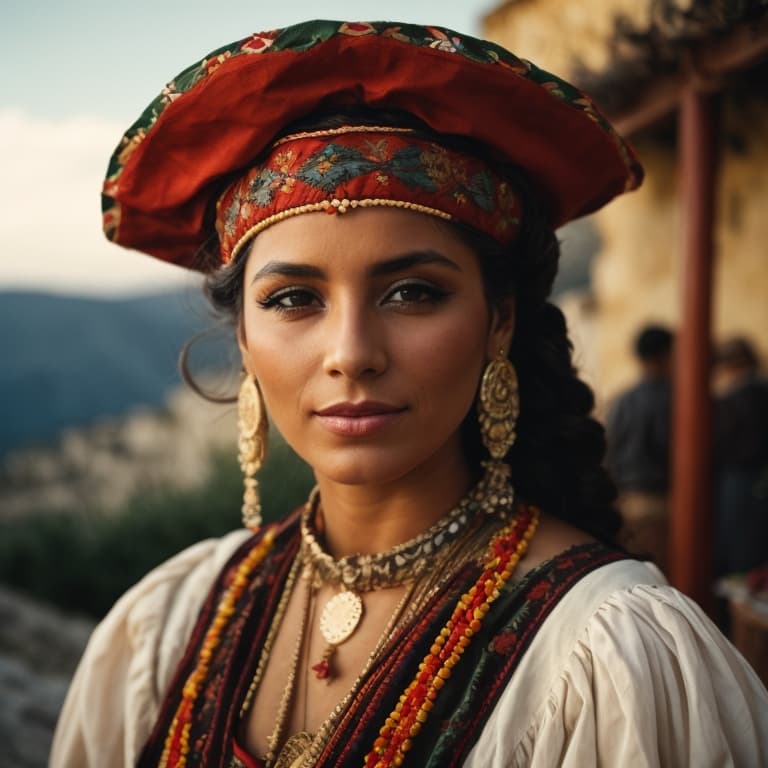
Corsicans sit at the Mediterranean center of gravity — closer phenotypically to Sardinians and mainland Italians than to northern French populations, with the island's long isolation producing a recognizable, somewhat compact look. Hair runs dark by default: deep brown to black is the baseline, with chestnut and warm mid-brown common across the interior. Texture is typically straight to softly wavy, occasionally tighter curl in coastal and southern villages where Genoese, North African, and Iberian inputs left a heavier mark. Natural blonds are rare; auburn and reddish-brown surface in pockets, often paired with the lighter end of the skin range.
Eyes are most often brown — warm hazel through near-black — but the green and gray-green seen in Sardinia and Tuscany shows up too, and clear blue eyes appear at a noticeably higher rate than the all-Mediterranean average, a quirk Napoléon's family carried. No epicanthic fold; eye shape tends almond, set under defined, often heavy brows. Skin is Fitzpatrick III–IV: olive with a green-gold undertone that tans deeply and rarely burns badly, rather than the pinker Type II of northern France. Sun exposure on shepherds and fishermen produces the leathered, deeply tanned look the island is known for.
Facial structure is the giveaway. Noses are typically straight or slightly aquiline with a defined bridge and moderate alar width — the Bonaparte profile is a fair anchor. Lips are medium, with a clear vermilion border rather than the very full or very thin extremes. Jaws are square in men, with strong chins and prominent cheekbones; faces read as architectural rather than soft.
Build is on the shorter, denser end of European norms — men averaging around 171–173 cm, women around 160 cm — with broad shoulders, short limbs relative to torso, and a tendency toward stocky, muscular composition rather than lean or willowy frames. Body hair is moderate to heavy in men, dark and visible. Aging tends compact and weather-cured rather than soft.
Data depth
75/100Coverage of image-grounded phenotype observations · drives AI generation diversity
- Sample size
- 40/40· 73 images
- Image quality
- 25/30· 51% high
- Confidence
- 10/20· mean 0.67
- Source diversity
- 0/10· wikipedia
- ·Wikipedia-only source — not population-representative
Observed Distribution — Image Sample
Empirical observations from analyzed photographs · supplementary signal, not population truth
Sample: 73 images analyzed (73 wikipedia). Quality: 37 high, 24 medium, 10 low, 2 very_low. Avg analyzer confidence: 0.67.
Skin tone (Fitzpatrick): II (56%), III (21%), IV (14%), V (3%), VI (1%), unclear (5%)
Hair color: black (45%), gray/white (36%), dark brown (5%), light/medium brown (5%), other (4%), unclear (4%)
Hair texture: straight (51%), wavy (29%), curly (4%), coily (1%), bald (7%), shaved (1%), covered (7%)
Eye color: dark brown (44%), blue (10%), hazel (8%), brown (5%), unclear (33%)
Epicanthic fold: 4% present, 82% absent, 14% unclear
Caveats: Sample is 100% Wikipedia notable people — skews toward male, public-life, and modern figures, not population-representative.
Last aggregated: May 7, 2026
Explore phenotype categories
Structured taxonomy with peer-reviewed scales · 22 anatomical categories
Notable Corsicans People
100 reference figures — sourced from Wikipedia
- Alizée — born 1984), singer
- Patrick Fiori — born 1969), singer
- Michel Giacometti — 1929-1990), ethnomusicologist who worked primarily in Portugal
- Jenifer — born 1982), French singer of Corsican ancestry
- Henry Padovani — born 1952), guitarist and singer, founder member of The Police
- Eddie Palmieri — 1936-2025), Puerto Rican pianist and composer of Corsican ancestry
- Antonio Paoli — 1871-1946), Puerto Rican opera singer of Corsican ancestry
- Tino Rossi — 1907-1983), singer and actor
- César Vezzani — 1888-1951), opera singer
- Germaine Ahidjo — 1932-2021), former First Lady of Cameroon 1960–1982, (father of Corsican ance…
- Sambucuccio d'Alando — 14th century), revolutionary
- Diego Arria — Saliceti (born 1938), Venezuelan economist, diplomat and politician of Corsic…
- John Bernard — 1893-1983), Corsican-born American Congressman
- Hammuda Bey — died 1666), Bey of Tunis (Corsican parents, Murad I Bey and Yasmine)
- Murad I Bey — born Jacques Senti, died 1631), Bey of Tunis
- Mariana Bracetti — Puerto Rican independentist of Corsican ancestry
- César Campinchi — 1882-1941), politician and lawyer
- Arthur Andrew Cipriani — 1875–1945), labour leader and politician of Trinidad and Tobago
- Giovanni Corso — died 1685), pirate and privateer
- Hasan Corso — born Pietro Paolo Tavera, died 1556), caliph and mayor of Algiers
- Pasquino Corso — died 1532), military leader
- Sampiero Corso — 1498-1567), military leader
- François Gaffori — 1744-1796), politician and military leader
- Petru Giovacchini — 1910-1955), fascist and pro-Italian collaborator in World War II
- Jean César Graziani — 1859–1932), Corsican French Army general who served in World War I
- Raul Leoni — 1905-1972), president of Venezuela 1964-1969, of Corsican ancestry
- Jaime Lusinchi — 1924-2014), president of Venezuela 1984-1989, of Corsican ancestry
- Norodom Monineath — born Paule Monique Izzi, 1936), former queen consort of Cambodia (father of C…
- Ángel Navarro — 1748-1808), early Texas settler and mayor of San Antonio
- José Antonio Navarro — 1795-1871), Texan politician of Corsican ancestry
- Alain Orsoni — born 1954), former guerrilla leader of the FLNC-Canal Habituel and former pre…
- François-Xavier Ortoli — 1925-2007), politician, former President of the European Commission
- Pasquale Paoli — 1725-1807), Corsican patriot, statesman and military leader
- Charles Pasqua — 1927-2015), French politician of Corsican ancestry
- Alicia Pietri — 1923-2011), public figure of Corsican ancestry who twice served as First Lady…
- Carlo Andrea Pozzo di Borgo — 1764-1842), French politician and Russian diplomat
- Antoine Christophe Saliceti — 1757-1809), politician, member of the National Convention during the French R…
- François Santoni — 1960-2001), guerrilla leader and co-leader of the FLNC-Canal Historique
- Norodom Sihamoni — born 1953), King of Cambodia and son of Norodom Monineath
- José Antonio Velutini — 1844-1912), Venezuelan military of Corsican ancestry
- Napoléon Bonaparte — 1769-1821), Emperor of France
- Carlo Bonaparte — 1746-1785), father of Napoléon Bonaparte
- Caroline Bonaparte — 1782-1839), sister of Napoléon Bonaparte
- Elisa Bonaparte — 1777-1820), sister of Napoléon Bonaparte
- Jérôme Bonaparte — 1784-1860), brother of Napoléon Bonaparte
- Joseph Bonaparte — 1768-1844), brother of Napoléon Bonaparte
- Louis Bonaparte — 1778-1846), brother of Napoléon Bonaparte
- Lucien Bonaparte — 1775-1840), brother of Napoléon Bonaparte
- Pauline Bonaparte — 1780-1825), sister of Napoléon Bonaparte
- Joseph Fesch — 1763-1839), half-uncle of Napoléon Bonaparte
- Letizia Ramolino — 1749-1836), mother of Napoléon Bonaparte
- Angelo Mariani — 1838-1914), chemist
- Pedro Penzini Fleury — Venezuelan pharmacist of Corsican ancestry
- Cédric Villani — born 1973), French mathematician of Corsican ancestry
- Paul Vincensini — 1896-1978), mathematician
- Xavier Anchetti — born 1866, date of death unknown), Corsican-born French Olympic fencer
- Michel Sebastiani — born 1937), French modern pentathlete and Olympic fencing coach
- Chahir Belghazouani — born 1986), former Moroccan international
- Chaouki Ben Saada — born 1984), Tunisian international
- Rémy Cabella — born 1990), French international
- Yanis Cimignani — born 2002)
- Dominique Colonna — born 1928), French former international
- Adama Diakhaby — born 1996), current player
- Wahbi Khazri — born 1991), Tunisian international
- François Modesto — born 1978), former player
- Pascal Olmeta — born 1961), former player
- Olivier Pantaloni — born 1966), former player
- Charles Orlanducci — born 1951), French former international
- Julian Palmieri — born 1986), former player
- Claude Papi — 1949-1983), French former international
- Nicolas Penneteau — born 1981), French player
- Adil Rami — born 1985), French international, 2018 World Cup winner
- Jean-Jacques Rocchi — born 1989), French international
- Benjamin Santelli — born 1991), French international
- Albert Vanucci — born 1947), French former international
- Cécile Lignot-Maubert — née Lignot; born 1971), Corsican-born hammer thrower
- Salim Sdiri — born 1978), long jumper
- Maxime Chevalier — born 1999), cyclist
- Laurent Lokoli — born 1994), tennis player
- Robertino Pietri — born 1974), Venezuelan professional motorcycle racer
- Marc Biancarelli — born 1968), writer
- Pedro César Dominici — 1873–1954), Venezuelan writer, playwright and diplomat of Corsican ancestry
- Michel Ferracci-Porri — born 1949), writer
- Hernán Garrido Lecca — born 1960, Peruvian economist, writer of Corsican ancestry
- Juan Liscano — 1915-2001), Venezuelan poet, writer, folklorist, editor of Corsican ancestry
- Francisco Massiani — 1944-2019), Venezuelan writer of Corsican ancestry
- José Rafael Pocaterra — Venezuelan writer, ambassador, politician, and lawyer of Corsican ancestry
- Arturo Uslar Pietri — 1906-2001), Venezuelan writer and politician of Corsican ancestry
- Bartolomé Tavera Acosta — 1865-1931), Venezuelan historian, ethnologist, linguist and journalist of Cor…
- Elisabeth Vincentelli — New York-based arts and culture journalist
- Sonia Ben Ammar — born 1999), model, singer, and actress
- Sully Bonnelly — born 1956), Dominican-American fashion designer
- Laetitia Casta — born 1978), French model and actress of Corsican ancestry
- Eva Colas — born 1996), Corsican-born French model; Miss Corsica 2017 and Miss Universe F…
- Garance Doré — born 1975), fashion blogger
- Baptiste Giabiconi — born 1989), French model and singer of Corsican ancestry
- Gaston Acurio — born 1967), Peruvian gastronomist and writer of Corsican ancestry
- Thomas Ceccaldi Hollis — born 1997), World record holder for most continuous cracking of different joints
- Theodor W. Adorno — born Theodor Ludwig Wiesengrund; 1903–1969), German philosopher, musicologist…
- Christian Boltanski — 1944–2021), French sculptor, photographer, painter, and filmmaker, Corsican m…
Generate Corsicans AI Content
Use this ethnicity's phenotype data to create AI-generated content with accurate physical traits and cultural context.
Open Creator Studio