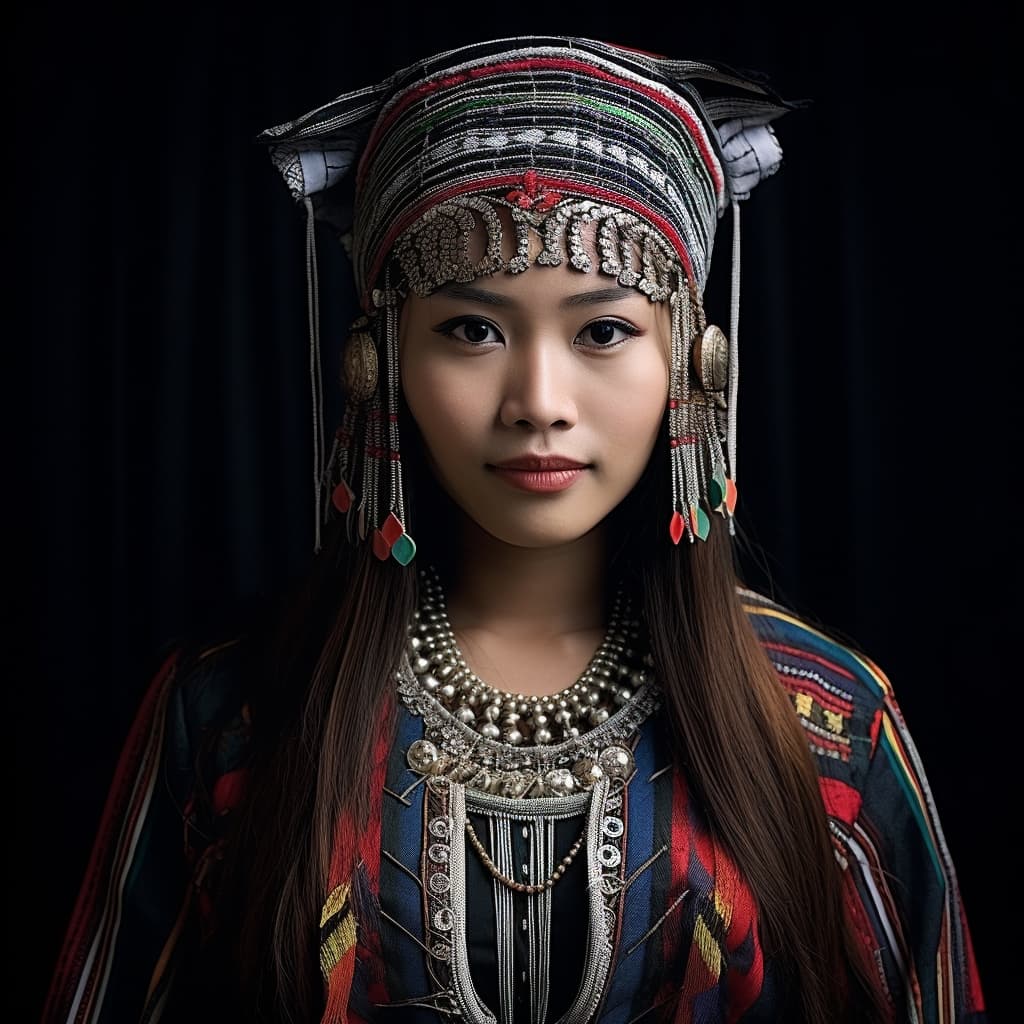
Kadazan-Dusun Erotic
Sabah (Malaysia)
Austronesian / Malayo-Polynesian / Dusunic
Christianity
Kadazan, Dusun, Dumpas, Ida'an, Kwijau, Lotud, Mangka'ak, Maragang, Minokok, Orang Sungai, Rumanau, Rungus, Tambanuo
Southeast Asia
About Kadazan-Dusun People
The Kadazan-Dusun are the largest Indigenous people of Sabah, the Malaysian state on the northern tip of Borneo, and the name itself is a political compound — a twentieth-century umbrella stitched together to give a constellation of related communities a single voice in state affairs. The "Kadazan" historically clustered around the coastal plains and the Penampang and Papar districts, the "Dusun" inland along the slopes and river valleys running up to Mount Kinabalu. The line between them is fuzzy and contested; many people use the terms interchangeably, others insist on the distinction, and the official hyphen is the compromise. Beneath that umbrella sit the Rungus of the Kudat peninsula, the Lotud of Tuaran, the Orang Sungai along the Kinabatangan, the Ida'an of the eastern coast, and roughly a dozen other named branches, each with its own dialect and ceremonial particularities.
The languages belong to the Dusunic branch of Malayo-Polynesian — close enough that a Central Dusun speaker and a Kadazan speaker can usually find their way to mutual understanding, distant enough that translation is sometimes required. Central Dusun has been adopted as the standard taught in schools, a choice that not everyone is happy about. Most Kadazan-Dusun today are Christian, predominantly Roman Catholic in the Penampang heartland and a mix of Protestant denominations elsewhere, the legacy of mission work that took hold in the late nineteenth and early twentieth centuries. Older animist beliefs, organized around rice spirits and a priestess class called the bobohizan (or bobolian, depending on the sub-group), have not disappeared. They run quietly underneath the Christian frame, and at the major rituals — particularly those tied to the rice harvest — the bobohizan still officiate.
The cultural anchor for the whole grouping is Kaamatan, the harvest festival held each May, which centers on thanksgiving to Bambazon, the rice spirit, and ends with the Unduk Ngadau, a beauty pageant whose roots are in the legend of Huminodun, a maiden sacrificed by the creator so that her body could become rice to feed her people. It is a state holiday in Sabah, and for a month the public buildings, longhouses, and village halls fill with bamboo dance, gong ensembles, and rice wine — tapai or lihing, depending on the household — poured for guests who are expected to drink it.
Typical Kadazan-Dusun Phenotypes
Reference for AI generation — hair, eyes, skin, facial structure, build
The Kadazan-Dusun phenotype reflects a deep Austronesian substrate overlaid by long contact with mainland Southeast Asian and southern Chinese populations, producing a look that is recognizably distinct from Peninsular Malay. Hair is almost universally black to very dark brown, straight to gently wavy, with the coarse, glossy texture characteristic of Austronesian populations. Premature greying is uncommon. Body hair is sparse, facial hair light — beard growth in men is typically thin and slow.
Eyes run from medium to very dark brown. The epicanthic fold is present in most individuals but often softer and less pronounced than in northern East Asian groups — many Kadazan-Dusun show a partial or "tapered" fold rather than a full one, and a meaningful minority have essentially no fold at all, especially among older Dusun and interior Murut-adjacent communities. Eye openings tend to be moderately wide and almond-shaped rather than narrow.
Skin sits in the Fitzpatrick III–IV range with warm golden-olive to light copper-brown undertones. Highland Dusun communities around Kundasang and the Crocker Range often appear notably lighter than coastal Kadazan and Orang Sungai groups, who weather darker through sun exposure. The undertone reads yellow-gold rather than the pink-olive of Peninsular Malay or the red-brown of indigenous Bornean groups further south.
Facial structure is the most distinctive feature: broad, high cheekbones with a relatively short, straight nose of moderate alar width — neither the narrow bridge of Han Chinese nor the broader nose typical of Malay populations. Jawlines are moderate, chins often slightly receding. Lips are medium in fullness, well-defined.
Build trends shorter and lean-compact. Average male height sits around 162–165 cm, female around 152–155 cm, with low body-fat baselines and wiry musculature shaped by generations of upland rice cultivation. The Rungus of the northern tip and the Lotud of Tuaran are sometimes shorter and more gracile; coastal Kadazan around Penampang tend slightly taller and broader-shouldered. Singer Atama Katama and former Miss Universe Malaysia Sabrina Beneett offer recognizable reference points.
Data depth
78/100Coverage of image-grounded phenotype observations · drives AI generation diversity
- Sample size
- 33/40· 33 images
- Image quality
- 30/30· 61% high
- Confidence
- 15/20· mean 0.82
- Source diversity
- 0/10· wikipedia
- ·Wikipedia-only source — not population-representative
Observed Distribution — Image Sample
Empirical observations from analyzed photographs · supplementary signal, not population truth
Sample: 33 images analyzed (33 wikipedia). Quality: 20 high, 11 medium, 2 low, 0 very_low. Avg analyzer confidence: 0.82.
Skin tone (Fitzpatrick): III (27%), IV (61%), V (12%)
Hair color: black (64%), gray/white (15%), blonde (3%), red/auburn (3%), dark brown (3%), unclear (12%)
Hair texture: straight (55%), wavy (27%), coily (3%), covered (15%)
Eye color: dark brown (97%), blue (3%)
Epicanthic fold: 91% present, 9% absent, 0% unclear
Caveats: Sample is 100% Wikipedia notable people — skews toward male, public-life, and modern figures, not population-representative.
Last aggregated: May 7, 2026
Explore phenotype categories
Structured taxonomy with peer-reviewed scales · 22 anatomical categories
Notable Kadazan-Dusun People
100 reference figures — sourced from Wikipedia
- Anwar Fazal — consumer, environmental activist, health advocate
- Amir Ahnaf — Malaysian actor
- Aaron Aziz — Singaporean actor
- Aedy Ashraf — Malaysian actor
- Alif Satar — Malaysian singer, TV host and actor, 1/2 Malay
- Aznil Nawawi — Malaysian TV host, singer and actor
- Cico Harahap — Malaysian actor, 1/2 Batak, 1/2 Malay
- Dini Schatzmann — Malaysian actor, 1/2 Malay 1/2 Switzerland Germans
- Iqram Dinzly — Malaysian actor
- Izzue Islam — Malaysian actor
- Pierre Andre — Malaysian actor
- Shaheizy Sam — Malaysian actor
- Syafiq Kyle — Malaysian actor
- Stephen Rahman-Hughes — Welsh actor, 1/2 Malay
- Zizan Razak — Malaysian actor and singer
- Asiah Aman — Singaporean actress and model, Singapore Hall of Fame 2022
- Artika Sari Devi — Indonesian actress and model
- Ayda Jebat — Malaysian singer and actress
- Fasha Sandha — Malaysian actress
- Heliza Helmi — Malaysian singer and activist
- Hazwani Helmi — Malaysian singer and activist
- Janna Nick — Malaysian actress, singer and producer, the most successful female singer in …
- Liyana Fizi — Malaysian actress, singer and famous songwriter
- Mathira — Pakistani and Zimbabwean actress, 1/2 Malay
- Mishqah Parthiepal — South African actress, 1/4 Malay
- Maisie Conceição — Singaporean actress and singer, 1/4 Malay
- Revalina S. Temat — Indonesian actress
- Uji Rashid — Bruneian-Malay actress and singer
- Zizi Kirana — famous Malaysian actress and singer from Sabah region
- Mazlan Othman — Malaysian astrophysicist who pioneered Malaysia's participation in Space expl…
- Sheikh Muszaphar Shukor — first Malaysian astronaut
- Nasimuddin Amin — founder, chairman and chief executive officer of the Naza Group of Malaysia.
- Syed Mokhtar Al-Bukhary — founder of the Albukhary Foundation
- Norman Musa — chef and restaurateur
- Rozman Jusoh — Malaysian convicted drug trafficker
- Ahmad Muin Yaacob — Malaysian convicted murderer
- Ahmad Najib Aris — Malaysian convicted murderer
- Mona Fandey — Malaysian convicted murderer
- Muid Latif — graphic designer, multimedia designer
- Nor Aini Shariff — fashion designer
- Ashley Isham — fashion designer
- P. Ramlee — Malaysian singer, actor and film director
- Jamil Sulong — Malaysian actor, film director and comic book artist
- M. Nasir — Singaporean poet, singer-songwriter, composer, producer, actor and film director
- Yasmin Ahmad — Malaysian film director, film writer, scriptwriter
- Aziz M. Osman — Malaysian film director
- Yusof Haslam — Malaysian actor and film director
- Syamsul Yusof — Malaysian actor and film director
- Syafiq Yusof — Malaysian actor and film director
- Nam Ron — Malaysian film director and producer
- Zainal Rashid Ahmad — Kedah famous author
- Tunku Abdul Rahman — 1st Prime Minister of Malaysia
- Abdul Razak Hussein — 2nd Prime Minister of Malaysia
- Mahathir Mohamad — 4th and 7th Prime Minister of Malaysia
- Abdullah Ahmad Badawi — 5th Prime Minister of Malaysia
- Najib Razak — 6th Prime Minister of Malaysia
- Muhyiddin Yassin — 8th Prime Minister of Malaysia
- Ismail Sabri Yaakob — 9th Prime Minister of Malaysia
- Anwar Ibrahim — 10th Prime Minister of Malaysia
- Ibrahim Mohammad Jaafar — 1st Brunei Chief Minister
- Marsal Maun — 2nd Brunei Chief Minister
- Pengiran Muhammad Yusuf — 3rd Brunei Chief Minister
- Pengiran Abdul Momin — 4th Brunei Chief Minister
- Abdul Aziz Umar — 5th Brunei Chief Minister
- Hassanal Bolkiah — 1st Brunei sovereign Prime Minister
- Hamzah Haz — 9th Vice President of Indonesia
- Raja Ali Haji — Johor Sultanate historian, poet and malay culture scholar, Malay royal family…
- Amir Hamzah — Indonesian national hero and poet
- A. Samad Said — father of Malaysian National Literature
- Salmi Manja — Singaporean female poet, wife of Samad Said
- Keris Mas — Asas 50's literature movement founder
- Faisal Tehrani — Malaysian writer of shia religion, Iranian maternal ancestry, Tehrani is his …
- Ishak Haji Muhammad — also known as Pak Sako, famous for his advocation of Maphilindo movement
- Shahnon Ahmad — famous writer from Kedah
- Tenas Effendy — Indonesian historian, renowned figure from Pelalawan Kingdom
- Taufik Ikram Jamil — Indonesian historian from Bengkalis, Riau
- Jamil Al-Sufri — Brunei historian, part of royal family
- Andrea Hirata — Indonesian novelist from Bangka Belitung
- Tere Liye — Indonesian best seller novelist from Lahat, Sumatra Selatan
- Hill Zaini — Bruneian singer and actor
- Evie Tamala — Indonesian dangdut singer and actress
- Shila Amzah — international Malaysian singer-songwriter
- Taliep Petersen — South African guitarist
- Yuna — Malaysian singer
- Aliff Aziz — Singaporean singer
- Meria Aires — known as Maria, a Bruneian singer
- Jamal Abdillah — Malaysian singer
- Sudirman Arshad — Malaysian singer
- Taufik Batisah — Singaporean singer
- Zul F — Bruneian actor and singer
- Elyana — Malaysian singer and actress
- Erwin Gutawa — Indonesian composer
- Eqah — Bruneian singer
- Erra Fazira — Malaysian actress and singer
- Sean Ghazi — Malaysian singer and actor
- Gita Gutawa — Indonesian singer 1/2 Malay
- Fauziah Latiff — Malaysian singer
- Sheila Majid — Malaysian singer
- Amy Mastura — Malaysian actress and singer
- Noorhaqmal Mohamed Noor — known as Aqmal. N, a Singaporean singer and songwriter

Generate Kadazan-Dusun AI Content
Use this ethnicity's phenotype data to create AI-generated content with accurate physical traits and cultural context.
Open Creator Studio