Finns Erotic
Finland
Uralic / Finnic / Finnish
Christianity / Protestantism
Kvens, Forest Finns, Tornedalians, Ingrian Finns, along with significant populations in Sweden, United States, and Canada.
Northern Europe
About Finns People
Finns are one of the few peoples in Europe whose language sets them apart before anything else does. Finnish belongs to the Uralic family — distantly related to Estonian and, much further back, to Hungarian — which means it shares almost no vocabulary with the Indo-European tongues that surround it. A Finn listening to Swedish or Russian hears a foreign language in the ordinary sense; the grammar runs on different rails. Fifteen noun cases, vowel harmony, agglutinative endings stacked into long single words: it is a language that rewards patience and resists shortcuts, and Finns tend to talk about it with a mix of pride and resignation.
The homeland is a long country of forest and lake, pressed between the Baltic and the Russian interior, and that geography has done a lot of the historical shaping. Finland spent roughly six centuries under Swedish rule, then a century as an autonomous Grand Duchy of the Russian Empire, before declaring independence in 1917 amid the chaos of the Russian Revolution. The Winter War of 1939–40, when a small Finnish army held off a Soviet invasion through one of the worst winters on record, sits near the center of national memory — less as triumphalism than as a kind of confirmation of how Finns prefer to see themselves: stubborn, undemonstrative, capable.
Lutheranism arrived with the Reformation and remains the nominal majority faith, though weekly observance is low; the church functions more as a civic institution than a devotional one for most. Older layers persist underneath. The Kalevala, compiled by Elias Lönnrot in the 19th century from oral runic poetry collected in Karelia, gave the national-romantic movement a foundational text and continues to shape how Finns talk about landscape, grief, and craft. The sauna is not a leisure amenity but a domestic fixture — there are more saunas than cars — and the etiquette around it is quietly serious.
The branches outside the core are real and distinct. The Kvens settled the far north of Norway centuries ago and speak a Finnic variety now recognized as its own minority language. Tornedalians straddle the Swedish-Finnish border along the Torne River valley with their own dialect, Meänkieli. Forest Finns migrated into central Scandinavia in the 16th and 17th centuries as slash-and-burn cultivators, and Ingrian Finns built villages around what is now St. Petersburg before being scattered by Soviet deportations. Large diaspora communities took root in Sweden, the American Upper Midwest, and northern Ontario, where Finnish-language newspapers and cooperative halls outlasted the immigrant generation by a long stretch.
Typical Finns Phenotypes
Reference for AI generation — hair, eyes, skin, facial structure, build
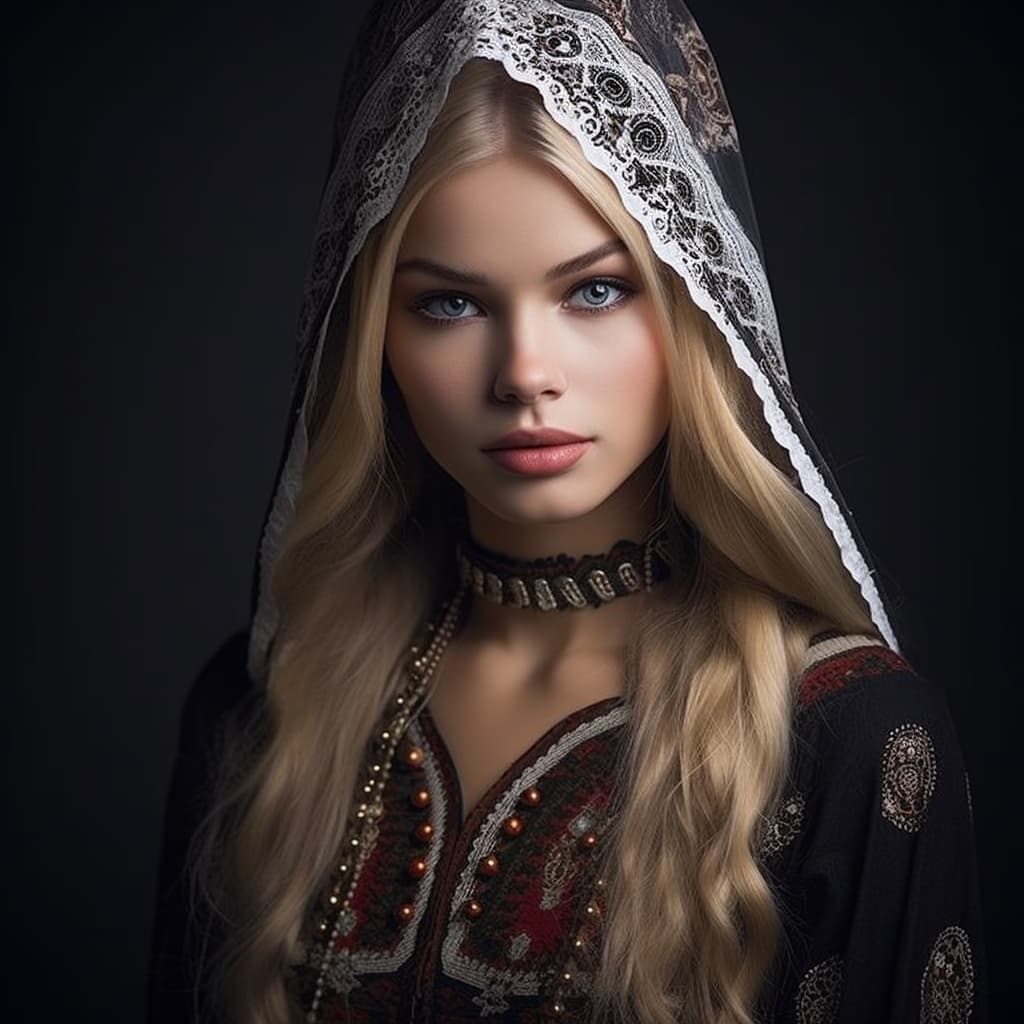
Finns sit at a genetic crossroads — Uralic-speaking populations who clustered along the Baltic for millennia in relative isolation, producing one of Europe's most distinctive phenotype clusters. The defining feature is hair and eye depigmentation at rates that rival or exceed Scandinavia: roughly 80% of Finns have blue or grey eyes, the highest concentration in continental Europe, and natural blond hair persists into adulthood far more often than in neighboring populations. Hair color spans pale platinum and ash blond through mid-brown, with a strand texture that runs fine and straight to gently wavy. Coily or tightly curled hair is essentially absent in unmixed lineages.
Eye shape tends toward narrow with subtle epicanthic folds — a Uralic inheritance visible across roughly 30% of the population and more pronounced in eastern and Sámi-adjacent regions. The eye opening often reads as slightly almond-shaped rather than round, set under low, pale brows. Skin sits firmly in Fitzpatrick I–II: very fair, pink or neutral undertones, freckling common, tanning poor, with the translucent quality that comes from low melanin and long winters.
The face structure is broad through the cheekbones with a flatter midface than Germanic or Slavic neighbors — high, wide zygomatics, a relatively short nose with a straight or slightly low bridge and narrow alar base, and a strong, square jaw. Lips run thin to medium. Actor Jasper Pääkkönen is a clean reference for the cheekbone-and-pale-eye combination. Build is tall and rangy: men average around 180 cm, women 167 cm, with broad shoulders, long limbs, and a tendency toward lean muscle and low body fat that's visible in athletes like strongman Jouko Ahola.
Sub-group variation is real but narrow. Eastern Finns and groups with Karelian or Ingrian admixture show stronger Uralic features — flatter midface, more frequent epicanthic fold, slightly darker hair. Western and coastal Finns, including Swedish-speaking communities, trend toward a more Scandinavian look: longer faces, taller noses, lighter pigmentation overall. Forest Finns and Kvens fall within the eastern cluster.
Data depth
69/100Coverage of image-grounded phenotype observations · drives AI generation diversity
- Sample size
- 40/40· 72 images
- Image quality
- 19/30· 39% high
- Confidence
- 10/20· mean 0.68
- Source diversity
- 0/10· wikipedia
- ·Wikipedia-only source — not population-representative
Observed Distribution — Image Sample
Empirical observations from analyzed photographs · supplementary signal, not population truth
Sample: 72 images analyzed (72 wikipedia). Quality: 28 high, 38 medium, 5 low, 1 very_low. Avg analyzer confidence: 0.68.
Skin tone (Fitzpatrick): I (1%), II (92%), unclear (7%)
Hair color: gray/white (38%), black (24%), light/medium brown (24%), red/auburn (6%), blonde (6%), other (1%), brown (1%), unclear (1%)
Hair texture: straight (53%), wavy (39%), curly (1%), bald (4%), covered (1%), unclear (1%)
Eye color: blue (25%), dark brown (11%), hazel (6%), green (3%), brown (3%), unclear (53%)
Epicanthic fold: 0% present, 93% absent, 7% unclear
Caveats: Sample is 100% Wikipedia notable people — skews toward male, public-life, and modern figures, not population-representative.
Last aggregated: May 7, 2026
Explore phenotype categories
Structured taxonomy with peer-reviewed scales · 22 anatomical categories
Notable Finns People
100 reference figures — sourced from Wikipedia
- Ida Aalberg — 1858–1915)
- Jouko Ahola — born 1970)
- Joalin Loukamaa — born 2001)
- Olavi Ahonen — 1923–2000)
- Irina Björklund — born 1973)
- Anna Easteden — born 1976)
- Samuli Edelmann — born 1968)
- Peter Franzén — born 1971)
- George Gaynes — 1927–2019)
- Gina Goldberg — born 1963)
- Beat-Sofi Granqvist — 1869–1960)
- Ville Haapasalo — born 1972)
- Anna-Leena Härkönen — born 1965)
- Ansa Ikonen — 1913–1989)
- Anni-Kristiina Juuso — born 1979)
- Kata Kärkkäinen — born 1968)
- Krista Kosonen — born 1983)
- Marta Kristen — born 1945)
- Mikko Leppilampi — born 1978)
- Vesa-Matti Loiri — 1945–2022)
- Masa Niemi — 1914–1960)
- Maila "Vampira" Nurmi — 1922–2008)
- Jaakko Ohtonen — born 1989)
- Kati Outinen — born 1961)
- Jasper Pääkkönen — born 1980)
- Turo Pajala — 1955–2007)
- Tauno Palo — 1905–1982)
- Pertti "Spede" Pasanen — 1930–2001)
- Matti Pellonpää — 1951–1995)
- Lasse Pöysti — 1927–2019)
- Oiva Sala — 1900–1980)
- Pentti Siimes — 1929–2016)
- Maria Silfvan — 1800–1865) – possibly Finland's first actress
- Markku Toikka — born 1955)
- Aino Aalto — 1894–1949)
- Alvar Aalto — 1898–1976)
- Marco Casagrande — born 1971)
- Herman Gesellius — 1874–1916)
- Elna Kiljander — 1889–1970)
- Juha Leiviskä — 1936–2023)
- Yrjö Lindegren — 1900–1952)
- Armas Lindgren — 1874–1929)
- Wivi Lönn — 1872–1966)
- Juhani Pallasmaa — born 1936)
- Reima Pietilä — 1923–1993)
- Viljo Revell — 1910–1964)
- Aarno Ruusuvuori — 1925–1992)
- Kerttu Rytkönen — 1895–1991)
- Eero Saarinen — 1910–1961)
- Eliel Saarinen — 1873–1950)
- J. S. Sirén — 1889–1961)
- Lars Sonck — 1870–1956)
- Josef Stenbäck — 1854–1929)
- Uno Ullberg — 1879–1944)
- Martti Välikangas — 1893–1973)
- Erna Aaltonen — born 1951), ceramist
- Wäinö Aaltonen — sculptor (1894–1966)
- Eija-Liisa Ahtila — photographer, video artist (born 1959)
- Helena Arnell — painter (1697–1751)
- Margareta Capsia — painter (1682–1759)
- Emil Cedercreutz — sculptor (1879–1949)
- Albert Edelfelt — painter (1854–1905)
- Magnus Enckell — painter (1870–1925)
- Gunnar Finne — sculptor (1886–1952)
- Hilda Flodin — sculptor (1877–1958)
- Alina Forsman — sculptor (1845–1899)
- Akseli Gallen-Kallela — painter (1865–1931)
- Jorma Gallen-Kallela — painter (1898–1939)
- Liisa Hallamaa — ceramist (1925–2008)
- Eemil Halonen — sculptor (1875–1950)
- Pekka Halonen — painter (1865–1933)
- Edith Hammar — illustrator and cartoonist (born 1992)
- Edvin Hevonkoski — sculptor (1923–2009)
- Eila Hiltunen — sculptor (1922–2003)
- Kari Huhtamo — sculptor (1943–2023)
- Tuuli Hypén — cartoonist (born 1983)
- Tove Jansson — painter, illustrator, and cartoonist of Moomin (1914–2001)
- Viktor Jansson — sculptor (1886–1958)
- Antti Jokinen — video director in Hollywood (born 1968)
- Eero Järnefelt — painter (1863–1937)
- Ville Juurikkala — photographer (born 1980)
- Rudolf Koivu — illustrator (1890–1946)
- Mauri Kunnas — born 1950)
- Touko Laaksonen (Tom of Finland) — fetish artist (1920–1991)
- Kari T. Leppänen — cartoonist (born 1945)
- Sven Lokka — painter and writer (1924-2008)
- Otto Maja — graffiti artist (born 1987)
- Totte Mannes — painter (born 1933)
- Arno Rafael Minkkinen — photographer
- Helvi Mustonen — painter (1947–2025)
- Kalervo Palsa — painter (1947–1987)
- Tuulikki Pietilä — graphic artist (1917–2009)
- Walter Runeberg — sculptor (1838–1920)
- Sampsa — painter and street artist
- Helene Schjerfbeck — painter (1862–1946)
- Hugo Simberg — painter (1873–1917)
- Venny Soldan-Brofeldt — painter (1863–1945)
- Kaj Stenvall — painter (born 1951)
- Kari Suomalainen — painter and cartoonist (1920–1999)
- Reidar Särestöniemi — painter (1925–1981)






More from Northern Europe
Generate Finns AI Content
Use this ethnicity's phenotype data to create AI-generated content with accurate physical traits and cultural context.
Open Creator Studio