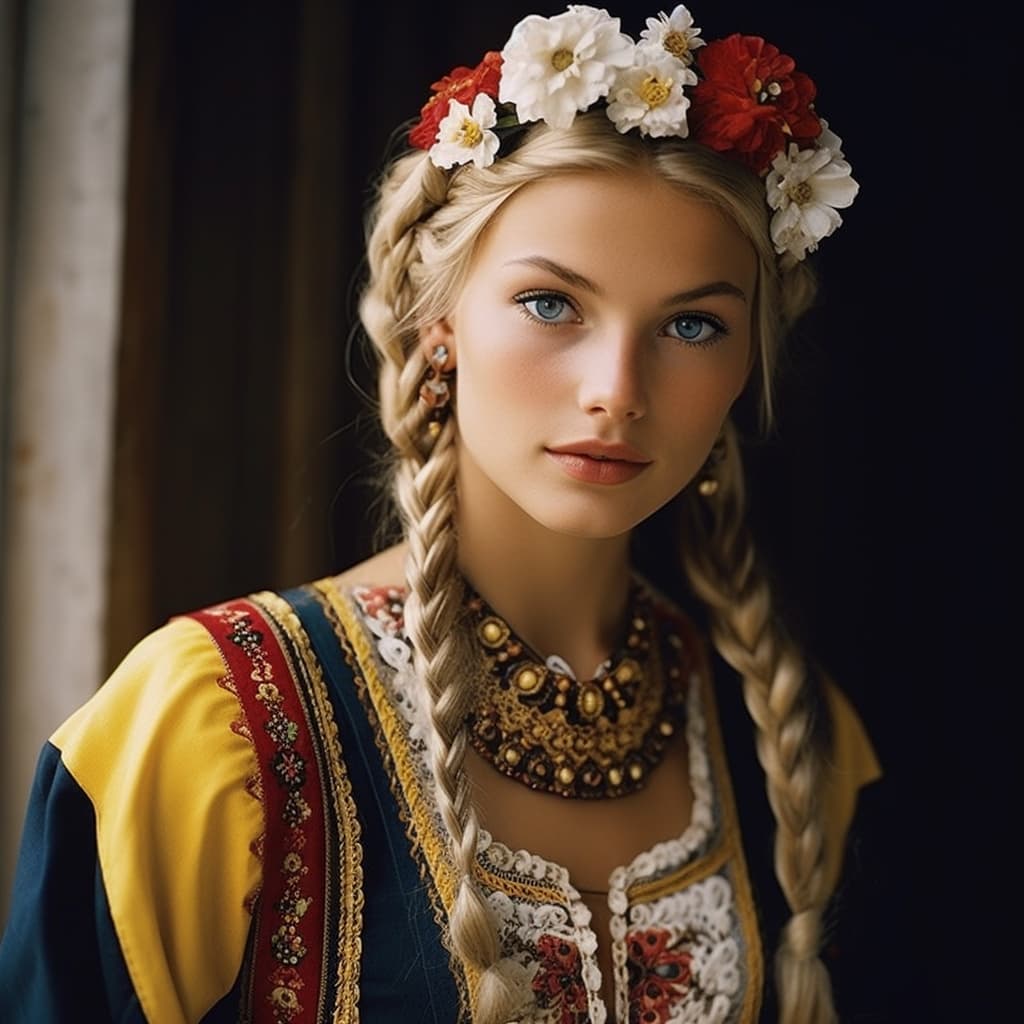
Swedes Erotic
Sweden
Indo-European / Germanic / Nordic / Swedish
Christianity / Protestantism
Scanians, Jamtish, Gutnish, along with significant populations in Finland (including Åland Swedes), the United States, Canada, Argentina and the United Kingdom
Northern Europe
About Swedes People
Swedes are a North Germanic people whose sense of themselves was forged less by conquest than by long stretches of organized stability — a state that consolidated early, reached briefly across the Baltic as a great power in the seventeenth century, then settled into a quieter role as one of Europe's most administratively coherent societies. The homeland stretches from the agricultural plains of Skåne in the south through the lake country of Götaland and Svealand to the forests and tundra of Norrland, a long thin country where most people live in the lower third and the upper reaches belong as much to the Sámi as to anyone. That north-south stretch shows up in the people too: Scanians in the south, with a soft burred speech that sounds halfway to Danish; the Jamtish of the inland north, historically Norwegian-leaning; and the Gutes of Gotland, whose old island dialect Gutnish preserves features the mainland lost centuries ago. Swedish-speakers in coastal Finland and on Åland are not a diaspora in the ordinary sense — they have been there as long as Finland has had cities — and there are older emigrant communities in the American Midwest, the Canadian prairies, and, more curiously, in a small Argentine farming colony in Misiones.
The language is mutually intelligible with Norwegian and largely with Danish, a continuum more than a set of separate tongues, and Swedes tend to read the other two with little effort and complain affectionately about how they sound. Lutheranism arrived with the Reformation under Gustav Vasa and became the state church for nearly five centuries; it was disestablished only in 2000, and active belief is now thin, but the cultural inheritance remains visible in the calendar, the architecture of every village, and a certain Protestant temperament — a preference for understatement, a discomfort with showing off, a deep suspicion of anyone who talks too much about themselves. The cultural code that foreigners notice first is lagom, the idea that the right amount is neither too little nor too much, paired with jantelagen, an unspoken northern injunction against considering yourself special. Set against this is a real streak of seasonal hedonism: the long dark winters are answered with crayfish parties in late summer, Midsummer poles raised in every meadow, and the candle-lit Lucia processions that mark the darkest week of December. The contrast is the point — restraint most of the year, then a few nights of organized abandon.
Typical Swedes Phenotypes
Reference for AI generation — hair, eyes, skin, facial structure, build
Swedes sit near the depigmented end of the European phenotype spectrum, though the popular image of uniformly platinum-blond Swedes oversimplifies what's actually a fairly broad northern-European range. Hair runs from very light ash-blond and flaxen through dark blond and light brown, with natural blondism most concentrated in central and northern Sweden — an estimated 60–70% of children are born blond, though hair characteristically darkens to dark blond or light brown by adulthood. Texture is overwhelmingly straight to gently wavy and fine in diameter. True black hair is rare without recent admixture; red hair occurs at low single-digit percentages, often paired with the lighter skin extreme.
Eye color skews heavily toward blue and grey-blue, with green and hazel common and pure brown a clear minority — Sweden has one of the highest blue-eyed frequencies in the world, with some surveys placing it above 75%. Eyelids are typically open and almond-shaped without epicanthic fold; brow ridges are usually soft, and lashes and brows often run several shades darker than scalp hair, giving the characteristic light-hair-dark-brow contrast.
Skin is predominantly Fitzpatrick I–II: pale, pink or neutral undertone, freckling readily on sun exposure, tanning poorly. A cooler, slightly rosier complexion is common in the south (Scania), while the far north can show flatter, almost bluish pallor.
Facial structure tends toward long, narrow faces with straight or very slightly aquiline noses, narrow alar bases, and modest lip fullness — upper lips are often noticeably thinner than lower. Cheekbones are typically high but not broad, and jaws are squared in men, oval in women.
Build is among the tallest in Europe — adult male mean around 180 cm, female around 167 cm — with long limbs, narrow hips and shoulders trending broad in men. Scanians lean shorter and slightly darker-featured, reflecting Continental European influence; Jamtish and northern populations show the lightest pigmentation extremes; Gutnish Gotlanders often display a distinct combination of very fair coloring with broader, more rounded facial proportions than the mainland average.
Data depth
0/100Coverage of image-grounded phenotype observations · drives AI generation diversity
- Sample size
- 0/40· 0 images
- Image quality
- 0/30· 0% high
- Confidence
- 0/20
- Source diversity
- 0/10
- ·No image observations yet
Explore phenotype categories
Structured taxonomy with peer-reviewed scales · 22 anatomical categories




More from Northern Europe
Generate Swedes AI Content
Use this ethnicity's phenotype data to create AI-generated content with accurate physical traits and cultural context.
Open Creator Studio