Serbs Erotic
Serbia, Republika Srpska (Bosnia and Herzegovina), Montenegro
Indo-European / Slavic / Serbo-Croatian / Serbian
Christianity / Eastern Orthodoxy
Kosovo Serbs, Triestine Serbs, along with significant populations in Croatia, Germany, Austria, France, and Sweden
Southern Europe
About Serbs People
The Serbs are a South Slavic people whose center of gravity sits on the Pannonian-Balkan hinge — the plains of Vojvodina sloping into the Šumadija hills, then south into the gorges of the Drina and the high country around Kosovo. That geography matters: Serbia has always been a corridor rather than a corner, sitting on the seam between Central Europe and the eastern Mediterranean, between the old Habsburg and Ottoman frontiers. A great deal of what reads as Serbian temperament — the suspicion of empire, the strong sense of village versus capital, the pride in stubbornness — comes out of centuries of living on that seam.
Serbian belongs to the South Slavic branch of Indo-European and is mutually intelligible with Croatian, Bosnian, and Montenegrin; the four were treated as a single Serbo-Croatian standard for most of the twentieth century, and the spoken differences are smaller than the political ones. What sets Serbian apart in writing is its comfortable bilingual life across two alphabets — Cyrillic, the official script and the one tied to church and state, and Latin, used interchangeably in commerce and the press. A Serb will read both without thinking about it.
Eastern Orthodoxy is the other defining inheritance. The Serbian Orthodox Church became autocephalous in 1219 under Saint Sava, and that early independence from both Constantinople and Rome shaped a national church that has functioned, at various points, as the keeper of identity when the state was absent — under Ottoman rule, under communism, in the diaspora. The most distinctive expression is the slava, the household feast day for a family's patron saint, passed down the male line and observed even by Serbs who rarely set foot in a church. It is the closest thing the culture has to a private liturgy.
The branches reflect that long history of edges and exits. Kosovo Serbs hold to the medieval heartland around Peć and the Patriarchate, in a position that has been politically unresolved for decades. The Krajina and Slavonian Serbs of Croatia, the Serbs of Republika Srpska in Bosnia, and the older Triestine and Vojvodina communities are all products of Habsburg-Ottoman frontier life, when Vienna settled Orthodox soldier-farmers along its military border. The newer diaspora — strong in Germany, Austria, France, Sweden, and the United States — was largely built by twentieth-century labor migration and the wars of the 1990s, and it remains tightly networked through parish, sport, and family.
Typical Serbs Phenotypes
Reference for AI generation — hair, eyes, skin, facial structure, build
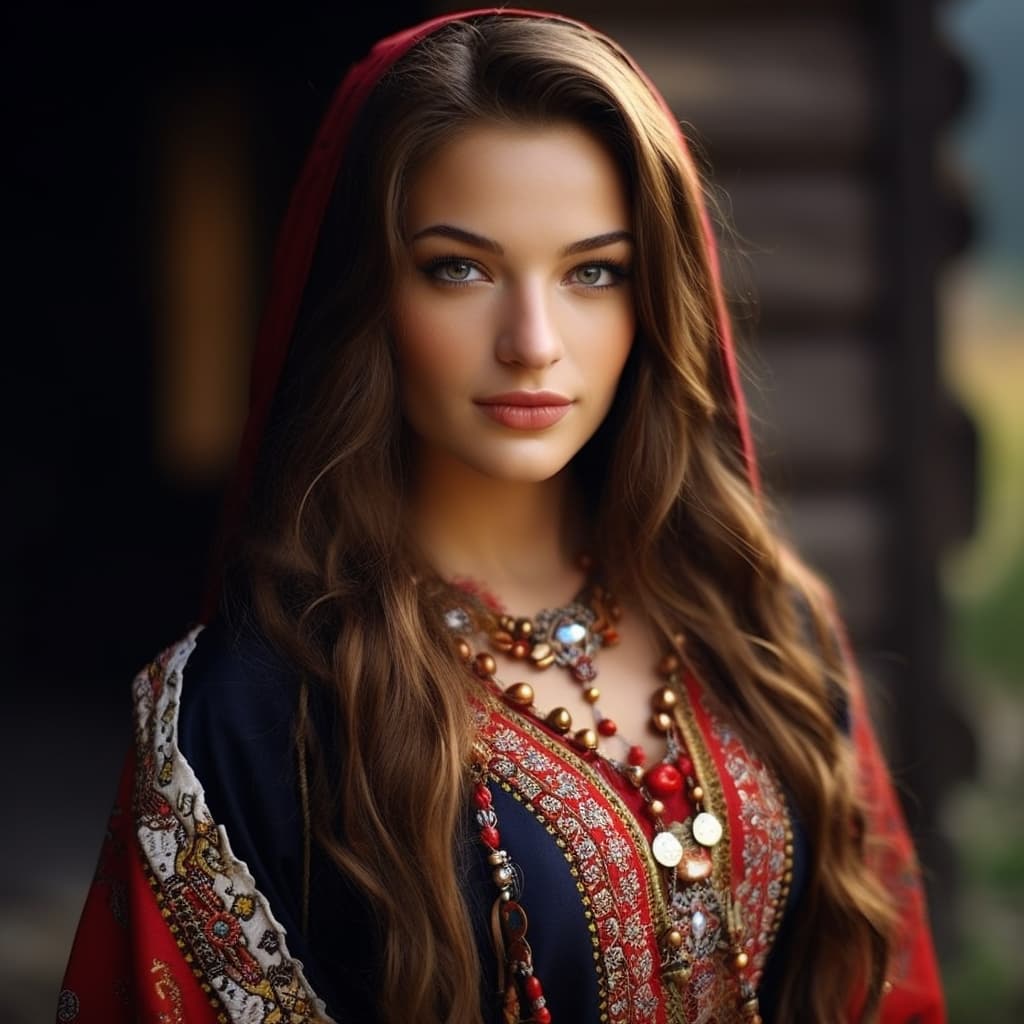
Serbs sit at the Slavic-Mediterranean seam, and the phenotype reflects it: predominantly Dinaric, with a tall, long-faced, often robust build that distinguishes them from the rounder Slavic morphology found further north and east. Average male stature runs around 182 cm, putting Serbs and neighboring Dinaric populations among the tallest in Europe — a documented anthropometric peak rather than folklore.
Hair is most often medium to dark brown, frequently with cool ash or near-black tones; chestnut and dark blonde are common, and true light blonde appears mainly in the Vojvodina north where Pannonian admixture shows. Texture is straight to gently wavy; tight curls are unusual. Greying tends to come in cleanly without the rusty cast seen in Celtic populations.
Eyes split fairly evenly between brown and lighter shades — hazel, green, and a distinctive cool grey-blue are all well represented, with light eyes more frequent than the broader Balkan average. Lids are flat-set, no epicanthic fold, often deep-set under a strong supraorbital ridge that gives the gaze a serious, hooded quality on camera.
Skin is overwhelmingly Fitzpatrick II–III with neutral-to-cool undertones; an olive III tone appears more often toward Kosovo and the Adriatic littoral, while northern Vojvodina Serbs trend paler. Sun tans well rather than burning out.
The face is the signature. Long, narrow, with a high straight or slightly convex nose bridge, moderate alar width, and a prominent brachycephalic skull shape behind it — a classic Dinaric pattern. Cheekbones are high but not broad-flared; the jawline is firm and often square in men, more tapered in women. Lips are typically medium-full, well-defined, without the heavy eversion seen further south.
Build skews lean-to-athletic in youth and broad-shouldered through middle age; women tend toward an hourglass with longer limbs than the central-European average. Kosovo Serbs read slightly darker in hair and skin and shorter on average, while Triestine and diaspora Serbs in Austria and Germany show more admixture-driven lightening, particularly in eye color.
Data depth
51/100Coverage of image-grounded phenotype observations · drives AI generation diversity
- Sample size
- 39/40· 49 images
- Image quality
- 7/30· 14% high
- Confidence
- 5/20· mean 0.50
- Source diversity
- 0/10· wikipedia
- ·Low overall confidence
- ·Mostly low-quality source images
- ·Wikipedia-only source — not population-representative
Observed Distribution — Image Sample
Empirical observations from analyzed photographs · supplementary signal, not population truth
Sample: 49 images analyzed (49 wikipedia). Quality: 7 high, 31 medium, 8 low, 2 very_low. Avg analyzer confidence: 0.50.
Skin tone (Fitzpatrick): II (59%), III (14%), unclear (27%)
Hair color: black (39%), gray/white (35%), dark brown (8%), unclear (18%)
Hair texture: straight (29%), wavy (45%), curly (6%), bald (2%), shaved (2%), covered (8%), unclear (8%)
Eye color: dark brown (12%), brown (10%), hazel (8%), blue (4%), unclear (65%)
Epicanthic fold: 2% present, 71% absent, 27% unclear
Caveats: Quality skews toward older or low-resolution photos; phenotype detail may be lossy. Low average analyzer confidence — many photos partially obscured or historical. Sample is 100% Wikipedia notable people — skews toward male, public-life, and modern figures, not population-representative.
Last aggregated: May 7, 2026
Explore phenotype categories
Structured taxonomy with peer-reviewed scales · 22 anatomical categories
Notable Serbs People
100 reference figures — sourced from Wikipedia
- Religion — Slava Christmas traditions
- Literature — Epic poetry
- Atanasije Nikolić — 1803–1882)
- Emilijan Josimović — 1823–1897)
- Nikola Djordjević — the 19th century)
- Aleksandar Bugarski — 1835–1891)
- Svetozar Ivačković — 1844–1924), post-Romantic architect
- Konstantin Jovanović — 1849–1923), architect who designed National assemblies of Serbia and Bulgaria…
- Milan Antonović — 1850–1929)
- Milica Krstić Čolak-Antić — 1887–1964), one of the most important female architects during the first half…
- Vladimir Nikolić — 1857–1922)
- Andra Stevanović — 1859–1929)
- Dimitrije T. Leko — 1864–1914), Serbian architect and urbanist
- Nikola Nestorović — 1868–1957)
- Danilo Vladisavljević — 1871–1923)
- Momčilo Tapavica — 1872–1949), designer of Novi Sad's Matica Srpska building; also 1st Serb to w…
- Petar Popović — 1873–1945)
- Petar Bajalović — 1876–1947)
- Branko Tanazević — 1876–1945)
- Jelisaveta Načić — 1876–1955), pioneer in women's architecture in Serbia
- Đura Bajalović — 1879–1949)
- Momir Korunović — 1883–1969)
- Dragiša Brašovan — 1887–1965), modernist architect, leading architect of the early 20th century …
- Jovanka Bončić-Katerinić — 1887–1966), architect, 1st woman engineer in Germany
- Milan Minić (architect) — 1889–1961, architect
- Aleksandar Deroko — 1894–1988), architect, artist, professor and author
- Nikola Dobrović — 1897–1967)
- Milan Zloković — 1898–1965), architect, founder of the Group of Architects of Modern Expressions.
- Branislav Kojić — 1899–1986)
- Mihailo Janković — 1911–1976), architect who designed several important structures in Serbia
- Milica Šterić — 1914–1998), architect for Energoprojekt, built post World War 2 power plants
- Alexis Josic — 1921–2011), French architect
- Bogdan Bogdanović — 1922–2010), architect, urbanist and essayist, designed monumental concrete sc…
- Ivan Antić — 1923–2005), architect and academic, considered one of the former Yugoslavia's…
- Ilija Arnautović — 1924–2009), Yugoslav and Serbian architect, known for his projects during the…
- Ivanka Raspopović — 1930–2015), Serbian architect
- Predrag Ristić — 1931–2019), Serbian architect
- Ranko Radović — 1935–2005)
- Aleksandar Đokić — 1936–2002), architect known for Brutalist and postmodernist styles
- Zoran Bojović — 1936–2018), architect for Energoprojekt, worked in Africa
- Zoran Manević — 1937–2019), prominent Serbian architecture historian
- Ljiljana Bakić — 1939–2022), Serbian architect
- Jovan Prokopljević — born 1940)
- Louis and Dennis Astorino — born 1948), American architects of Serbian origin, Louis was the 1st American…
- Ksenija Bulatović — born 1967), architect
- Maja Vidaković Lalić — born 1972), architect
- Dubravka Sekulić — born 1980), architect and academic
- Petar Ubavkić — 1852–1910), recognized as the first sculptor of modern Serbia
- Đorđe Jovanović — 1861–1953), won prizes at the World Exhibitions in Paris 1889 and 1900 for th…
- Simeon Roksandić — 1874–1943), sculptor and academic, highly regarded for his bronzes and founta…
- Dragomir Arambašić — 1881–1945)
- Vukosava Velimirović — 1888–1965)
- Iva Despić-Simonović — 1891–1961)
- Risto Stijović — 1894–1974), sculptor, author of Monument to Franchet d'Esperey in Belgrade
- Sreten Stojanović — 1898–1960)
- John David Brcin — 1899–1983), Serbian American sculptor
- Yevgeny Vuchetich — 1908–1974)
- Vojin Bakić — 1915–1992), Yugoslav sculptor
- Bogosav Živković — 1920–2005)
- Jovan Soldatović — 1920–2005)
- Dragiša Stanisavljević — 1921–2012)
- Olga Jevrić — 1922–2014), awarded sculptor
- Matija Vuković — 1925–1985)
- Dušan Džamonja — 1928–2009), sculptor
- Miodrag Živković — 1928–2020)
- Slavomir Miletić — born 1930)
- Nebojša Mitrić — 1931–1989)
- Mirjana Isaković — born 1936), former professor at Faculty of Applied Arts
- Drinka Radovanović — born 1943), sculptor of many monuments to national heroes
- Slobodan Pejić — 1944–2006)
- Lilly Otasevic — born 1969), Serbian born Canadian sculptor/designer
- Mihailo Stošović — born 1971)
- Lovro Dobričević — of Kotor (c. 1420 – 1478), Venetian painter who first started to paint at the…
- Đorđe Mitrofanović — c. 1550 – 1630), Serbian fresco painter and muralist who travelled and worked…
- Joakim Marković — c. 1685 – 1757)
- Hristofor Žefarović — 1710–1753)
- Teodor Stefanov Gologlavac — 18th century)
- Janko Halkozović — 18th century)
- Jovan Četirević Grabovan — 1720–1781)
- Jakov Orfelin — early 18th century–1803)
- Vasa Ostojić — 1730–1791)
- Teodor Kračun — 1730–1781)
- Dimitrije Bačević — 1735–1770)
- Nikola Nešković — 1740–1789)
- Lazar Serdanović — 1744–1799)
- Simeon Lazović — c. 1745 – 1817)
- Teodor Ilić Češljar — 1746–1793)
- Stefan Gavrilović — c. 1750 – 1823)
- Jovan Pačić — 1771–1849)
- Pavel Đurković — 1772–1830)
- Aleksije Lazović — 1774–1873)
- Petar Nikolajević Moler — 1775–1816), revolutionary and painter
- Georgije Bakalović — 1786–1843), Serbian painter
- Konstantin Danil — 1798–1873), painter and portraitist of the 19th century
- Grigorije Davidović-Obšić — 18th century)
- Uroš Knežević — 1811–1876)
- Katarina Ivanović — 1811–1882)
- Dimitrije Avramović — 1815–1855), painter known best for his iconostasis and frescos.
- Pavel Petrović — 1818–1887)
- Novak Radonić — 1826–1890)
Generate Serbs AI Content
Use this ethnicity's phenotype data to create AI-generated content with accurate physical traits and cultural context.
Open Creator Studio