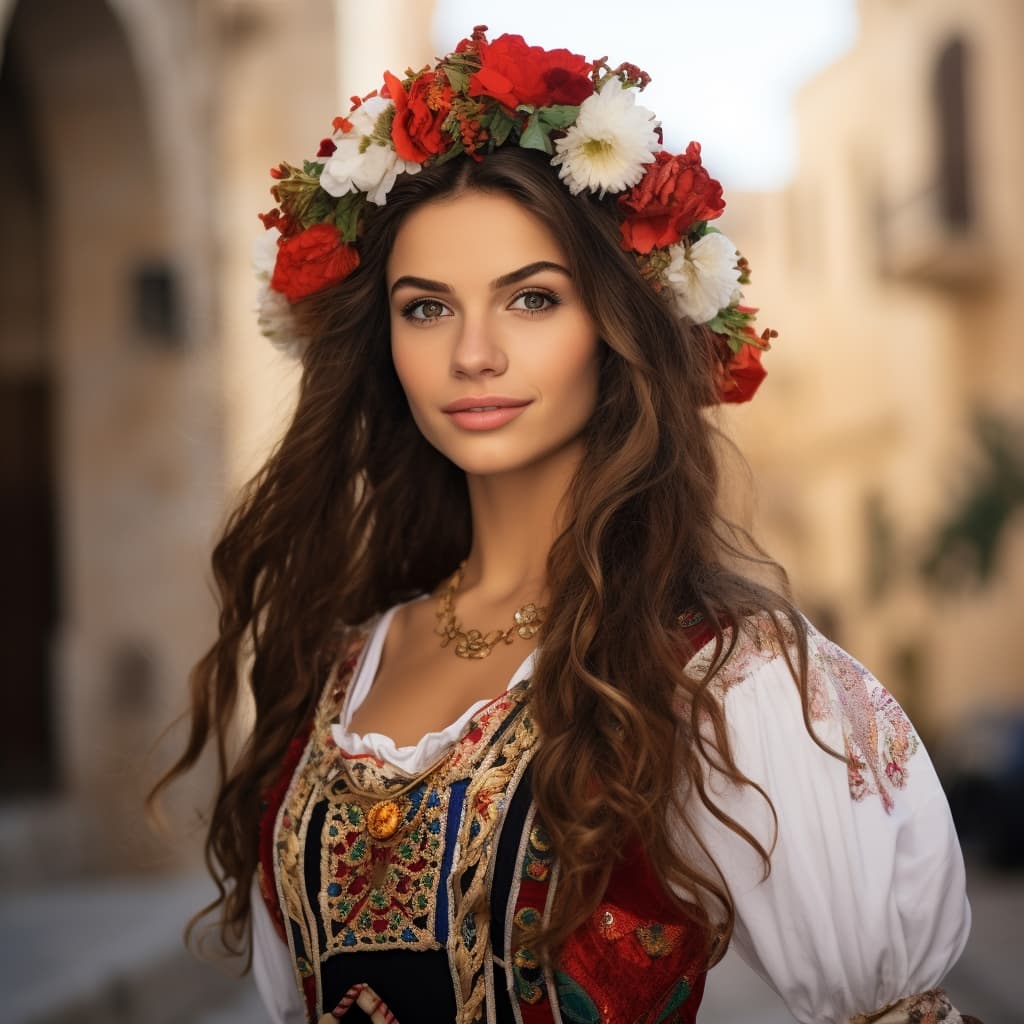
Maltese Erotic
Malta
Afroasiatic / Semitic / Arabic / Maltese
Christianity / Catholicism
Gozitans
Southern Europe
About Maltese People
The Maltese are the only people in Europe whose mother tongue is Semitic. Maltese descends from a medieval Arabic dialect carried to the islands during the Fatimid period, then layered for centuries with Sicilian, Italian, and English until it became something genuinely its own — written in Latin script, peppered with Romance vocabulary, but grammatically still recognizable as a cousin of North African Arabic. A speaker of Tunisian Arabic can pick out the bones of a Maltese sentence; a speaker of Italian can pick out half the meat. That linguistic split-personality is the through-line of Maltese identity.
The homeland is small and crowded — three inhabited islands south of Sicily, closer to Tunis than to Rome, totalling under 320 square kilometres. Geography did most of the historical work. Whoever held the central Mediterranean held Malta: Phoenicians, Romans, Byzantines, Arabs, Normans, the Knights Hospitaller, the French, and finally the British, who left in 1979. Each occupier added a layer without quite displacing the last, which is why a Maltese village fiesta can feel simultaneously North African, Sicilian, and faintly Anglican-parish.
Catholicism is not a quiet affiliation here. The Church arrived early — the Maltese trace their conversion to a shipwreck attributed to the apostle Paul in 60 AD — and has stayed central to public life in a way that has faded across most of Europe. Parish churches anchor every town, often disproportionately large for the population they serve, and the summer festa calendar still organizes village rivalries, brass bands, and competitive firework displays. Civil divorce was only legalized in 2011, after a referendum.
The Gozitans, who live on the smaller northern island of Gozo, hold themselves slightly apart. They speak with a distinguishable accent, kept a more agrarian rhythm longer than the main island, and carry a quiet reputation among Maltese for being more conservative and more clannish — not unfriendly, but a tighter circle.
A few things outsiders rarely know: the traditional Maltese fishing boat, the luzzu, still carries the painted Phoenician eye on its bow as a charm against bad luck. The country fields one of Europe's highest densities of band clubs per capita. And the siege mentality runs deep — Malta has been besieged spectacularly twice, by the Ottomans in 1565 and by the Axis in 1940–42, and both episodes are still part of how the Maltese explain themselves to themselves.
Typical Maltese Phenotypes
Reference for AI generation — hair, eyes, skin, facial structure, build
Maltese phenotype sits at a Mediterranean crossroads — structurally Southern European with an unmistakable Sicilian-Italic core, threaded with Levantine, Phoenician and North African input from the islands' deep trading and colonial history. The dominant impression is dark-haired, olive-skinned, sharply featured, but with a wider light-pigmentation tail than most non-Maltese expect.
Hair is overwhelmingly dark brown to black, typically straight to loosely wavy, with a meaningful minority showing tighter waves or soft curls — the kind of springy texture that reads more Sicilian than mainland Italian. True blondes are uncommon but not absent in childhood; many darken to mid-brown by adolescence. Body and facial hair tends to be dense in men, with strong beard growth and pronounced arm and chest hair.
Eyes run brown to dark brown in the clear majority, with hazel and green appearing at maybe 15–20% and pure blue at single digits — concentrated more on Gozo, where smaller-pool genetics preserve lighter variants. The epicanthic fold is absent. Eye shape tends almond, set under fairly heavy, well-defined brows. Lashes are typically thick.
Skin is Fitzpatrick III–IV — light olive to medium olive with a warm yellow-green undertone that tans deeply and rarely burns badly. The summer-tan baseline is striking; winter-pale Maltese often look noticeably darker than mainland Southern Italians at the same latitude. Truly fair, freckling Type II skin appears occasionally in red-haired and light-eyed individuals.
Facial structure is the giveaway: a strong, often slightly convex nasal bridge with a defined tip, moderate alar width, full but not heavy lips, and pronounced cheekbones over a square-to-oval jaw. Marisa Abela is a representative anchor for the lighter-eyed, fine-boned end; the broader-featured, deeply olive register dominates the everyday population.
Build trends short-to-medium — average male stature is around 169 cm, female around 159 cm, among Europe's shorter — with compact, sturdy frames that thicken with age. Gozitans skew slightly shorter, broader-faced, and marginally lighter-pigmented than Maltese on the main island.
Data depth
70/100Coverage of image-grounded phenotype observations · drives AI generation diversity
- Sample size
- 36/40· 40 images
- Image quality
- 29/30· 57% high
- Confidence
- 5/20· mean 0.53
- Source diversity
- 0/10· wikipedia
- ·Low overall confidence
- ·Wikipedia-only source — not population-representative
Observed Distribution — Image Sample
Empirical observations from analyzed photographs · supplementary signal, not population truth
Sample: 40 images analyzed (40 wikipedia). Quality: 23 high, 10 medium, 6 low, 1 very_low. Avg analyzer confidence: 0.53.
Skin tone (Fitzpatrick): II (35%), III (25%), IV (8%), unclear (33%)
Hair color: black (33%), gray/white (18%), dark brown (8%), brown (8%), other (8%), light/medium brown (3%), unclear (25%)
Hair texture: straight (35%), wavy (35%), bald (10%), covered (3%), unclear (18%)
Eye color: dark brown (40%), hazel (15%), brown (3%), other (3%), blue (3%), unclear (38%)
Epicanthic fold: 3% present, 70% absent, 28% unclear
Caveats: Low average analyzer confidence — many photos partially obscured or historical. Sample is 100% Wikipedia notable people — skews toward male, public-life, and modern figures, not population-representative.
Last aggregated: May 7, 2026
Explore phenotype categories
Structured taxonomy with peer-reviewed scales · 22 anatomical categories
Notable Maltese People
100 reference figures — sourced from Wikipedia
- Angelo Muscat — 1930–1977)
- Anthony J. Mifsud — actor, (singer, songwriter)
- Charles Clews — 1919–2009)
- Charles Thake — 1927–2018)
- Davide Tucci — born 1987) – actor
- Ivan De Battista — born 1977)
- Joseph Calleia — 1897–1975)
- Joseph Gatt — born 1974) actor, model, voice artist
- Madeleine Collinson — 1952–2014) – actress, model
- Marisa Abela — born 1996)
- Mary Collinson — 1952-2021) – actress, model, twin sister of Madeleine Collinson
- Simone De Battista — born 1977)
- Terry Camilleri — born 1949)
- Valerie Buhagiar — born 1964)
- Andrea Belli — 1703–1772) – architect and businessman
- Andrea Vassallo — 1856–1928) – eclectic architect
- Antonio Cachia — 1739–1813) – architect, civil and military engineer and archaeologist
- Antonio Falzon — 16th century) – military engineer, worked in Germany
- Carlo Gimach — 1651–1730) – architect, engineer and poet
- Cesar Castellani — died 1905) – worked in Guyana
- Domenico Cachia — c. 1690–1761) – master builder
- Emanuele Luigi Galizia — 1830–1907) – designed many public buildings
- Francesco Zerafa — 1679–1758) – architect and capomastro
- Giorgio Costantino Schinas — 1834–1894) – architect and civil engineer
- Giorgio Grognet de Vassé — 1774–1862) – architect and antiquarian
- Giorgio Pullicino — 1779–1851) – painter and architect
- Giovanni Attard — c. 1570–1636) – architect, military engineer and stone carver
- Giovanni Barbara — 1642–1728) – architect and military engineer
- Girolamo Cassar — c. 1520 – c. 1592) – designed many buildings in Valletta
- Giuseppe Bonavia — 1821–1885) – draughtsman and architect
- Giuseppe Bonici — 1707–1779) – architect and military engineer
- Giuseppe Psaila — 1891–1960) – Art Nouveau architect
- Gustavo R. Vincenti — 1888–1974) – architect and developer
- Isabelle Barratt-Delia — born 1938) – architect
- Joseph G. Huntingford — 1926–1994) – Modernist architect
- Lorenzo Gafà — 1638–1703) – Baroque architect
- Michele Cachia — 1760–1839) – architect and military engineer
- Richard England — born 1937)
- Roger de Giorgio — 1922–2016) – architect
- Tommaso Dingli — 1591–1666) – designed various churches
- Vittorio Cassar — c. 1550 – c. 1609) – military engineer
- Albert Garzia — born 1977)
- Alessandro Curmi — 1801–1857)
- Benigno Zerafa — 1726–1804)
- Carmelo Pace — 1906–1993) – composer, professor of musical theory and harmonics
- Charles Camilleri — 1931–2008)
- Francesco Azopardi — 1748–1809)
- Girolamo Abos — 1715–1760)
- Nicolas Isouard — 1775–1818)
- Reuben Pace — born 1974)
- Robert Samut — 1869–1934) – composer of "L-Innu Malti" (the national anthem of Malta), profe…
- Jon Cassar — born 1958) – director; producer
- Rebecca Cremona — director
- Antonio Williams — 1825–1908) – United States Navy seaman
- Brigadier — Martin Xuereb (born 1968) – former commander of the Armed Forces of Malta
- Clemente Tabone — c. 1575–1665) – landowner and militia member
- Juan Bautista Azopardo — 1772–1848) – founder of the Argentine Navy
- Orlando E. Caruana — 1844–1917) – fought during the American Civil War
- Toni Bajada — 16th century) – spy during the Great Siege of Malta
- Emmanuele Vitale — 1758–1802) – general of the Maltese forces and representing Città Vecchia or …
- Francesco Saverio Caruana — Don Francesco Saverio Caruana – rebel leader
- Vincenzo Borg — rebel leader and representing Birkirkara
- Safi — Chierico Giuseppe Abdilla for Safi
- Zebbug — Notary Pietro Buttigieg for Zebbug
- Zejtun — Michele Cachia for Zejtun
- Mosta — Parish Priest Don Felice Calleja for Mosta
- Mqabba — Parish Priest Don Bartolomeo Caraffa for Mqabba
- Luqa — Rev. Fr. Giuseppe Casha for Luqa
- Filippo Castagna — for Gudja
- Siggiewi — Parish Priest Don Salvatore Corso for Siggiewi
- Zurrieq — Rev. Fortunato Dalli for Zurrieq
- Balzan — Giuseppe Frendo for Balzan
- Gharghur — Chevalier Giovanni Gafa' for Gharghur
- Lia (Lija) — Salvatore Gafà for Lia (Lija)
- Casal Fornaro (Qormi) — Stanislao Gatt for Casal Fornaro (Qormi)
- Ghaxaq — Don Pietro Mallia for Ghaxaq
- Qrendi — Gregorio Mifsud for Qrendi
- Tarxien — Giuseppe Montebello for Tarxien
- Naxxar — Chev. Baron Paolo Parisio Muscati for Naxxar
- Zabbar — Agostino Sayd for Zabbar
- Kirkop — Dr Enrico Xerri for Kirkop
- Attard — Notary Saverio Zarb for Attard
- Gharb — Tommaso Cassar and Felice Grech for Gharb
- Xagħra — Liberato Grech and Liberato Sultana for Xagħra
- Rabat — Dr Francesco Pace for Rabat
- Sannat — Angelo Vella and Giuseppe Zammit for Sannat
- Xewkija — Francesco Zammit and Francesco Refalo for Xewkija
- Aidan Zammit — born 1965) – composer, musician and singer
- Amber Bondin — born 1991) – singer
- Antoinette Miggiani — born 1937) – opera singer
- Antonio Olivari — born 1980) – songwriter and composer
- Brent Muscat — born 1967) – guitarist
- Capitol K — musician
- Chiara Siracusa — born 1976) – singer
- Christabelle — born 1992) – singer-songwriter
- Claudette Pace — born 1968) – singer and politician
- Claudia Faniello — born 1988) – singer
- Daniel Testa — born 1997) – singer, radio and television presenter
- Debbie Scerri — born 1969) – singer and television presenter
- Destiny Chukunyere — born 2002) – singer, winner of the Junior Eurovision Song Contest 2015
Generate Maltese AI Content
Use this ethnicity's phenotype data to create AI-generated content with accurate physical traits and cultural context.
Open Creator Studio