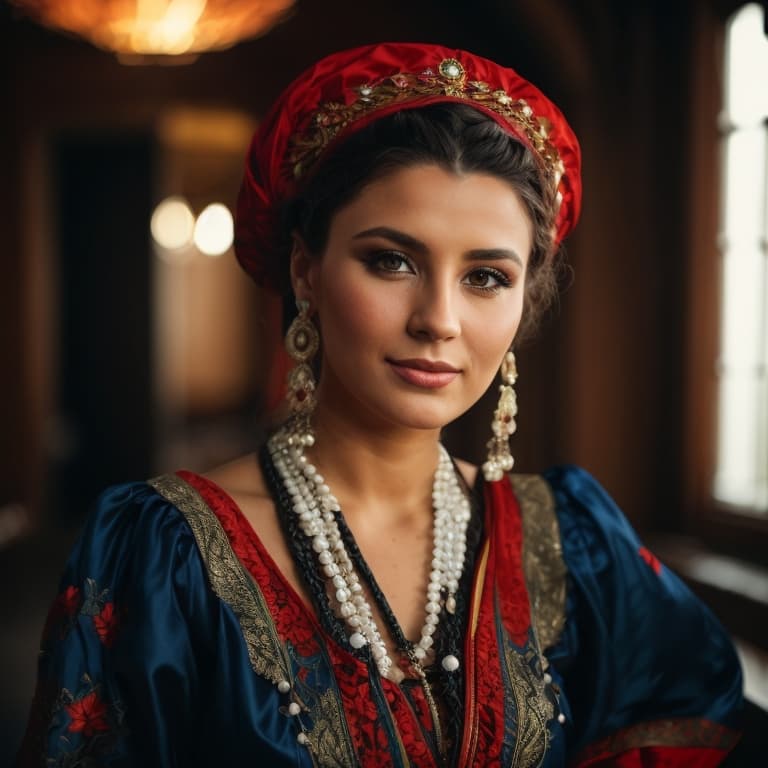
Croats Erotic
Croatia, Federation of Bosnia and Herzegovina (Bosnia and Herzegovina)
Indo-European / Slavic / Serbo-Croatian / Croatian
Christianity / Catholicism
Bunjevci, Krashovani, Janjevci, Sokci, Bosnian Croats, along with significant populations in Italy (including Molise Croats), Austria, United States, Chile, Argentina, Germany, Australia and Canada
Southern Europe
About Croats People
Croats define themselves through a stubborn alignment of three things: the Latin alphabet, Roman Catholicism, and a stretch of Adriatic coast that has been fought over for two thousand years. The first two are what separate them, on the page, from Serbs — a people they share a mutually intelligible language with but whose history pulled eastward toward Constantinople and Cyrillic. Croats went the other way. Their medieval kingdom struck a personal union with Hungary in 1102, came under Habsburg rule for nearly four centuries, and the cultural pull of Vienna, Venice, and Rome set the tone for everything from architecture to legal tradition to the fact that a Croatian village square usually has a baroque church on it rather than an Orthodox one.
The homeland is two countries at once. There is the long, bone-dry Dalmatian coast — limestone islands, olive groves, walled towns built by people who knew Venice would either trade with them or sack them — and there is the wetter, flatter Pannonian interior toward Slavonia, which is closer in feel to Hungary and grows wheat and corn. Bosnian Croats occupy a third world: the inland highlands of Herzegovina and central Bosnia, where Catholic identity has been sharpened by centuries of living next to Muslim and Orthodox neighbors. The branches reflect this scatter. Bunjevci drifted north into Vojvodina and southern Hungary; Sokci settled the Sava and Danube floodplains; Janjevci are a small, old Catholic community in Kosovo; and the Molise Croats of southern Italy have spoken a frozen, fifteenth-century version of the language ever since their ancestors fled the Ottoman advance.
The language itself is the štokavian dialect, written in a Latin script reformed in the nineteenth century by Ljudevit Gaj — though the Adriatic islands and parts of Istria still hold onto čakavian, and pockets of the northwest speak kajkavian, which a Slovenian can follow more easily than a Dalmatian can. Catholicism here is woven into the calendar rather than worn loudly: pilgrimages to Marija Bistrica and Medjugorje, name-day celebrations (imendan) often outranking birthdays, the klapa singing tradition with its roots in liturgical harmony. The 1991–1995 war of independence from Yugoslavia is recent enough that most adult Croats remember it personally, and it remains the inflection point against which national life is still measured.
Typical Croats Phenotypes
Reference for AI generation — hair, eyes, skin, facial structure, build
Croats sit on the phenotypic seam between Central Europe and the Dinaric Balkans, and that geography drives almost everything visible. Hair runs a wide brown spectrum: light to mid-brown is the modal adult shade, with ash and dark-blond common in the Pannonian north (Slavonia, Zagorje) and noticeably darker chestnut-to-near-black frequencies along the Dalmatian coast and inland Herzegovina. Texture is overwhelmingly straight to loosely wavy; tight curl is rare. Natural blondness in adulthood is meaningful but not dominant — closer to Czech or Slovenian rates than to Baltic ones — and red hair is uncommon.
Eyes are split fairly evenly between light and dark, with a regional gradient: blue, blue-grey and green run high in the continental north, while hazel and brown rise sharply moving south and east. Eyelid morphology is standard European — no epicanthic fold, generally horizontal palpebral fissures, often a visible upper-lid crease. Skin sits in Fitzpatrick II–III for most northerners and III–IV along the coast, with neutral-to-warm olive undertones particularly characteristic of Dalmatians and Bosnian Croats; winter pallor in inland populations can read closer to II.
Facial structure is where Croats are anthropometrically distinctive. The Dinaric substrate produces tall, narrow faces with straight or slightly convex nasal bridges, moderate alar width, and a flattened occiput (brachycephaly is well-documented in coastal and Herzegovinian samples). Cheekbones are present but not broad in the Slavic sense; jawlines tend rectangular in men, oval in women. Lips are medium — fuller than Northern European averages, thinner than Mediterranean ones.
Build is the headline: Dinaric Croats from the karst belt are among the tallest populations on earth, with male means around 184–186 cm in parts of Herzegovina and Dalmatian Zagora. Northern Croats trend slightly shorter and stockier. Bunjevci and Šokci of the Vojvodina-Slavonia plain skew lighter-pigmented and broader-built; Bosnian Croats and Dalmatian islanders skew taller, leaner, and darker, as figures like Mira Furlan illustrate.
Data depth
53/100Coverage of image-grounded phenotype observations · drives AI generation diversity
- Sample size
- 30/40· 27 images
- Image quality
- 13/30· 26% high
- Confidence
- 10/20· mean 0.60
- Source diversity
- 0/10· wikipedia
- ·Mostly low-quality source images
- ·Wikipedia-only source — not population-representative
Observed Distribution — Image Sample
Empirical observations from analyzed photographs · supplementary signal, not population truth
Sample: 27 images analyzed (27 wikipedia). Quality: 7 high, 10 medium, 10 low, 0 very_low. Avg analyzer confidence: 0.60.
Skin tone (Fitzpatrick): II (85%), III (4%), unclear (11%)
Hair color: gray/white (48%), black (37%), blonde (11%), unclear (4%)
Hair texture: straight (59%), wavy (30%), shaved (4%), covered (7%)
Eye color: dark brown (19%), blue (15%), hazel (11%), brown (7%), unclear (48%)
Epicanthic fold: 0% present, 85% absent, 15% unclear
Caveats: Quality skews toward older or low-resolution photos; phenotype detail may be lossy. Sample is 100% Wikipedia notable people — skews toward male, public-life, and modern figures, not population-representative.
Last aggregated: May 7, 2026
Explore phenotype categories
Structured taxonomy with peer-reviewed scales · 22 anatomical categories
Notable Croats People
100 reference figures — sourced from Wikipedia
- Viktor Axmann — architect
- Nikola Bašić — architect
- Vjekoslav Bastl — architect
- Julio Deutsch — architect
- Hugo Ehrlich — architect
- Ignjat Fischer — architect
- Stjepan Gomboš — architect
- Leo Hönigsberg — architect
- Viktor Kovačić — architect
- Slavko Löwy — architect
- Rudolf Lubinski — architect
- Paskoje Miličević Mihov — architect
- Vlado Milunić — architect
- Juraj Neidhardt — architect
- Velimir Neidhardt — architect
- Stjepan Planić — architect
- Vjenceslav Richter — architect
- Vladimir Šterk — architect
- Anđeo Lovrov Zadranin — architect
- Bela Čikoš Sesija — painter, representative of symbolism: art-deco and art nouveau
- Ivan Generalić — naïve art
- Mirko Ilić — cartoonist, graphic designer
- Juraj Julije Klović — portrait miniatures
- Ivan Lacković Croata — naïve art
- Dora Maar — photographer, painter, model
- Andrija Maurović — illustrator
- Ivan Rabuzin — naïve art
- Ana Tzarev — naïve art
- Milivoj Uzelac — painter
- Mladen Veža — illustrator
- Mirko Virius — naïve art
- Viktor Đerek — photographer
- George Beban — actor, director, writer and producer
- Vinko Brešan — director
- Veljko Bulajić — film director
- Christina Cindrich — television producer, host, and actress
- Claire Du Brey — actress
- Jenna Elfman — television and movie actress
- Nela Eržišnik — actress, comedian
- Judah Friedlander — actor and comedian
- Mira Furlan — actress (Babylon 5, Lost)
- Gallagher — comedian and prop comic
- Stanka Gjurić — actress, writer, filmmaker
- Frank Gorshin — actor and comedian
- Gloria Grey — screen, stage actress and director
- Werner Herzog — film director, producer, screenwriter, actor, and opera director
- Anne Jackson — actress
- Anthony Jeselnik — comedian
- Sylva Koscina — actress, model
- Mario Kovač — theatre and film director
- Rachel Leskovac — actress
- Branko Lustig — film producer
- Ivana Miličević — actress
- Ildy Modrovich — television producer, writer and singer
- Lorenzo Music — actor, voice actor, writer, television producer and musician
- Krsto Papić — film director
- Frank Pavich — film director, producer
- Anton Perich — filmmaker, photographer and video artist
- Edo Peročević — actor, radio speaker
- Ivica Rajković — cinematographer
- Joseph Sirola — actor and producer
- Mia Čorak Slavenska — prima ballerina
- Tonko Soljan — film and television producer
- Gabriela Spanic — actress
- Lita Stantic — producer, screenplay writer, and director
- Yvonne Suhor — actress
- Vanessa Terkes — actress, TV show host in Latin America of Croatian descent
- Goran Višnjić — actor (ER)
- Antun Vrdoljak — film director
- Severina Vučković — entertainer, actress
- Dianne Wiest — American actress
- Anthony Yerkovich — television producer and writer
- Matthew Yuricich — special effects artist
- Richard Yuricich — special visual effects artist
- Louis Zorich — American actor
- Jim Zulevic — actor, comedian, TV writer, and radio host
- Lidia Bastianich — American celebrity chef, television host, author, and restaurateur
- Adrian Chiles — British television and radio presenter
- Slavica Ecclestone — British-Croatian former model
- Robert Herjavec — Canadian businessman, investor, author, dancer, and television personality fr…
- Vladimir Herzog — Croatian-born Brazilian journalist
- Bill Kurtis — journalist, television reporter, producer
- Goran Milić — journalist
- Katie Pavlich — American conservative commentator, author, blogger, podcaster
- Gene Rayburn — American radio and television personality.
- Tony Robbins — American life coach, self-help author and motivational speaker
- Teresa Scanlan — Miss America 2011
- Petra Stunt — British designer
- James Belich — historian
- Julije Kempf — historian, writer
- Nada Klaić — historian
- Vjekoslav Klaić — historian
- Ivan Kukuljević Sakcinski — historian
- Ivan Lučić — historian
- Dominik Mandić — historian
- Franjo Rački — historian
- Ivan Ratkaj — historian, Jesuit, explorer
- Juraj Ratkaj — historian
- Ferdo Šišić — historian
- Ludovicus Tubero — historian

Generate Croats AI Content
Use this ethnicity's phenotype data to create AI-generated content with accurate physical traits and cultural context.
Open Creator Studio