Catalans Erotic
Catalan Countries (Spain, France)
Indo-European / Romance / Catalan
Christianity / Catholicism
Valencians, Balearics, Andorrans
Southern Europe
About Catalans People
Catalans are defined less by a state than by a language and a stretch of Mediterranean coast. The Països Catalans — the Catalan Countries — run from the Pyrenees down through Catalonia proper, across Valencia, out to the Balearic Islands, into the small mountain principality of Andorra, and over the French border into Roussillon. There is no single political unit that contains all of this. What holds it together is Catalan itself, a Romance language that sits between Occitan and Iberian Romance and is mutually understandable with neither Spanish nor French. For most of the twentieth century the language was suppressed — banned from schools, print, and public life under Franco — and its return after 1975 was deliberate, organized, and is still ongoing. To speak Catalan in Barcelona today is a routine act; to speak it in Perpignan is increasingly a political one.
The internal divisions matter more than outsiders tend to assume. Valencians often resist being folded into a Catalan identity and call their language Valencian, with its own academy and standard. Balearic islanders — Mallorcans, Menorcans, Eivissencs — speak distinct dialects and carry centuries of separate maritime history. Andorrans run the only sovereign state in which Catalan is the sole official language, co-governed in a feudal arrangement that has, improbably, survived since 1278 between a French head of state and a Spanish bishop. These branches do not always want to be branches.
Catholicism is the inherited religion and shapes the calendar — Sant Jordi on April 23rd, when men give roses and women give books, is more widely observed than most national holidays — but actual practice has thinned considerably, and Catalan civil society is markedly secular in temper. What persists with more force than the liturgy is a set of communal customs: the castells, human towers raised eight or nine levels high at town festivals, built by neighborhood teams that train year-round; the sardana, a circle dance done in plain clothes in public squares; the cooperative tradition that produced both anarchist collectives in the 1930s and the contemporary network of consumer co-ops. Food is regional rather than national — rice in Valencia, ensaïmada in Mallorca, fideuà on the Costa Daurada — but the habit of long, late, conversational meals is shared. Catalans are not a Spanish minority that happens to speak differently. They are a people whose self-understanding has always sat uneasily inside the borders drawn around them.
Typical Catalans Phenotypes
Reference for AI generation — hair, eyes, skin, facial structure, build
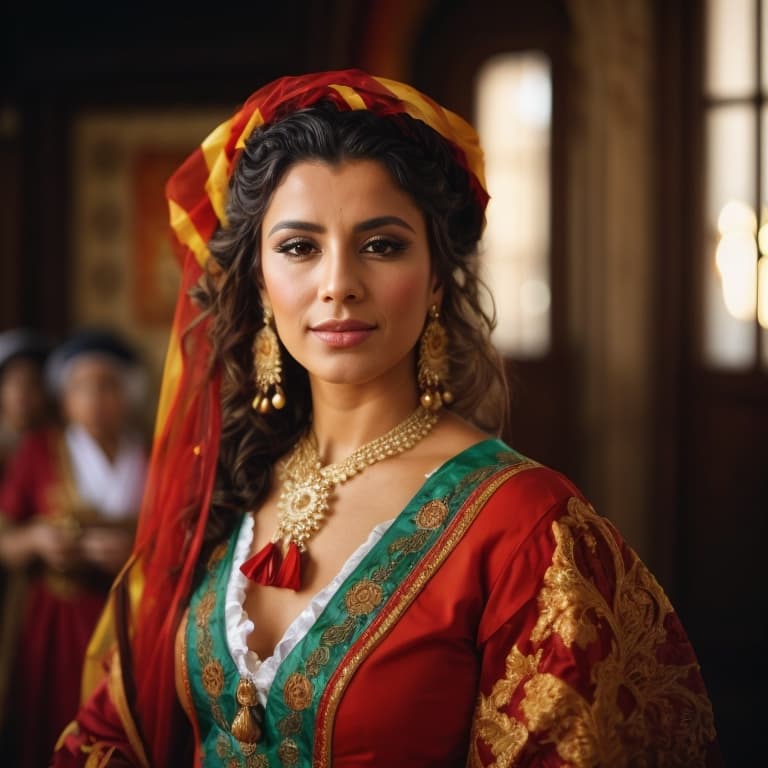
Catalans sit at the western Mediterranean's phenotypic crossroads, sharing the Iberian baseline with Aragonese and Occitan neighbors but trending slightly lighter and lankier than Andalusians to the south. Hair runs predominantly dark brown to near-black, straight or with a soft wave; chestnut and dark-blond shades surface in the Pyrenean foothills and inland Lleida, where Frankish and Occitan admixture left a visible trace. True curls are uncommon, but a loose Mediterranean wave is the default. Body hair tends to be moderate to dense in men, less so than in southern Iberians.
Eye color leans brown — warm honey-brown through deep chocolate — but green and hazel appear at noticeably higher rates than the Spanish average, and clear blue eyes are not unusual in the Empordà and northern Catalonia. The eye shape is almond, the orbital ridge moderate, with no epicanthic fold. Skin sits at Fitzpatrick II–III: a pale olive that reads almost ivory in winter and tans evenly to a warm tawny by August, with a yellow-green undertone rather than the pinker cast common further north.
Facial structure favors a straight, narrow nose with a defined bridge — the classic Mediterranean nose, neither aquiline like Sephardic profiles nor wide-alared. Lips are medium, the lower fuller than the upper. Cheekbones are present but not high-set; jaws are oval to slightly squared in men, with the long, slightly elongated head form that Salvador Dalí and Joan Miró both displayed in caricature. Brows are thick and dark.
Build is medium — average male stature around 175–177 cm, female around 162–164 cm — leaner and more wiry than the stockier Basque or northern Iberian frame. Valencians trend a touch darker in skin and hair, reflecting longer Moorish presence; Balearics show more blue eyes and sandier hair from medieval Catalan-Aragonese settlement layered over earlier Mediterranean stock; Andorrans, isolated in the high Pyrenees, run lighter still, often closer to Occitan French than coastal Catalan.
Data depth
57/100Coverage of image-grounded phenotype observations · drives AI generation diversity
- Sample size
- 39/40· 48 images
- Image quality
- 13/30· 25% high
- Confidence
- 5/20· mean 0.54
- Source diversity
- 0/10· wikipedia
- ·Low overall confidence
- ·Mostly low-quality source images
- ·Wikipedia-only source — not population-representative
Observed Distribution — Image Sample
Empirical observations from analyzed photographs · supplementary signal, not population truth
Sample: 48 images analyzed (48 wikipedia). Quality: 12 high, 22 medium, 14 low, 0 very_low. Avg analyzer confidence: 0.54.
Skin tone (Fitzpatrick): II (67%), III (15%), unclear (19%)
Hair color: gray/white (52%), black (27%), light/medium brown (6%), dark brown (2%), blonde (2%), unclear (10%)
Hair texture: straight (42%), wavy (40%), curly (6%), bald (2%), covered (2%), unclear (8%)
Eye color: dark brown (27%), blue (15%), hazel (6%), unclear (52%)
Epicanthic fold: 0% present, 83% absent, 17% unclear
Caveats: Quality skews toward older or low-resolution photos; phenotype detail may be lossy. Low average analyzer confidence — many photos partially obscured or historical. Sample is 100% Wikipedia notable people — skews toward male, public-life, and modern figures, not population-representative.
Last aggregated: May 7, 2026
Explore phenotype categories
Structured taxonomy with peer-reviewed scales · 22 anatomical categories
Notable Catalans People
100 reference figures — sourced from Wikipedia
- Ferrer Bassa — 1285–1348), Catalan Gothic master and miniaturist
- Arnau Bassa — ????–1348), altarpiece master and son of the previous
- Jacint Rigau i Ros — 1659–1743), portrait artist
- Josep Tapiró i Baró — 1836–1913), watercolour painter and fundamental member of Orientalism
- Marià Fortuny i Marsal — 1838–1874), painter
- Josep Masriera — 1841–1912), painter, goldsmith, and businessman
- Étienne Terrus — 1857–1922), painter considered one of the precursors of fauvisme
- Eliseu Meifrèn — 1857–1940), impressionist painter
- Aristide Maillol — 1861–1944), sculptor and painter
- Santiago Rusiñol — 1861–1931), painter, poet and playwright
- Ramon Casas i Carbó — 1866–1932), artist and painter
- Ramon Pichot — 1871–1925), painter
- Joaquin Mir Trinxet — 1873–1940), painter
- Josefa Texidor i Torres — 1875–1914), painter
- Juli González i Pellicer — 1876–1942), sculptor and painter
- Josep Clarà — 1878–1958), sculptor
- Pau Gargallo i Catalán — 1881–1934), sculptor and painter
- Adelaida Ferré Gomis — 1881–1955), lace-maker, folklorist, and teacher
- Joan Miró — 1893–1983), surrealist artist
- Lola Anglada — 1893–1984), illustrator and writer
- Charlie Rivel — 1896–1983), clown
- Àngel Planells — 1901–1989), surrealist painter
- Salvador Dalí — 1904–1989), surrealist artist
- Marti Montserrat Guillemat — 1906–1990), musician
- Ceferí Olivé i Cabré — 1907–1995), painter
- Remedios Varo — 1908–1963), surrealist painter
- Angeles Santos Torroella — 1911–2013), surrealist painter
- Antoni Clavé — 1913–2005), painter, printmaker, sculptor, stage designer and costume designer
- Joan-Josep Tharrats — 1918–2001), abstract artist and member of Dau al Set
- Joan Brossa — 1919–1998), poet, playwright, graphic designer and visual artist
- Joan Colom — 1921–2017), photographer
- Manuel Carnicer i Fajó — 1922–1998), hyperrealist colour pencil artist
- Albert Ràfols-Casamada — 1923–2009), artist
- Antoni Tàpies — 1923–2012), surrealist painter and member of Dau al Set
- Xavier Valls — 1923–2006), painter
- Modest Cuixart — 1925–2001), painter and member of Dau al Set
- Marcel Martí — 1925–2010), sculptor
- Joan Ponç — 1927–1984), painter and member of Dau al Set
- Josep Guinovart — 1927–2007), abstract expressionist painter
- Josep Maria Subirachs — 1927–2014), sculptor and painter
- Josep Ponsatí — born 1947), sculptor
- Jordi Bonet — 1932–1979), painter, ceramist, muralist and sculptor
- Antoni Pitxot — 1934–2015), surrealist painter
- Silvia Torras — 1936–1970), informalist painter
- Xavier Miserachs — 1937–1998), photographer
- Vicenç Caraltó — 1939–1995), painter, draftsman and engraver
- Fina Rifà — born 1939), illustrator
- Isabel Steva i Hernández, "Colita" — born 1940), photographer
- Josep Royo — born 1945), contemporary artist
- Glòria Muñoz — born 1949), painter
- Anna Manel·la — 1950–2019), sculptor
- Jaume Plensa — born 1955), sculptor
- Pep Duran — born 1955], sculptor
- Pere Jaume Borrell i Guinart, "Perejaume" — born 1957), contemporary artist
- Enric Bug — born 1957), comic book artist and industrial designer
- Carlos Grangel — born 1963), character designer
- Neil Harbisson — born 1982), artist, founder of the Cyborg Foundation
- Moon Ribas — born 1985), choreographer, dancer, cyborg activist, founder of the Cyborg Fou…
- Laura Vila Kremer — born 1985), performance artist and intersex rights activist
- Ildefons Cerdà i Sunyer — 1815–1876), urban planner who designed the 19th-century "extension" of Barcel…
- Lluís Domènech i Montaner — 1850–1927), modernist architect and politician, designed the Palau de la Músi…
- Antoni Gaudí — 1852–1926), modernist architect, designed the Catholic church of the Sagrada …
- Josep Puig i Cadafalch — 1867–1956), architect, designed the urban gothic palace Casa Amatller
- Cebrià de Montoliu i de Togores — 1873–1923), town planner, architect, and social reformer
- Josep Maria Jujol i Gibert — 1879–1949), architect and designer; worked with Antoni Gaudí on many of his m…
- Isidre Puig i Boada — 1891–1987), architect
- Carles Buïgas i Sans — 1898–1979), architect, engineer, inventor and author; designed the Magic Foun…
- Josep Lluís Sert i López — 1902–1983), architect, co-founder of the GATCPAC group, professor at Harvard
- Josep Antoni Coderch — 1913–1984), architect recognized as one of the most important post-World War …
- Antoni Bonet i Castellana — 1913–1989), architect and urban planner
- Alfons Milà i Sagnier — 1924–2009), architect
- Frederic de Correa i Ruiz — 1924–2020), architect
- Oriol Bohigas i Guardiola — 1925–2021), architect and urban planner
- Lluís Nadal i Oller — born 1929), architect
- Josep Emili Donato i Folch — born 1934), architect
- Lluís Cantallops Valeri — born 1934), architect
- Joan Margarit — 1938–2021), architect
- Ricardo Bofill i Leví — 1939–2022), architect
- Carme Pigem Barceló — born 1962), architect and member of the Pritzker Prize-winning architectural …
- Xavier Vilalta — born 1980), architect
- Facundo Bacardí — 1814–1886), founder of Bacardi rum
- Joseph Oller — 1839–1922), founder of Moulin Rouge cabaret
- Andrés Brugal Montaner — 1850–1914), founder of Brugal & Co. rum
- Enric Bernat — 1923–2003), founder of Chupa Chups candy
- Eusebi Güell — 1846–1918), industrial entrepreneur and patronage
- John Casablancas — 1942–2013), founder of Elite Model Management (American from Catalan parents)
- Fructuós Gelabert — 1874–1955), inventor, screenwriter, film director
- Asunción Balaguer — 1925–2019), actress
- Rosa Maria Sardà — 1941–2020), actress and comedian
- Albert Boadella — born 1943), playwright, director, actor, political activist, and founder of E…
- Ventura Pons — born 1945), film director
- Bigas Luna — 1946–2013), award-winning filmmaker
- Vicky Peña — born 1954), actress
- Assumpta Serna — born 1957), actress
- Francesc Orella — born 1957), actor
- Emma Vilarasau — born 1959), actress
- Isabel Coixet — born 1960), film director
- Eduard Fernandez — born 1964), actor
- Jordi Sánchez — born 1964), actor, comedian, well-known thanks to his leading roles in the po…
- Sergi López — born 1965), actor, César's best actor winner in 2000






Generate Catalans AI Content
Use this ethnicity's phenotype data to create AI-generated content with accurate physical traits and cultural context.
Open Creator Studio