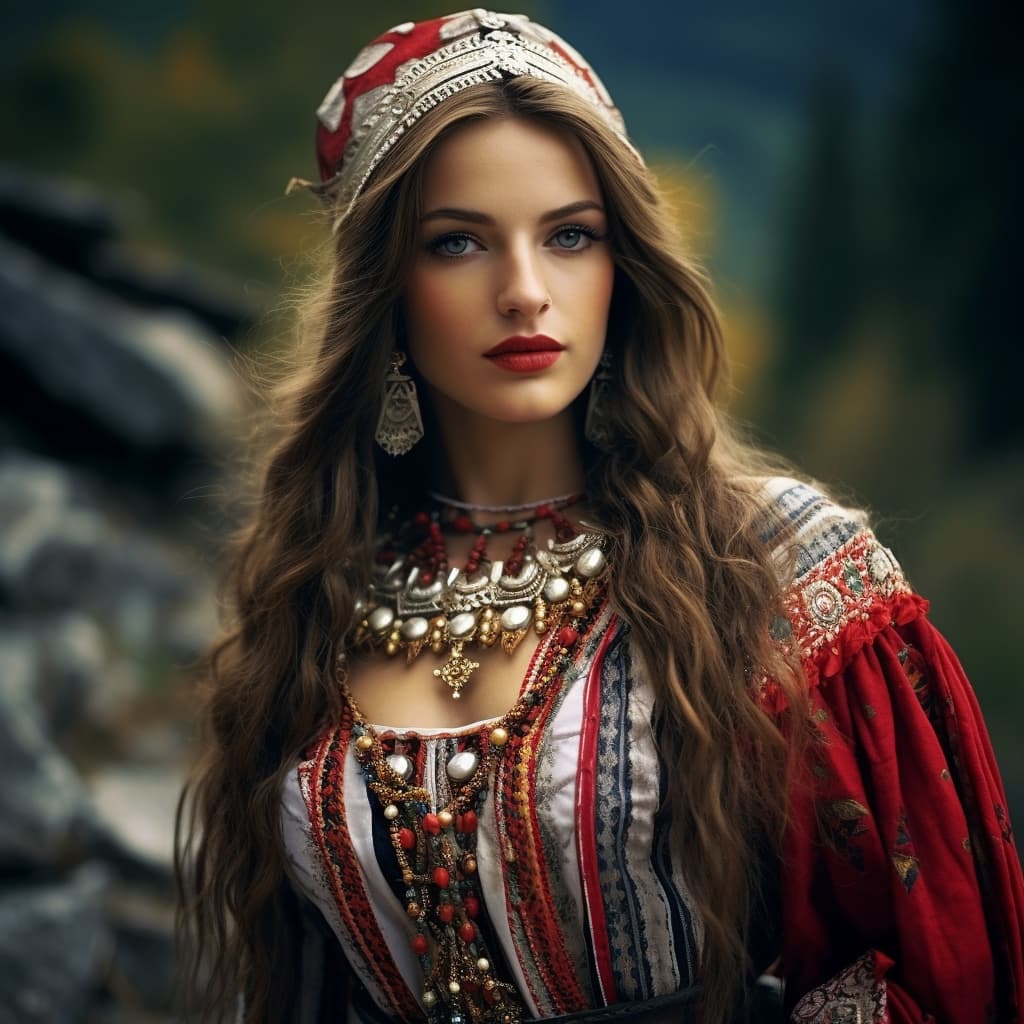
Macedonians Erotic
North Macedonia
Indo-European / Slavic / Macedonian
Christianity / Eastern Orthodoxy
Torbesh, Mijaks, along with significant populations in Australia, Germany, Italy, Switzerland and Greece
Southern Europe
About Macedonians People
Macedonians are a South Slavic people whose modern national identity crystallized later than most of their neighbors — a fact that still shapes how they are seen, and how they see themselves. They sit at the south end of the Slavic world, in a small landlocked republic of mountains, lakes and the long valley of the Vardar river that cuts the country roughly in half. Skopje, the capital, was rebuilt after the 1963 earthquake and rebuilt again, controversially, by a 2010s state project that scattered neoclassical statues across the centre. Outside the capital, life is quieter and more legibly old: stone villages in the western highlands, vineyards on the southern plains, monasteries set into cliffs above Lake Ohrid.
The Macedonian language is Slavic, closely related to Bulgarian and only slightly more distantly to Serbian, written in a Cyrillic alphabet adapted in 1945. Its codification as a separate standard language is recent enough that Bulgaria, until very recently, formally disputed it — one of several reasons Macedonia's accession path to the EU has stalled. The country's name itself was the subject of a thirty-year argument with Greece, resolved in 2019 when the republic became North Macedonia. None of this is academic: every Macedonian adult has lived through it.
The dominant religion is Eastern Orthodoxy, organized around the Macedonian Orthodox Church, which received canonical recognition from the Serbian Patriarchate only in 2022 after decades as an unrecognized splinter. Religious life is woven into the calendar — slava-style family saint days, the lake-edge pilgrimage to Sveti Naum, the basil-and-cross ritual of Vodici in January, when men dive into freezing rivers to retrieve a thrown crucifix. The Mijaks, a highland sub-group from the Reka region, are known for woodcarving traditions — the iconostasis at the Bigorski Monastery is their most famous work — and for a wedding cycle that runs to several days. The Torbeshi, by contrast, are Macedonian-speaking Muslims, a reminder that the country's Slavic Orthodox majority has always lived alongside Albanian, Turkish, Roma and Vlach communities rather than apart from them.
Emigration has been a constant. Large diaspora populations in Australia, Germany, Switzerland and Italy mean that for many families the village house is now a summer house, and remittances are a quiet but real part of the economy. The Greek question — the existence of a Slavic-speaking Macedonian minority across the southern border — remains tender on both sides.
Typical Macedonians Phenotypes
Reference for AI generation — hair, eyes, skin, facial structure, build
Macedonians sit at a Balkan crossroads where South Slavic settlement layered over older Paleo-Balkan, Greek, and Roman populations, and the phenotype reads accordingly: Mediterranean-leaning rather than Northern-Slavic. Hair runs predominantly dark — chestnut to near-black — with a meaningful minority of medium and dark brown shades carrying warm undertones. True blondes are uncommon outside childhood, though dark-blond and ash-brown surface more often in the western highlands among the Mijaks, who tend to retain lighter coloring than lowland populations. Texture is typically straight to softly wavy; tight curls are rare. Body and facial hair growth in men is moderate to heavy, beards filling in densely and often a shade darker than scalp hair.
Eyes are most often brown in its full range from honey to near-black, with hazel and green appearing at noticeably higher rates than in neighboring Slavic populations to the north — a Balkan signature. Pure blue is a clear minority. Eyelids are open and almond-shaped; epicanthic folds are absent. Brows are typically full, set close to the eye, and often the darkest feature on the face.
Skin spans Fitzpatrick II to IV, clustering at III — an olive-to-light-olive base with warm yellow or faint green undertones that tan readily and rarely burn deeply. Coastal and southern lineages skew darker; western mountain communities lighter. Facial structure tends toward angular: a straight or gently aquiline nose with a moderately defined bridge, medium alar width, and a defined tip. Cheekbones are present but not prominent in the Slavic-northern sense; jaws are squared in men, oval in women. Lips are medium in fullness, often with a defined cupid's bow.
Build is mid-height by European standards — men averaging around 178 cm, women around 165 cm — with broader shoulders and stronger lower-body musculature than the Mediterranean average, a legacy of mountain-pastoral ancestry. The Torbesh, Macedonian-speaking Muslims, fall within the same phenotype range; visible differentiation is cultural rather than morphological.
Data depth
0/100Coverage of image-grounded phenotype observations · drives AI generation diversity
- Sample size
- 0/40· 0 images
- Image quality
- 0/30· 0% high
- Confidence
- 0/20
- Source diversity
- 0/10
- ·No image observations yet
Explore phenotype categories
Structured taxonomy with peer-reviewed scales · 22 anatomical categories






Generate Macedonians AI Content
Use this ethnicity's phenotype data to create AI-generated content with accurate physical traits and cultural context.
Open Creator Studio