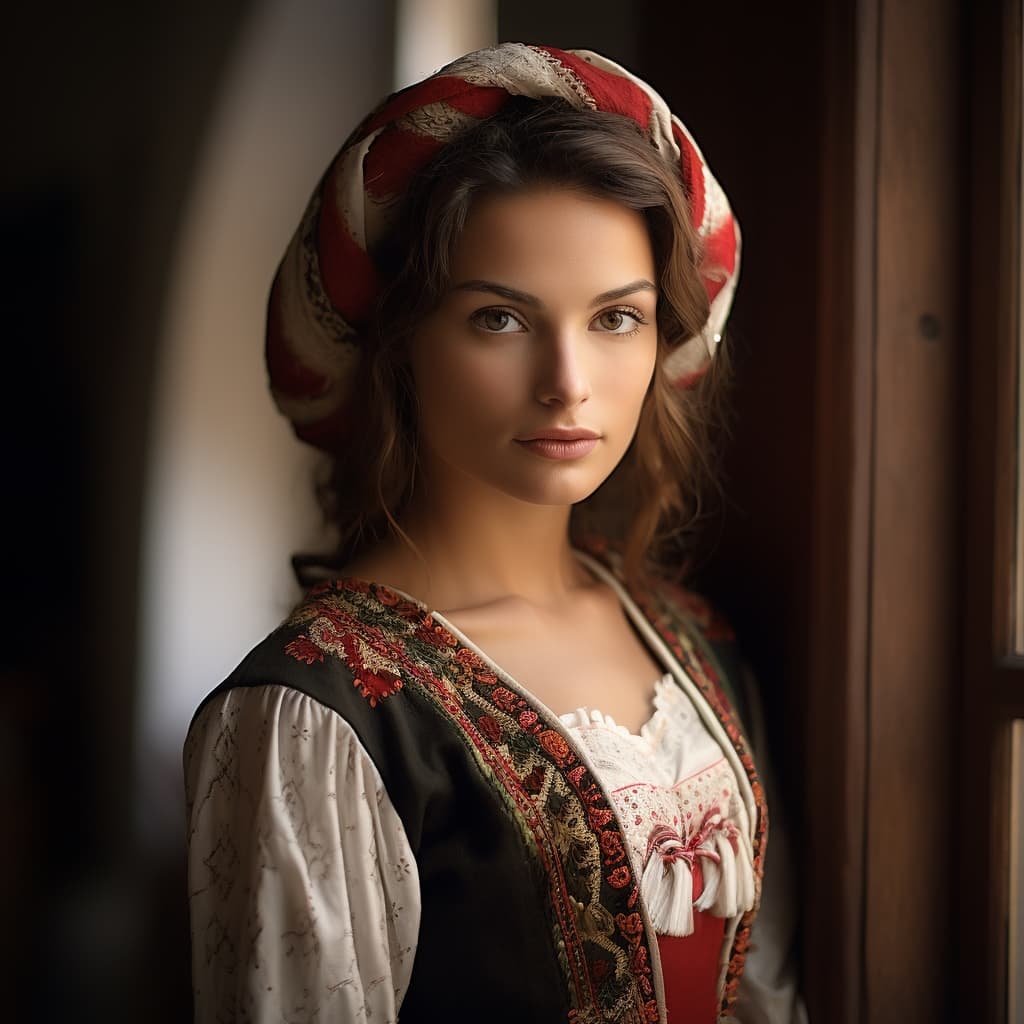
Friulians Erotic
Friuli (Italy)
Indo-European / Romance / Friulian
Christianity / Catholicism
Southern Europe
About Friulians People
The Friulians occupy the corner of northeastern Italy that wedges up against Slovenia and Austria — a flat coastal plain rising into Alpine foothills and then the Carnic and Julian Alps. The region's geography did most of the cultural work: it sat on the trade road between Venice and Vienna, was the easternmost reach of Latin Rome, and absorbed pressure from Slavic and Germanic neighbors without quite becoming any of them. What emerged was a people who think of themselves as Italian in citizenship but distinctly not in language, cuisine, or temperament.
The Friulian language — furlan — is the marker most Friulians point to first. It belongs to the Rhaeto-Romance branch alongside Romansh in Switzerland and Ladin in the Dolomites, which means it descends from the Latin spoken in the Roman province of Aquileia rather than from the Tuscan that became standard Italian. To an Italian speaker it sounds adjacent but unintelligible: vowels are longer, plurals are formed differently, and there's a layer of vocabulary that a Venetian or Roman simply doesn't recognize. UNESCO classifies it as endangered, but it is taught in regional schools, used on bilingual road signs, and still spoken as a first language in villages on the plain and in the mountains. Within Friuli itself there are recognizable variants — the Carnic dialects of the high valleys, the central Friulian around Udine, and a western variant around Pordenone that fades toward Veneto.
Catholicism is the default religious frame, anchored historically by the Patriarchate of Aquileia, which for centuries was one of the great ecclesiastical territories of medieval Europe and gave Friuli a clerical identity separate from Rome's direct orbit. The patriarchate is gone, but its physical traces — the basilica at Aquileia, the small Romanesque churches scattered across the plain — still organize the landscape. Day-to-day religious practice is less performative than in southern Italy: feast days, processions, and the agricultural calendar rather than ostentation.
The defining historical wound is the First World War, fought up and down the Isonzo river along Friuli's eastern edge, and then the 1976 earthquake that flattened much of the central region. The reconstruction afterward — locally organized, deliberately faithful to the old building stock — became a point of regional pride and is still cited as a reference case for how disaster recovery should work. Friulians tend to mention it unprompted.
Typical Friulians Phenotypes
Reference for AI generation — hair, eyes, skin, facial structure, build
Friulians sit at a phenotypic seam in northeastern Italy, where Alpine, Venetic, and Slavic-Slovenian inputs meet the broader North Italian baseline. The result is a population that reads as Northern rather than Mediterranean — lighter on average than Tuscans or Romans, but still distinctly Italian in facial structure rather than Central European.
Hair runs predominantly mid-to-dark brown, with a meaningful minority of dark blond and chestnut shades that lighten further north toward the Carnic Alps. True black hair is uncommon; auburn and reddish-brown turn up sporadically, more often along the Slovenian-border valleys. Texture is overwhelmingly straight to loosely wavy, fine to medium in caliber. Children frequently start blond and darken through adolescence, a pattern shared with much of the Alpine arc.
Eyes show one of the higher light-eye frequencies in Italy — blue, blue-grey, green, and hazel together account for a sizeable share of the population, particularly in Carnia and the Friulian Dolomites. Brown eyes still predominate overall but trend toward lighter, amber-flecked browns rather than the deep near-black common further south. Eyelids are typically Caucasian-flat with no epicanthic fold; the orbital region tends to be moderately deep-set.
Skin sits mostly at Fitzpatrick II–III with neutral to slightly cool undertones, tanning to a light olive in summer rather than going deeply bronze. Lowland Friulians from the Udine and Pordenone plains tend to be a half-shade darker and warmer than mountain Friulians from Carnia, who often present a paler, rosier complexion that flushes easily.
Facial structure favors a straight or gently aquiline nose with a narrow-to-medium bridge and modest alar width — less prominent than the classic Roman profile. Lips are medium, jaws clean rather than heavy, cheekbones moderately defined. Build is solidly average-to-tall for Italy, with men commonly 174–180 cm; mountain populations skew leaner and wirier, while plains and coastal Friulians carry a broader, sturdier frame.
Data depth
0/100Coverage of image-grounded phenotype observations · drives AI generation diversity
- Sample size
- 0/40· 0 images
- Image quality
- 0/30· 0% high
- Confidence
- 0/20
- Source diversity
- 0/10
- ·No image observations yet
Explore phenotype categories
Structured taxonomy with peer-reviewed scales · 22 anatomical categories






Generate Friulians AI Content
Use this ethnicity's phenotype data to create AI-generated content with accurate physical traits and cultural context.
Open Creator Studio