Bosniaks Erotic
Bosnia and Herzegovina, Sandžak (Serbia, Montenegro)
Indo-European / Slavic / Serbo-Croatian / Bosnian
Islam / Sunni Islam
Significant populations in Serbia, Turkey, Austria, Germany and the United States
Southern Europe
About Bosniaks People
Bosniaks are the South Slavs whose ancestors stayed Muslim after the Ottomans left. That single sentence holds most of what distinguishes them from their Serb and Croat neighbors, with whom they share a language, a landscape, and roughly a thousand years of intertwined history. The split is not ethnic in any biological sense — it is confessional, and the confession became an identity slowly, then suddenly, over the course of the twentieth century. Bosnian, Serbian, and Croatian are mutually intelligible variants of what linguists still often call Serbo-Croatian; a Bosniak speaks the same Slavic tongue as a Sarajevan Serb, written in the same Latin script, with a slightly higher load of Turkish and Arabic loanwords carried over from four centuries of Ottoman rule.
The homeland is Bosnia and Herzegovina, a country shaped like a rough triangle wedged between the Dinaric Alps and the Sava plain, with a sliver of Adriatic coast at Neum and very little else. Bosniaks also form the majority Muslim population of the Sandžak, a historical region split between southwestern Serbia and northeastern Montenegro, and substantial diaspora communities sit in Turkey, Austria, Germany, and the United States — many of them displaced or descended from those displaced by the wars of the 1990s. The Srebrenica genocide of July 1995 is the inflection point that any honest account has to name; it is recent enough that survivors are middle-aged, and it shapes the political and emotional life of the community in ways outsiders routinely underestimate.
Religious practice is generally Hanafi Sunni, mediated through the Islamic Community of Bosnia and Herzegovina, an institution that traces its organizational lineage to the Austro-Hungarian period and operates with a distinctly European, post-Ottoman character. Bosniak Islam is often described as moderate, which is a flattening word for something more interesting: a tradition that absorbed centuries of coexistence with Catholic Croats, Orthodox Serbs, and Sephardic Jews who arrived after the Spanish expulsion. The dervish orders — Naqshbandi, Qadiri, Mevlevi — left a Sufi imprint that survives in tekkes scattered across the country. Coffee culture is taken seriously; the small copper džezva is a household object, not a souvenir. Sevdalinka, the urban folk-song form, is the place where the language's emotional register lives most fully, and it remains the genre Bosniaks reach for when they want to say something about themselves that prose cannot quite carry.
Typical Bosniaks Phenotypes
Reference for AI generation — hair, eyes, skin, facial structure, build
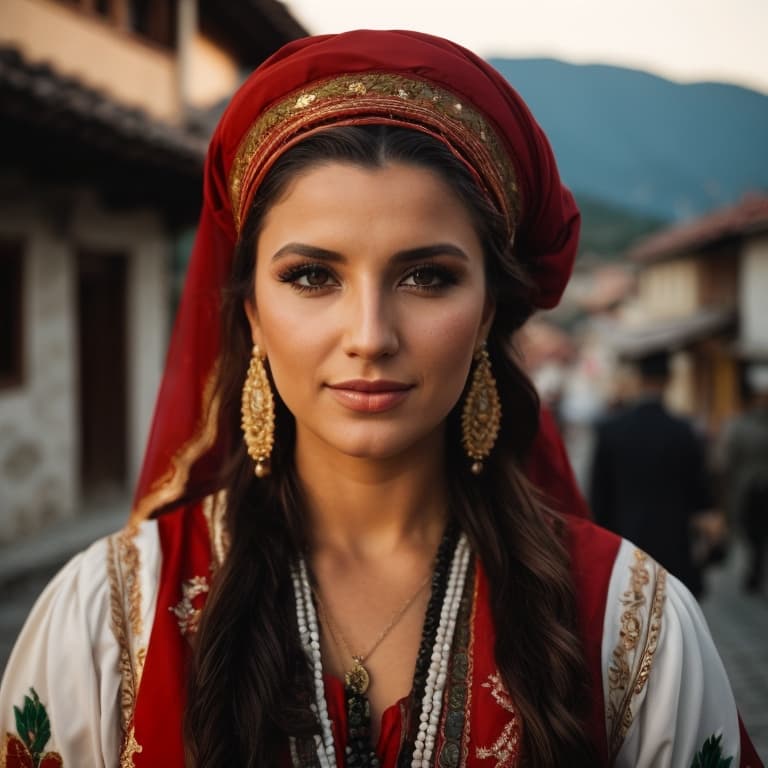
Bosniaks sit at a Slavic–Dinaric crossroads, and the phenotype reflects it: tall, broad-framed Southern Europeans with a Mediterranean caste that runs cooler than Italians or Greeks but warmer than Northern Slavs. Hair is most commonly dark brown to near-black, with chestnut and ash-brown frequencies climbing in the northern Sava basin and among populations bordering Croatia. Mid- to dark-blonde occurs in childhood and often darkens by adolescence; true red is uncommon. Texture skews straight to loosely wavy, fine to medium in density, with frizz and tight curl genuinely rare.
Eyes lean dark — brown predominates — but light eyes appear at a meaningfully higher rate than the Balkan average, with green, hazel, and a cool grey-blue showing up regularly, particularly in the Herzegovinian highlands. Lids are deep-set with no epicanthic fold; brow ridges are pronounced in men, and the upper-lid crease is high and sharply defined. Skin reads Fitzpatrick II–III, occasionally IV in the south, with neutral-to-olive undertones; cheeks flush easily, and tanning is even rather than ruddy.
The facial signature is structural. Bosniaks carry the Dinaric craniofacial pattern more visibly than almost any neighboring population: a long, narrow face, a flattened occiput, a straight or slightly convex nose with a narrow bridge and tight alar base, and a strong, often square jaw. Lips are medium — the lower fuller than the upper — and cheekbones are high but not broad. Adi Granov's features are a fair anchor for the male type.
Build is the headline. Bosniaks rank among the tallest peoples on earth: contemporary male means cluster around 183–184 cm, with Herzegovinian sub-populations reported above 185 cm. Frames are long-limbed and broad-shouldered; women run tall and slender-hipped through youth, with a tendency toward fuller bust and softer waistline by middle age. Diaspora populations in Turkey, Austria and Germany show the same template, slightly diluted toward host-country averages over generations.
Data depth
74/100Coverage of image-grounded phenotype observations · drives AI generation diversity
- Sample size
- 39/40· 48 images
- Image quality
- 20/30· 40% high
- Confidence
- 15/20· mean 0.73
- Source diversity
- 0/10· wikipedia
- ·Wikipedia-only source — not population-representative
Observed Distribution — Image Sample
Empirical observations from analyzed photographs · supplementary signal, not population truth
Sample: 48 images analyzed (48 wikipedia). Quality: 19 high, 22 medium, 7 low, 0 very_low. Avg analyzer confidence: 0.73.
Skin tone (Fitzpatrick): II (58%), III (31%), IV (6%), V (2%), unclear (2%)
Hair color: black (46%), gray/white (27%), blonde (13%), light/medium brown (8%), dark brown (6%)
Hair texture: straight (56%), wavy (35%), coily (2%), shaved (6%)
Eye color: dark brown (50%), hazel (8%), blue (8%), brown (6%), unclear (27%)
Epicanthic fold: 0% present, 85% absent, 15% unclear
Caveats: Sample is 100% Wikipedia notable people — skews toward male, public-life, and modern figures, not population-representative.
Last aggregated: May 7, 2026
Explore phenotype categories
Structured taxonomy with peer-reviewed scales · 22 anatomical categories
Notable Bosniaks People
100 reference figures — sourced from Wikipedia
- Adil Zulfikarpašić — politician and intellectual
- Aida Hadžialić — Swedish youngest minister ever
- Asim Peco — linguist and academic
- Edina Lekovic — Director of Policy & Programming at the Muslim Public Affairs Council
- Emir Vildić — academic musician
- Enver Redžić — historian, cultural observer, publisher, professor
- Faruk Čaklovica — Professor of Bromatology and Rector of the University of Sarajevo
- Ferid Muhić — Professor of Philosophy
- Hasan Muratović — former rector of the University of Sarajevo
- Kemal Gekić — professor of piano at the Florida International University
- Rifat Rastoder — politician, writer and journalist
- Metin Boşnak — [citation needed], scholar of American Studies and Comparative Literature
- Muhamed Filipović — historian and philosopher
- Mustafa Imamović — historian
- Mina Aganagić — mathematical physicist
- Nasiha Kapidžić-Hadžić — children's book author and poet
- Nijaz Duraković — author, intellectual, professor and politician
- Nijaz Ibrulj — philosopher and a professor at the University of Sarajevo's Department of Phi…
- Endi E. Poskovic — Professor at the University of Michigan School of Art and Design and Associat…
- Seada Palavrić — judge of the Constitutional Court of Bosnia and Herzegovina
- Senahid Halilović — linguist
- Smail Balić — Austrian historian and culturologist of Bosniak origin
- Šemso Tucaković — writer, historian and faculty member in the Department of Political Sciences …
- Šerbo Rastoder — historian
- Zijad Delic — Bosnian-Canadian Imam, activist, teacher, scholar and public speaker
- Adi Granov — comic book artist
- Kemal Curić — Bosnian automobile designer
- Nela Hasanbegović — sculptor
- Nesim Tahirović — painter, sculptor
- Omer Halilhodžić — Bosnian automobile designer
- Safet Zec — painter, graphic designer
- Selma Harrington — Bosnian-born architect and designer who currently lives in Dublin, Ireland
- Dino Zonić — composer and conductor
- Jasmin Bašić — born 1971)
- Aida Čorbadžić — born 1976)
- Bahrija Nuri Hadžić — 1904–1993)
- Anabela Atijas — born 1975), father was a Bosniak
- Adnan Babajić — born 1988)
- Alma Čardžić — born 1968)
- Amila Glamočak — born 1966)
- Dalal Midhat-Talakić — born 1981)
- Danijel Alibabić — Montenegrin singer with a Bosniak father
- Deen — born 1982)
- Denial Ahmetović — born 1995)
- Dino Merlin — born 1962)
- Donna Ares — 1977–2017)
- Dua Lipa — maternal grandmother is Bosniak
- Dženy — born 1987)
- Eldin Huseinbegović — born 1978)
- Elvir Mekić — born 1981)
- Emina Jahović — born 1982)
- Fazla — born 1967)
- Indira — born 1973), mother is a Bosniak
- Kemal Monteno — 1948–2015)
- La Lana — born 1984), mother is a Bosniak
- Lepa Brena — born 1960)
- Maya Sar — born 1981)
- Mirza Šoljanin — born 1985)
- Peter Nalitch — born 1981), Russian singer whose grandfather was a Bosniak
- Rialda — born 1992)
- Sabahudin Kurt — 1935–2018)
- Seka Aleksić — born 1981), mother was a Bosniak
- Selma Bajrami — born 1980), mother was a Bosniak
- Selma Muhedinović — born 1972)
- Senidah — born 1985), Slovenian singer whose parents were Bosniaks
- Zuzi Zu — born 1978)
- Alen Islamović — born 1957)
- Branko Đurić — born 1962), mother was a Bosniak
- Cem Adrian — born 1980), Turkish singer of Bosniak ancestry
- Elvir Laković Laka — born 1969)
- Hari Varešanović — born 1961)
- Sead Lipovača — born 1955)
- Seid Memić — born 1950)
- Buba Corelli — born 1989)
- Edo Maajka — born 1978)
- Frenkie — born 1982)
- Jala Brat — born 1986)
- Beba Selimović — 1936–2020)
- Damir Imamović — born 1978)
- Dina Bajraktarević — born 1953)
- Emina Zečaj — 1929–2020)
- Hanka Paldum — born 1956)
- Meho Puzić — 1937–2007)
- Safet Isović — 1936–2007)
- Zaim Imamović — 1920–1994)
- Zehra Deović — 1938–2015)
- Zekerijah Đezić — 1937–2002)
- Al' Dino — born 1970), singer-songwriter and composer
- Asim Brkan — born 1954)
- Elvira Rahić — born 1975)
- Enes Begović — born 1965)
- Esad Plavi — born 1965)
- Halid Bešlić — born 1953)
- Halid Muslimović — born 1960)
- Haris Džinović — born 1951)
- Jasmin Muharemović — born 1965)
- Kemal Malovčić — born 1946)
- Osman Hadžić — born 1966)
- Nihad Alibegović — born 1962)
- Nino Rešić — 1964–2007)
Generate Bosniaks AI Content
Use this ethnicity's phenotype data to create AI-generated content with accurate physical traits and cultural context.
Open Creator Studio