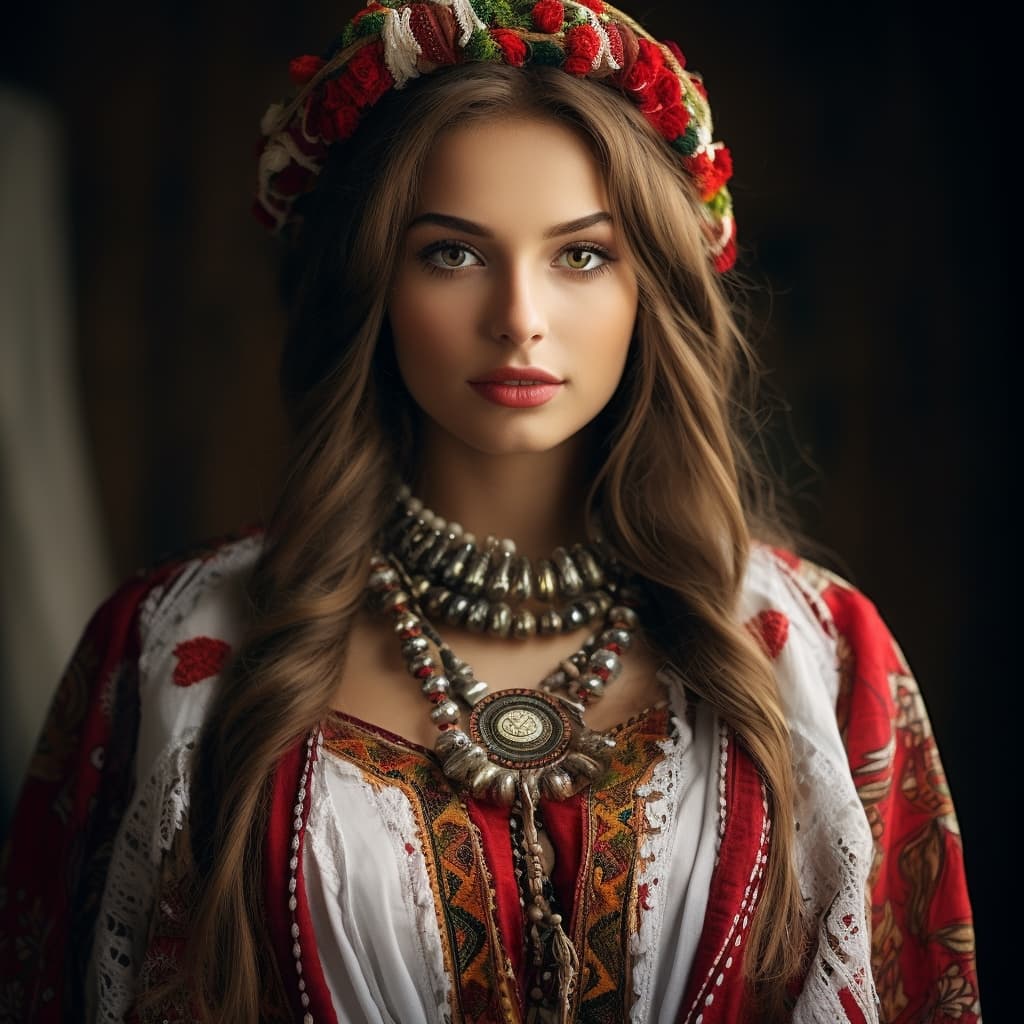
Moldovans Erotic
Moldova
Indo-European / Romance / Romanian / Moldavian
Christianity / Eastern Orthodoxy
Significant populations in Romania, Ukraine, Russia, and the United States
Southern Europe
About Moldovans People
Whether Moldovans are a distinct people or simply Romanians on the wrong side of a river is a question the Moldovans themselves have never fully settled, and the ambiguity is the most honest place to start. The land between the Prut and the Dniester has been Bessarabia, a tsarist province, a Romanian region, a Soviet republic, and since 1991 the independent Republic of Moldova. Each of those identities left a sediment, and the modern Moldovan tends to carry several at once — speaking what the constitution now calls Romanian to a Romanian visitor, Moldovan to a grandmother, and often Russian at work, especially in the cities and in the breakaway sliver of Transnistria that still operates on Soviet muscle memory.
The language itself is straightforward Daco-Romance, a Latin-rooted holdout pressed into the Slavic world, closer to the speech of Iași than to anything spoken in Sofia or Kyiv. What makes it sound Moldovan rather than Romanian is mostly accent and a thicker layer of Russian and Ukrainian loanwords, plus a stubborn taste for diminutives — everything in conversation gets a softer, smaller suffix. For decades the Soviets wrote the language in Cyrillic and insisted it was its own thing; the return to Latin script in 1989 was one of the loud opening notes of independence.
Most Moldovans are Eastern Orthodox, but the church is split along the same fault as the politics: a Metropolis under Bucharest and a larger one under Moscow, with parishes occasionally changing sides. Religion shows up less in doctrine than in calendar — Easter is the central event of the year, and rural Moldova still keeps a dense schedule of saints' days that double as agricultural markers. Hospitality is taken seriously to the point of obligation, and the wine that gets poured is almost always made by someone in the room or one degree removed; Moldova produces an enormous amount of wine for a country its size, and household production is a cultural constant rather than a hobby.
Demographically the country has been hollowing out for thirty years. Working-age Moldovans have gone to Italy, Romania, Russia, Germany, and the United States in numbers large enough to bend the economy around remittances, and the diaspora is now an organic part of how Moldovans see themselves — half the family abroad, half at home, the village the fixed point both sides return to.
Typical Moldovans Phenotypes
Reference for AI generation — hair, eyes, skin, facial structure, build
Moldovans sit at a phenotypic crossroads — Eastern Romance populations carrying clear admixture from Slavic, Turkic, and Balkan neighbors after centuries of being the corridor between Carpathian Europe and the Pontic steppe. The result is a population that reads broadly Southeastern European but with more internal variation than the Romanian core to the west.
Hair is most often medium to dark brown, with chestnut and ash-brown common; true black hair appears but is a minority, and natural blond persists in northern districts and among Russian-descended Moldovans. Texture runs straight to softly wavy — tight curls are uncommon. Greying tends toward early salt-and-pepper rather than uniform silver. Eyes lean brown and hazel, but light eyes — green, grey-green, and a steel blue — are notably more frequent than in Mediterranean populations to the south, a legacy of Slavic and broader Eastern European gene flow. Eyelids are typically open and almond-shaped with no epicanthic fold; brows tend to be defined and full, often darker than the hair.
Skin generally falls in Fitzpatrick II–III: fair to light olive with neutral-to-warm undertones that tan readily through Moldova's hot continental summers. Pale, pink-leaning complexions exist alongside a more sallow olive cast — the latter more common in the south near the Bugeac and the Black Sea littoral. Faces show moderately high cheekbones, straight or slightly aquiline noses with medium alar width, medium-full lips, and softer rather than sharply angular jawlines. Sofia Rotaru is a useful anchor for the warmer, fuller-featured southern Moldovan look.
Build is mid-tall by European averages — men commonly around 175–178 cm, women 163–166 cm — with broader shoulders and stronger lower-body musculature than Mediterranean averages, reflecting a long agrarian and viticultural population. Sub-group variation runs north-to-south: northern Moldovans (Bălți, Edineț) trend lighter in hair, eyes, and skin under stronger Slavic influence, while southern and Transnistrian populations show warmer skin, darker hair, and a touch more Balkan-Turkic facial structure.
Data depth
74/100Coverage of image-grounded phenotype observations · drives AI generation diversity
- Sample size
- 40/40· 62 images
- Image quality
- 19/30· 39% high
- Confidence
- 15/20· mean 0.72
- Source diversity
- 0/10· wikipedia
- ·Wikipedia-only source — not population-representative
Observed Distribution — Image Sample
Empirical observations from analyzed photographs · supplementary signal, not population truth
Sample: 62 images analyzed (62 wikipedia). Quality: 24 high, 29 medium, 8 low, 1 very_low. Avg analyzer confidence: 0.72.
Skin tone (Fitzpatrick): II (76%), III (16%), IV (5%), unclear (3%)
Hair color: gray/white (42%), black (34%), light/medium brown (13%), dark brown (5%), blonde (3%), red/auburn (3%)
Hair texture: straight (63%), wavy (31%), curly (2%), bald (2%), shaved (3%)
Eye color: dark brown (40%), blue (23%), hazel (6%), brown (3%), green (2%), unclear (26%)
Epicanthic fold: 2% present, 90% absent, 8% unclear
Caveats: Sample is 100% Wikipedia notable people — skews toward male, public-life, and modern figures, not population-representative.
Last aggregated: May 7, 2026
Explore phenotype categories
Structured taxonomy with peer-reviewed scales · 22 anatomical categories
Notable Moldovans People
78 reference figures — sourced from Wikipedia
- Baruch Agadati — Palestinian-Israeli classical ballet dancer, choreographer, painter, and film…
- Tudor Cataraga — sculptor
- Nachum Gutman — Teleneşti-born Israeli painter, sculptor, and author
- Valentin Mednek — architect
- Alexandru Plămădeală — sculptor
- Alexey Shchusev — Russian architect
- Alexandru Donici — poet and translator
- Alexei Mateevici — poet and publicist
- Victor Ciobanu — writer and specialist in agriculture
- Bogdan Petriceicu-Hasdeu — writer and historian
- Constantin Stamati — writer and translator
- Constantin Stamati-Ciurea — writer and translator
- Grigore Vieru — poet and writer
- Ion Anton — poet and writer
- Ion Druță — novelist
- Lidia Kulikovski — librarian, bibliographer and editor
- Mihai Eminescu — poet, novelist, and journalist
- Petru Cărare — poet and epigrammatist
- Victor Teleucă — writer and poet
- Vladimir Beșleagă — novelist
- Sergiu Moraru — folklorist
- Anna Odobescu — singer and actress
- Valentina Naforniță — soprano opera singer
- Dan Bălan — pop singer
- Arsenie Todiraș — pop singer
- Natalia Barbu — pop singer
- Maria Bieșu — opera singer
- Maria Cebotari — opera singer
- Mihai Dolgan — pop singer
- Valeriu Găină — guitarist
- Lidia Isac — pop singer
- Radu Marian — opera singer
- Sofia Rotaru — pop singer
- Radu Sîrbu — pop singer
- Pavel Stratan — folk singer
- Vika Jigulina — pop singer made famous for her hit Stereo Love
- Mark Zeltser — concert pianist
- Andrew Rayel — trance producer and DJ
- Sergey Stepanov — saxophonist, feminist
- Misha Miller — pop singer
- Lev Berg — Russian biologist and geographer
- George de Bothezat (Gheorghe Botezatu) — engineer and pioneer of helicopter flight
- Ștefan Ciobanu — historian
- Nicolae Donici — astronomer
- Jerzy Neyman — Polish statistician
- Anatolie Kovarski — [ro], (1904–1974), agronomist
- Brigitta P. Kovarskaia — 1930–1998) physicist, computer scientist, educator, and local historian
- Victor Kovarski — [ro] (1929–2000), physicist
- Sergiu Rădăuțanu — physicist
- Nikolay Sclifosovsky — Russian surgeon and physiologist
- Nicolae Testemițanu — physician, surgeon and hygienist
- Timofei Moșneaga — physician, associate professor and former Minister of Health
- Nikolay Zelinsky — Russian chemist
- Radu Albot — first Moldovan tennis player to win an ATP title
- Alexandru Bratan — weightlifter
- Serghei Covalciuc — football player
- Boris Polak — Israeli world champion and Olympic sport shooter
- Ion Cuțelaba — UFC fighter
- Serghei Spivac — UFC fighter
- Dumitru Braghiș — former Prime Minister of Moldova
- Dorin Chirtoacă — former Mayor of Chișinău
- Dumitru Diacov — former President of the Parliament
- Vladimir Filat — former Prime Minister of Moldova
- Mihai Ghimpu — former acting President of Moldova
- Avigdor Lieberman — Moldovan-born Israeli Member of the Knesset
- Petru Lucinschi — 2nd President of Moldova
- Tatiana Molcean — Executive Secretary of the United Nations Economic Commission for Europe (UNECE)
- Alexandru Moșanu — historian, 1st President of the Parliament
- Iurie Roșca — former Deputy Prime Minister
- Oleg Serebrian — political scientist and diplomat
- Mircea Snegur — 1st President of Moldova
- Vasile Tarlev — former Prime Minister of Moldova
- Stepan Topal — Gagauz politician and activist
- Serafim Urechean — former Mayor of Chișinău
- Vladimir Voronin — 3rd President of Moldova
- Daria Harjevschi — librarian who improved the services of the Chișinău Public Library
- Xenia Deli — fashion model
- Zvi Kogan — rabbi killed in the United Arab Emirates
Generate Moldovans AI Content
Use this ethnicity's phenotype data to create AI-generated content with accurate physical traits and cultural context.
Open Creator Studio