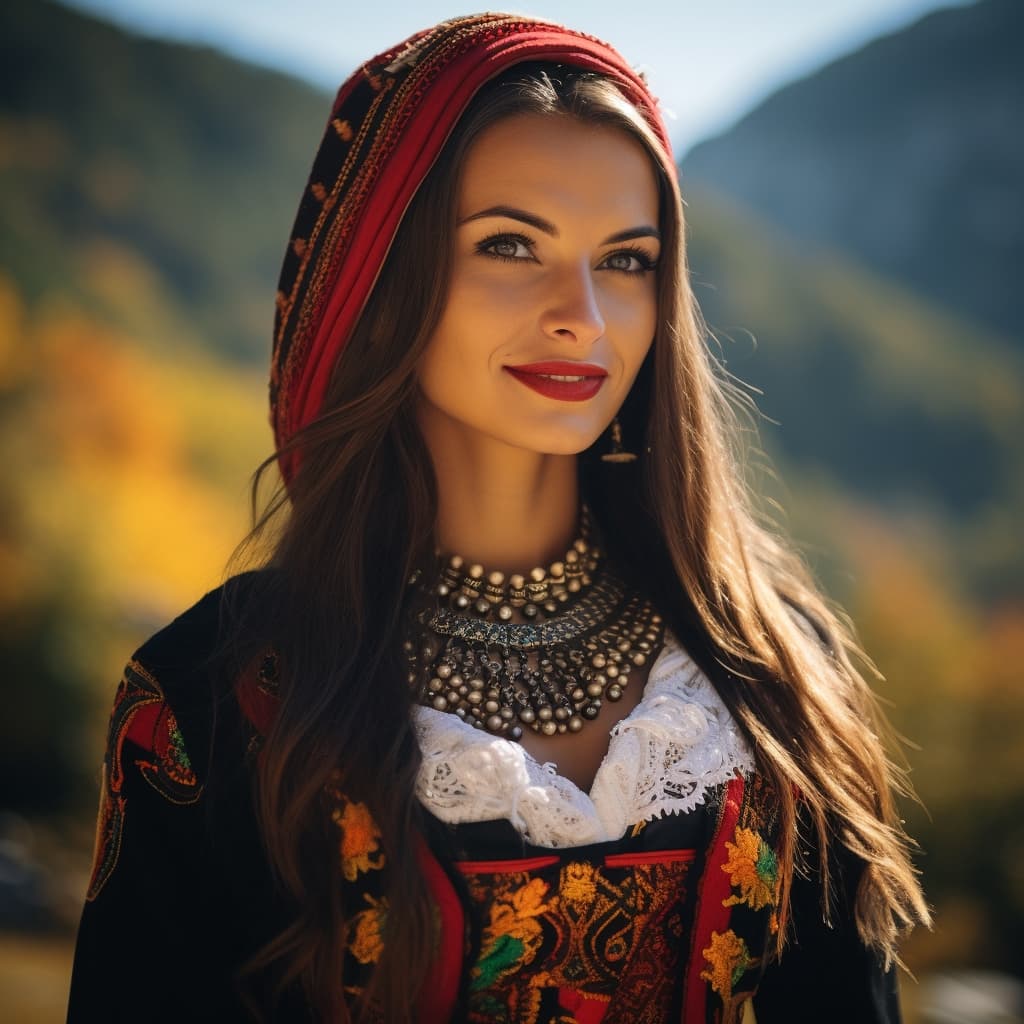
Montenegrins Erotic
Montenegro
Indo-European / Slavic / Serbo-Croatian / Montenegrin
Christianity / Eastern Orthodoxy
Significant populations in Serbia and the United States
Southern Europe
About Montenegrins People
Montenegrins are a South Slavic people whose identity was forged less by language than by terrain. The country they take their name from — Crna Gora, "black mountain" — is barely larger than Connecticut, but its karst highlands and the steep limestone shoulders behind the Bay of Kotor created pockets that Ottoman administration never fully penetrated. That partial autonomy, sustained for centuries by clan-based militias and a series of prince-bishops from the Petrović-Njegoš line, is the historical fact most Montenegrins still locate themselves against. The country was small, poor, and stubborn, and it stayed Orthodox Christian while neighbors converted under pressure.
The language they speak is mutually intelligible with Serbian, Croatian, and Bosnian — all four are standardized varieties of the same Shtokavian base — and the question of whether to call it Montenegrin or Serbian carries political weight that linguistic description cannot settle. Both Latin and Cyrillic scripts are in use. Two extra letters, ś and ź, were added to the Montenegrin standard in 2009 to mark sounds heard in southern dialects, a small orthographic gesture in a much longer argument about whether Montenegrins are a distinct nation or a regional branch of Serbs. Census results swing depending on how the question is asked.
Religious life runs through the Serbian Orthodox Church and, since 1993, a separately constituted Montenegrin Orthodox Church whose canonical status remains disputed. For most families the practical expression is the slava, the household feast for a patron saint inherited down the male line — a custom shared with Serbs and one of the clearest carriers of pre-modern clan identity into ordinary life. Older social structures around the pleme (tribe) and bratstvo (brotherhood) are no longer governing institutions, but the surnames, the village ties, and the long memory of who fought alongside whom in the wars against the Ottomans are still legible in how people introduce themselves.
The diaspora is concentrated in Serbia, with smaller communities in the United States — particularly around the steel and mining towns of the Midwest, where Montenegrin emigrants arrived in the late nineteenth and early twentieth centuries and built parishes that still hold liturgy in Church Slavonic. Independence from the state union with Serbia came by referendum in 2006, narrowly, and the country has spent the years since negotiating the awkward work of being formally separate from the people it most closely resembles.
Typical Montenegrins Phenotypes
Reference for AI generation — hair, eyes, skin, facial structure, build
Montenegrins carry one of the most striking statures in Europe — adult male mean height sits around 183 cm, placing them, alongside Dutch and Dinaric neighbors in Bosnia-Herzegovina and Dalmatia, at the very top of global anthropometric tables. The build is the classic Dinaric frame: long-limbed, broad-shouldered, narrow through the hips, with comparatively short trunks relative to leg length. Lean musculature is common in younger adults; older men carry weight in the chest and shoulders rather than the midsection. Women are tall by European norms (around 170 cm mean), often with pronounced shoulder breadth and a long-waisted silhouette.
Hair runs from medium brown through dark brown and near-black, with chestnut and dark-blond shades surfacing in the northern karst highlands. Texture is overwhelmingly straight to loosely wavy; tight curls are uncommon. Greying tends to come early relative to Mediterranean neighbors. Eyes split roughly evenly between brown and lighter shades — hazel, grey-green, and a cool slate-blue that is regionally characteristic, particularly around Nikšić and the Old Montenegro highlands. Eyelids are open and almond-shaped without epicanthic folds; brows are typically heavy and well-defined.
Skin sits in Fitzpatrick II–III: pale-to-light olive with a cool or neutral undertone that tans readily along the Adriatic coast and stays fairer in the interior mountains. The face is the most identifiably Dinaric feature — a tall, narrow cranium, a flattened or vertically planed occiput, a long straight or slightly aquiline nose with a high bridge and narrow alar base, prominent malar bones, and a strong, square jawline. Lips are moderate, neither thin nor full. The overall facial impression is angular and vertically elongated rather than rounded.
Coastal Montenegrins from Kotor and Budva tend toward darker hair, warmer olive skin, and a more Mediterranean cast, while highlanders from the Old Montenegro and Brda regions show paler skin, greater frequency of light eyes, and the most exaggerated Dinaric craniofacial proportions — the phenotype carried abroad by diaspora figures like Mark Brnovich.
Data depth
0/100Coverage of image-grounded phenotype observations · drives AI generation diversity
- Sample size
- 0/40· 0 images
- Image quality
- 0/30· 0% high
- Confidence
- 0/20
- Source diversity
- 0/10
- ·No image observations yet
Explore phenotype categories
Structured taxonomy with peer-reviewed scales · 22 anatomical categories
Notable Montenegrins People
17 reference figures — sourced from Wikipedia
- Andrija Paltašić — writer, editor and publisher
- Giovanni Bona Boliris — Ivan Bolica or Ivan Bunić)
- Jorge Milton Capitanich — Argentinian Senator
- Michael Anthony Stepovich — Governor of Alaska
- Melissa Bean — Luburic, Democratic Party representative in the United States of America Hous…
- Mark Brnovich — Attorney General of Arizona
- Oliver Vujović — Secretary General SEEMO; Austria
- Princess Anastasia Petrović-Njegoš of Montenegro — /Grand Duchess Anastasia Nicholaievna of Montenegro
- Princess Milica Petrović-Njegoš of Montenegro — /Grand Duchess Militsa Nicholaievna of Montenegro
- Princess Jelena Petrović-Njegoš of Montenegro — /Queen Elena of Italy
- Princess Ljubica (Zorka) Petrović-Njegoš of Montenegro — / Ljubica (Zorka) of the Kingdom of Serbs, Croats, and Slovenes
- Ozana of Kotor — beatified)
- Taylor Rochestie — born 1985), American-Montenegrin player in the Israel Basketball Premier League
- Velibor Radović — born 1972), Montenegrin-Israeli professional basketball player
- Jovan Vavic — lived in Montenegro)
- Nero Wolfe — fictional detective created by American writer Rex Stout
- Darinka Mirković Borović — nurse during World War I and a bearer of the Albanian Commemorative Medal






Generate Montenegrins AI Content
Use this ethnicity's phenotype data to create AI-generated content with accurate physical traits and cultural context.
Open Creator Studio