Scots Erotic
Scotland (United Kingdom)
Indo-European / Germanic / Scots, Indo-European / Celtic / Scottish Gaelic
Christianity / Protestantism
Ulster Scots, Orcadians, Shetlanders, Highlanders, Lowlanders, Highland Travellers, along with significant populations in the United States (including Scotch-Irish Americans), Canada, Australia, Argentina, and the Bahamas
Western Europe
About Scots People
The Scots are a nation defined as much by internal contrast as by anything that separates them from their southern neighbors. The line that runs roughly from the Firth of Clyde to the Firth of Forth has shaped the identity for centuries: Lowlanders looking outward to the North Sea trading world and developing the institutions — kirk, burgh, university — that gave Scotland its mercantile and intellectual weight; Highlanders organized for most of recorded history around clan and kin, with a different language, a different settlement pattern, and a long memory of being treated as a problem by Edinburgh as well as London. The islands complicate the map further. Orcadians and Shetlanders are Scots who still flag their Norse inheritance in dialect, place names, and a quiet insistence that they are not quite Highlanders and not quite anyone else.
Two languages sit alongside English. Scots — the Germanic tongue of Burns, of the Lowland towns, of Ulster across the water — is close enough to English to be dismissed by outsiders as an accent and distinct enough that its speakers know better. Scottish Gaelic is the Celtic language of the Highlands and the Hebrides, related to Irish but on its own trajectory for roughly a millennium; it has been hammered down by clearance, schooling policy, and economic gravity, and is now sustained by a determined revival rather than by ordinary household use. Religion since the Reformation has been overwhelmingly Protestant and specifically Presbyterian, the Church of Scotland organized around elders rather than bishops — a structure that bled into civic life and helped produce the famously literate parish culture that fed the eighteenth-century Enlightenment in Edinburgh and Glasgow.
The Highland Clearances of the late eighteenth and nineteenth centuries are the inflection point that explains why there are arguably more people of Scots descent abroad than at home. Tenants were pushed off the glens to make way for sheep, and the diaspora that followed — Scotch-Irish into Appalachia, Highlanders into Cape Breton and Otago, Lowlanders into the cities of the new world — carried Presbyterian institutions, surnames, and a particular flavor of stubbornness with them. Inside Scotland the Highland Travellers, sometimes called Nawken, are a smaller and older internal group with their own cant and trades. Hogmanay at New Year still outranks Christmas in the older reckoning, Burns Night each January is observed with a seriousness that surprises foreigners, and the country continues, as it has for some time, to argue with itself about whether it would rather be governed from Edinburgh alone.
Typical Scots Phenotypes
Reference for AI generation — hair, eyes, skin, facial structure, build
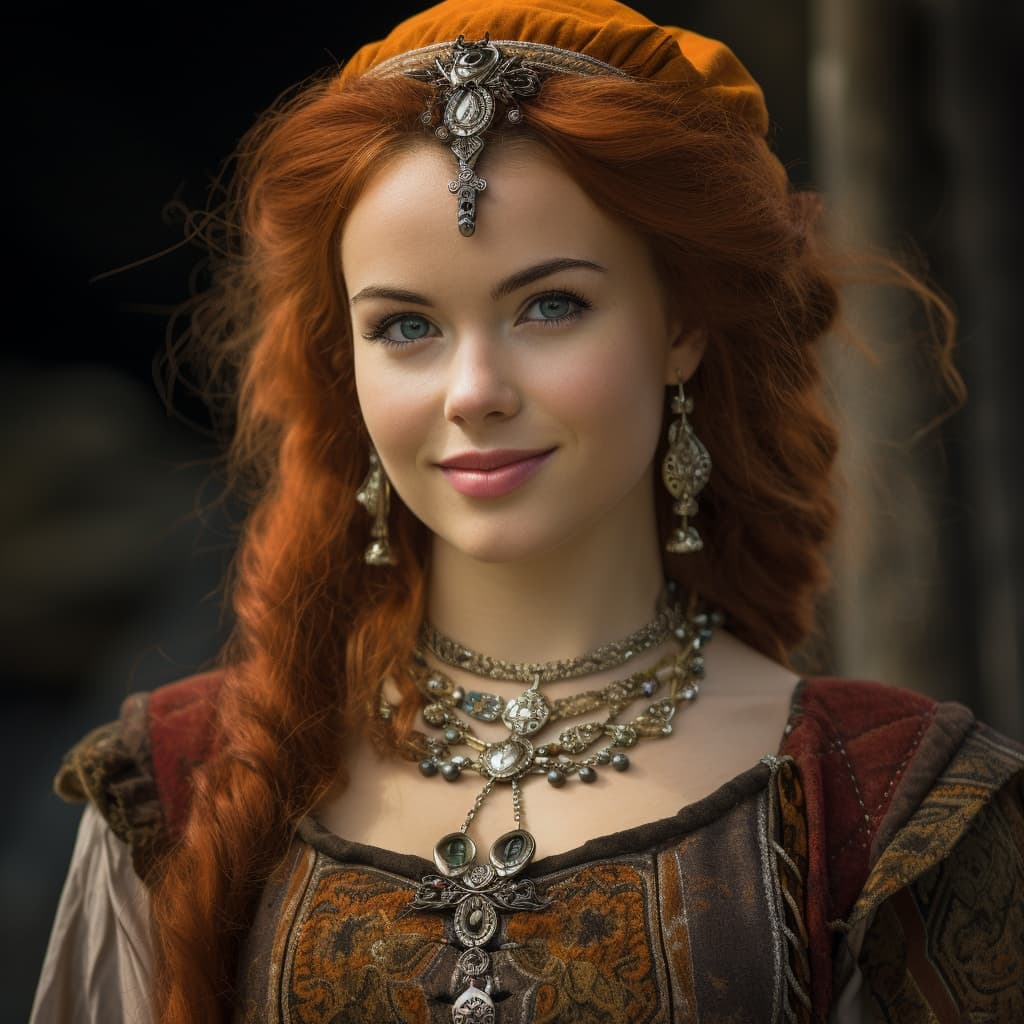
Scots phenotype reflects a Northwest European base with strong Gaelic and Norse layering, producing a population unusually rich in cool-toned colouring even by European standards. Hair runs the full spectrum from blue-black through every shade of brown to ash and platinum blond, but the defining trait is red — Scotland holds roughly 13% natural redheads, the highest concentration anywhere on Earth, with another ~30% carrying the recessive gene. Red hair appears across the auburn-to-copper-to-strawberry-blond range, often paired with freckling. Texture is most often straight to gently wavy; loose curls turn up regularly, tight coils almost never.
Eyes skew light. Blue, grey-blue, and grey dominate, with green and hazel common — Scotland and Ireland together carry the world's highest frequency of blue and green eyes. Brown occurs but is the minority. Eyelids are open and Northern European in shape, no epicanthic fold, often with a visible upper-lid crease and a slightly hooded look that becomes more pronounced with age.
Skin sits firmly in Fitzpatrick I–II: pale, often translucent, with pink or rosy undertones rather than olive. It burns easily and tans poorly, and freckling — sometimes dense, sometimes scattered across the bridge of the nose and shoulders — is near-universal in redheads and very common in blonds and light-browns. Cheeks flush readily; visible capillaries are typical.
Facial structure tends toward a straight or slightly aquiline nose with a narrow alar base, a defined jaw, and high-set cheekbones — the long, somewhat angular Gaelic face is a recognisable type alongside a rounder, softer-featured Lowland variant. Lips are usually moderate, neither notably full nor thin.
Build is solid and tall by historical European standards: men average around 5'9"–5'10", women 5'4"–5'5", with broad shoulders and a tendency toward sturdy, mesomorphic frames. Sub-regional variation is real: Orcadians and Shetlanders carry visible Norse input — taller, blonder, longer-faced — while Highlanders trend darker-haired and finer-boned than Lowlanders, and Highland Travellers often show distinctively dark hair against very fair skin.
Data depth
33/100Coverage of image-grounded phenotype observations · drives AI generation diversity
- Sample size
- 24/40· 17 images
- Image quality
- 9/30· 18% high
- Confidence
- 0/20· mean 0.38
- Source diversity
- 0/10· wikipedia
- ·Modest sample (n<25)
- ·Low overall confidence
- ·Mostly low-quality source images
- ·Wikipedia-only source — not population-representative
Observed Distribution — Image Sample
Empirical observations from analyzed photographs · supplementary signal, not population truth
Sample: 17 images analyzed (17 wikipedia). Quality: 3 high, 9 medium, 4 low, 0 very_low. Avg analyzer confidence: 0.38.
Skin tone (Fitzpatrick): II (65%), unclear (35%)
Hair color: gray/white (41%), black (24%), unclear (35%)
Hair texture: straight (29%), wavy (24%), curly (6%), bald (6%), unclear (35%)
Eye color: dark brown (18%), blue (12%), brown (12%), unclear (59%)
Epicanthic fold: 0% present, 65% absent, 35% unclear
Caveats: Sample size 17 is modest — secondary patterns may not be reliable. Quality skews toward older or low-resolution photos; phenotype detail may be lossy. Low average analyzer confidence — many photos partially obscured or historical. Sample is 100% Wikipedia notable people — skews toward male, public-life, and modern figures, not population-representative.
Last aggregated: May 7, 2026
Explore phenotype categories
Structured taxonomy with peer-reviewed scales · 22 anatomical categories
Notable Scots People
100 reference figures — sourced from Wikipedia
- Cypriot — Turkish) · (Greek)
- James Adam — 1732–1794), son of William Adam
- John Adam — 1721–1792), eldest son of William Adam
- Robert Adam — 1728–1792), architect, son of William Adam
- William Adam — 1689–1748), father of James, John and Robert; architect and mason
- James Alison — 1862–1932), architect responsible for the appearance of late Victorian Hawick
- John Macvicar Anderson — 1835–1915)
- Robert Rowand Anderson — 1834–1921)
- George Ashdown Audsley — 1838–1925), architect, artist, illustrator, writer, and pipe organ designer
- William James Audsley — 1833–1907)
- Ormrod Maxwell Ayrton — 1874–1960), FRIBA
- John Baird — 1798–1859), influential figure in the development of Glasgow Georgian and Vic…
- Andrew Balfour — 1863–1943), architect, work including Holmlea Primary School, Glasgow
- Isobel Hogg Kerr Beattie — 1900–1970), possibly the first woman to practise architecture in Scotland
- John Begg — 1866–1937), architect who practised in London, South Africa and India, and ta…
- William Bryce Binnie — c. 1885–c. 1963)
- Alexander Black — c.1790–1858)
- Hippolyte Blanc — 1844–1917)
- Thomas Bonnar — c.1770–1847), interior designer and architect
- James MacLellan Brown — c. 1886–1967), city architect of Dundee, designer of the Mills Observatory
- Thomas Brown — 1781–1850), architect, works including Bellevue Church, Edinburgh
- Sir George Washington Browne — 1853–1939)
- Sir William Bruce — c. 1630–1710)
- David Bryce — 1803–1876)
- William Burn — 1789–1870)
- John Burnet — 1814–1901), architect who lived and practised in Glasgow
- Sir John James Burnet — 1857–1938), Edwardian architect, son of John Burnet
- James Burton — 1761–1837), famous London property developer and architect; father of Decimus…
- James Byres of Tonley — 1733–1817), architect, antiquary and dealer in Old Master paintings and antiq…
- Edward Calvert — c. 1847–1914)
- Charles Cameron — 1743–1812)
- Alexander Buchanan Campbell — 1914–2007)
- Alexander Lorne Campbell — 1871–1944), architect founder of Scott & Campbell
- Colen Campbell — 1676–1729)
- Colin Robert Vaughan Campbell, 7th Earl Cawdor — born 1962)
- John Campbell — 1857–1942)
- John Chesser — 1819–1892), architect largely based in Edinburgh
- Sir John Ninian Comper — 1864–1960), Gothic Revival architect
- George Corson — 1829–1910)
- David Cousin — 1809–1878), architect, landscape architect and planner
- James Craig — 1739–1795)
- James Hoey Craigie — 1870–1930)
- Alexander Hunter Crawford — 1865–1945), architect and businessman, owner of Crawford's Biscuits
- Alexander Davidson — 1839–1908), architect active in Australia
- William Gordon Dey — 1911–1997), architect who specialised in college buildings
- John Douglas — of Pinkerton (c.1709–1778), architect who designed and reformed several count…
- Sir Robert Drummond of Carnock — died 1592), Master of Work to the Crown of Scotland
- Sir James Duncan Dunbar-Nasmith — 1927–2023), leading conservation architect
- Alan Dunlop — born 1958)
- John Murray Easton — 1889–1975), architect, winner of the Royal Gold Medal for architecture
- Alexander Edward — 1651–1708), Episcopalian clergyman, draughtsman, architect and landscape desi…
- Archibald Elliot — 1760–1823)
- Reginald Francis Joseph Fairlie — 1883–1952), architect of the National Library of Scotland
- James Fergusson — 1808–1886)
- Claude Waterlow Ferrier — 1879–1935), architect, specialising in the Art Deco style
- James Leslie Findlay — 1868–1952)
- Kathryn Findlay — 1953–2014)
- Robert Findlay — 1859–1951)
- George Topham Forrest — 1872–1945)
- William Fowler — 1824–1906), architect
- Malcolm Fraser — born 1959)
- Patrick Allan Fraser — 1812–1890), architect and painter
- Andrew Frazer — died 1792)
- Thomas Gildard — died 1895), architect of Britannia Music Hall
- James Gibbs — 1682–1754)
- Charles Lovett Gill — 1880–1960)
- James Gowan — 1923–2015), postmodernist architect of the "engineering style"
- Sir James Gowans — 1821–1890), maverick Edinburgh architect and builder
- James Gillespie Graham — 1776–1855)
- John Edgar Gregan — 1813–1855)
- David Hamilton — 1768–1843)
- Sir James Hamilton of Finnart — c. 1495–1540), Master of Work to the Crown of Scotland
- Thomas Hamilton — 1784–1858)
- John Henderson — 1804–1862), architect chiefly remembered as a church architect
- James Macintyre Henry — 1852–1929)
- William Hastie — 1753/1763–1832)
- Gareth Hoskins — 1967–2016), architect, UK Architect of the year 2006
- Edith Mary Wardlaw Burnet Hughes — 1888–1971), considered Britain's first practising woman architect, who establ…
- Robert Hurd — 1905-1963)
- Ernest Auldjo Jamieson — 1880–1937), architect specialising in country houses, largely for wealthy fam…
- George Meikle Kemp — 1795–1844), carpenter, draughtsman, and architect, best known as the designer…
- Robert Kerr — 1823–1904), co-founder of the Architectural Association
- Sir William Hardie Kininmonth — 1904–1988), architect whose work mixed a modern style with Scottish vernacular
- Alexander Laing — 1752–1823), architect
- William Leiper — 1839–1916)
- David Lennox — 1788–1873), bridge-builder and master stonemason, working in Australia
- John Lessels — 1809–1883)
- Ian G Lindsay — 1906–1966)
- Robert Lorimer — 1864–1929)
- David MacGibbon — 1831–1902)
- Kate Macintosh — born 1937), architect of Dawson's Heights in Southwark
- Alexander George Robertson Mackenzie — 1879–1963), architect, in London and Aberdeen
- Alexander Marshall Mackenzie — 1848–1933)
- Charles Rennie Mackintosh — 1868–1928), architect, designer and watercolourist; husband and business part…
- James Marjoribanks MacLaren — 1853–1890), associated with the Arts and Crafts movement and Scottish Vernacu…
- Thomas MacLaren — 1863–1928), architect who worked in worked in London, and the United States
- Andy MacMillan — 1928–2014), architect, educator, writer and broadcaster
- Ebenezer James MacRae — 1881–1951), City Architect for Edinburgh
- Thomas P. Marwick — 1854–1927), architect based in Edinburgh, important to the architectural char…
- Robert Matheson — 1808–1877), architect and Clerk of Works for Scotland






Generate Scots AI Content
Use this ethnicity's phenotype data to create AI-generated content with accurate physical traits and cultural context.
Open Creator Studio