Occitans Erotic
Occitania (France, Italy, Spain)
Indo-European / Romance / Occitan
Christianity
Aranese, Auvergnats, Provençals, Languedociens, Gascons
Southern Europe
About Occitans People
The Occitans are the people of the long southern arc of what is now France, plus a sliver of northwestern Italy and the Aran Valley in Spain — a territory that never quite became a country. What binds them is language: Occitan, a Romance tongue that diverged from Latin on its own track, neither French nor Catalan nor Italian, though it shares features with all three. For a reader trying to place it: Occitan is closer to Catalan than to modern French, and a Languedocien speaker and a Catalan speaker can usually muddle through a conversation. The major branches — Provençal in the east, Languedocien in the center, Gascon in the southwest, Auvergnat in the volcanic uplands, and Aranese over the Spanish border — shade into one another rather than standing as discrete dialects.
Occitan carried real cultural weight in the medieval period. The troubadours of the eleventh and twelfth centuries wrote in it, and their lyric tradition — the invention of fin'amor, courtly love as a literary code — shaped European poetry for centuries afterward. That world was broken by the Albigensian Crusade in the early 1200s, when northern French armies, blessed by the papacy, dismantled the Cathar heresy and, with it, much of Occitania's political autonomy. The region was absorbed piecemeal into the French crown, and from then on Occitan was a language spoken at home while French was the language of administration, schooling, and advancement. The 1539 Ordinance of Villers-Cotterêts made French the sole language of law; the Third Republic finished the job in the late nineteenth century by punishing schoolchildren for speaking the local tongue.
What survives is patchy but real. Occitans are overwhelmingly Catholic, in the relaxed Mediterranean register — saints' days, village processions, and food calendars matter more than weekly mass attendance. Regional cuisine is the most legible inheritance: cassoulet from the Languedoc, the duck-and-walnut economy of Gascony, the olive-oil and herb cooking of Provence, all of it built on a sharp distinction from the butter-and-cream cuisine of the north. The Félibrige movement, founded by the poet Frédéric Mistral in 1854, fought to keep the literary language alive and won him a Nobel Prize in 1904. Today there are calandretas — Occitan-medium schools — and bilingual road signs across the south, and a couple of million people who still speak the language to some degree, though daily users are far fewer. The identity persists more as cultural memory and regional pride than as ethnic separatism.
Typical Occitans Phenotypes
Reference for AI generation — hair, eyes, skin, facial structure, build
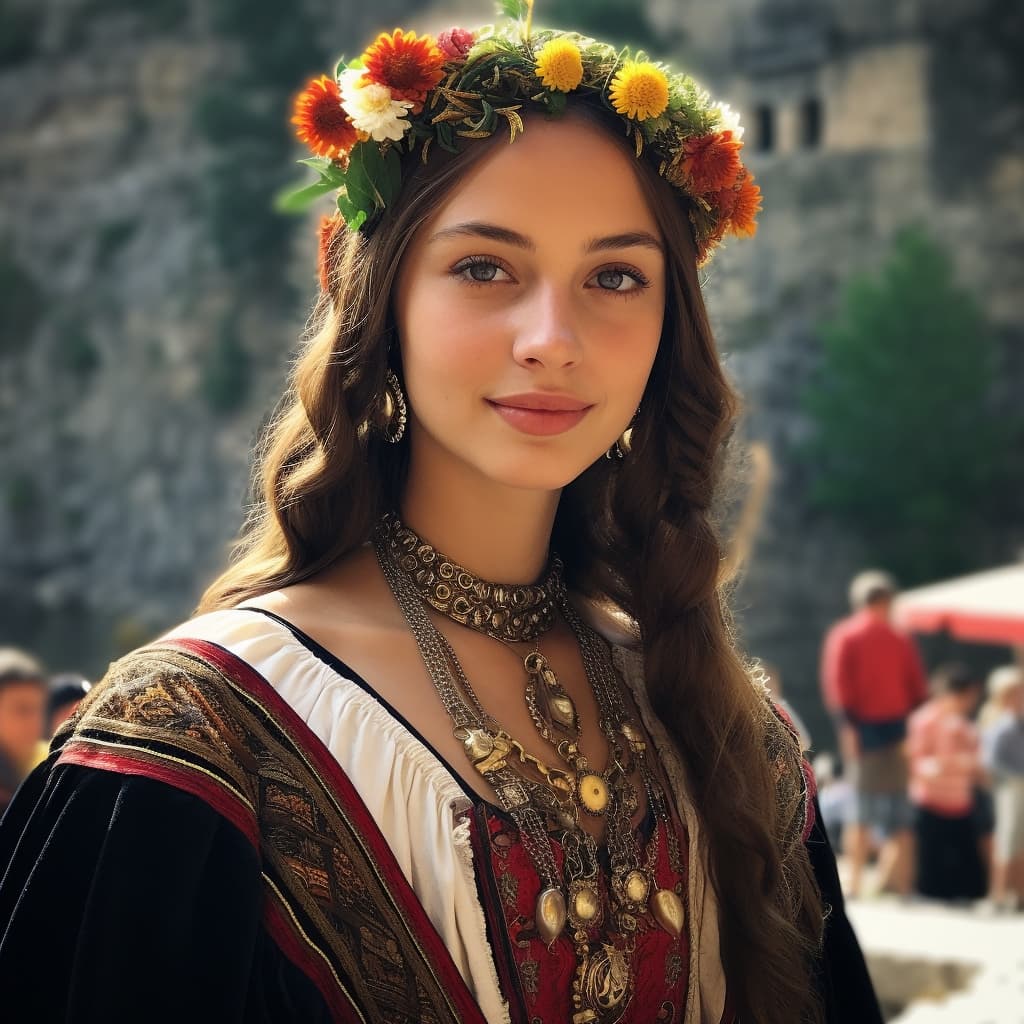
Occitans sit at the Mediterranean edge of the West European cline, and their phenotype reflects that crossroads — Iberian, Italic, Celtic, and a measurable Saracen-era North African contribution layered onto a Gallo-Roman base. The result is a population that reads as recognizably Southern French rather than Northern French: darker on average, with finer features and a narrower facial frame than the Germanic-influenced north.
Hair runs predominantly dark — chestnut to near-black is the modal range, with a meaningful brown-blond minority along the Atlantic Gascon coast and in the Auvergne highlands where Celtic substrate is heavier. Texture is typically straight to loosely wavy; tight curls appear but aren't the rule. True blondism is uncommon; redheads exist but at far lower frequency than in the Celtic fringe. Eyes follow the same logic: brown dominates at perhaps two-thirds of the population, with hazel and green well-represented and clear blue most frequently encountered among Gascons and Aranese near the Pyrenean and Atlantic edges. The epicanthic fold is absent; the eye opening is typically almond, set under a moderate brow.
Skin sits in the Fitzpatrick II–IV band, leaning III — an olive or wheaten undertone that tans readily and rarely burns deeply. Provençals and Languedociens often present visibly more Mediterranean coloring than Auvergnats from the volcanic interior, who skew lighter. Noses tend to be straight or gently aquiline with a moderately narrow bridge and restrained alar width; the heavy Roman nose appears but isn't the default. Lips are medium in fullness, jawlines moderately defined, and cheekbones often prominent without being broad — the face overall reads angular rather than rounded.
Build is on the shorter end of European averages, with men typically 170–177 cm and women 158–164 cm, lean to wiry frames, and a tendency toward compact musculature rather than the rangier proportions of Northern France. Frédéric Mistral's late portraits are a fair anchor for the classic Provençal type — dark-haired, olive-skinned, sharp-featured, and finely boned.
Data depth
34/100Coverage of image-grounded phenotype observations · drives AI generation diversity
- Sample size
- 32/40· 32 images
- Image quality
- 2/30· 3% high
- Confidence
- 0/20· mean 0.28
- Source diversity
- 0/10· wikipedia
- ·Low overall confidence
- ·Mostly low-quality source images
- ·Wikipedia-only source — not population-representative
Observed Distribution — Image Sample
Empirical observations from analyzed photographs · supplementary signal, not population truth
Sample: 32 images analyzed (32 wikipedia). Quality: 1 high, 9 medium, 15 low, 7 very_low. Avg analyzer confidence: 0.28.
Skin tone (Fitzpatrick): I (3%), II (31%), III (3%), V (3%), unclear (59%)
Hair color: black (31%), gray/white (28%), dark brown (9%), brown (6%), unclear (25%)
Hair texture: straight (13%), wavy (28%), curly (13%), covered (47%)
Eye color: dark brown (13%), blue (9%), hazel (6%), unclear (72%)
Epicanthic fold: 0% present, 63% absent, 38% unclear
Caveats: Quality skews toward older or low-resolution photos; phenotype detail may be lossy. Low average analyzer confidence — many photos partially obscured or historical. Sample is 100% Wikipedia notable people — skews toward male, public-life, and modern figures, not population-representative.
Last aggregated: May 7, 2026
Explore phenotype categories
Structured taxonomy with peer-reviewed scales · 22 anatomical categories
Notable Occitans People
100 reference figures — sourced from Wikipedia
- Petronius — courtier during the reign of Nero from Massalia, author of the Satyricon.
- Ausonius — 4th century Roman poet from Burdigalia.
- Bertran de Born — 12th century troubadour.
- William IX, Duke of Aquitaine — early troubadour and knight crusader.
- Marcabru — early 12th century troubadour.
- Monge de Montaudon — 12th century troubadour.
- Peire Vidal — early 13th century troubadour.
- Jaufre Rudel — major troubadour and crusader.
- Peire d'Alvernhe — second half of the 12th century troubadour.
- Comtessa de Dia — 12th century trobairitz (female troubadour).
- Raimbaut de Vaqueiras — 13th century troubadour and knight crusader during the Fourth Crusade.
- Arnaut Daniel — late 12th century major troubadour.
- Bernard de Ventadour — 12th century major troubadour.
- Peire Cardenal — 13th century troubadour.
- Antoine de la Sale — 15th century courtier, educator and writer.
- Mellin de Saint-Gelais — Poet Laureate of Francis I of France.
- Augièr Galhard — 16th century writer.
- Clément Marot — 16th century Renaissance poet.
- Théodore Agrippa d'Aubigné — early 17th century Baroque poet.
- Bartas — 17th century poet who wrote both in French and in Occitan.
- Honoré d'Urfé — 17th century Pastoral writer.
- Jean-Louis Guez de Balzac — 17th century Baroque author.
- La Rochefoucauld — 17th century moralist born in Paris to the famous noble Rochefoucauld family …
- Théophile de Viau — 17th century Baroque poet and dramatist.
- Cyrano de Bergerac — 17th century novelist and playwright. He was from a Dordognaise aristocratic …
- Fénelon — 17th century Renaissance writer.
- Nicolas Chamfort — 18th century poet, member of the Jacobin club.
- Marquis de Sade — 18th century aristocrat, revolutionary politician, philosopher, and writer. B…
- Marquis de Pompignan — 18th century man of letter.
- Luc de Clapiers, marquis de Vauvenargues — 18th century moralist.
- Baron de Montesquieu — an important writer and philosopher of the 18th century Enlightenment.
- Jean-François Marmontel — historian and novelist, member of the Encyclopédistes movement.
- Fleury Mesplet — founder of the Montreal Gazette (1778).
- André Chénier — late 18th century poet and figure of French Romanticism.
- Jansemin — 19th century Occitan language poet.
- Comte de Lautréamont — 19th century poet born in Uruguay to François Ducasse (consular officer) and …
- Émile Augier — 19th century dramatist.
- Honoré de Balzac — 19th century realist writer. Born in Tours, he was the son of Bernard Françoi…
- André Antoine — actor, theatre manager, film director, author, and critic as well as one of t…
- Théophile Gautier — 19th century poet and writer.
- Jules Vallès — 19th century writer.
- Émile Gaboriau — 19th century writer, journalist and novelist.
- Jules Laforgue — 19th century poet.
- Maurice de Guérin — 19th century poet.
- Alphonse Daudet — 19th century novelist.
- Pierre Loti — 19th century novelist and naval officer.
- Frédéric Mistral — 19th century and early 20th century Occitan-language poet and 1904 Nobel Priz…
- Théodore Aubanel — 19th century poet.
- Edmond Rostand — late 19th century playwright and novelist.
- Charles Maurras — late 19th century and 20th century influential poet, author and critic.
- Marguerite Genès — 20th century woman of letters and teacher who wrote in Occitan and French.
- Saint-Pol-Roux — 20th century poet.
- Paul Valéry — 20th century poet.
- Jean Paulhan — 20th century writer and intellectual.
- Henri Bosco — 20th century writer.
- Pierre Reverdy — 20th century poet.
- André Gide — 20th century writer and 1947 Nobel Prize in Literature. Born in Paris, his fa…
- Francis Jammes — 20th century lyrical poet.
- Jean Giraudoux — 20th century novelist, essayist and playwright.
- Jules Romains — 20th century poet and writer, founder of the Unanimism literary movement.
- Francis Ponge — 20th century poet and essayist.
- Léon Bloy — Christian writer.
- Jules Supervielle — 20th century poet.
- Jean Anouilh — 20th century playwright.
- René Char — 20th century poet.
- François Mauriac — 20th century writer and 1952 Nobel Prize in Literature winner.
- Marcel Pagnol — 20th century writer.
- Marguerite Duras — 20th century writer. Born Marguerite Donnadieu in French Indochina, she chose…
- Jean Giono — 20th century writer.
- Antonin Artaud — 20th century dramatist, poet, essayist, actor, and theatre director.
- Pierre Boulle — 20th century writer.
- Margareta Priolo — 20th century writer, singer, teacher
- Françoise Sagan — 20th century novelist, screenwriter and playwright.
- Marcela Delpastre — 20th century Occitan-language writer.
- Jean Vilar — theatre director and actor, founder of the Festival d'Avignon.
- Anne Desclos — 20th century journalist and novelist.
- Joan Bodon — 20th century Occitan-language writer. His mother, Albanie Boudou (née Balssa)…
- Jean Echenoz — 20th century writer.
- Jean Lacouture — 20th century journalist, historian and author, known for his biographies of f…
- J. M. G. Le Clézio — 20th century writer and poet, 2008 Nobel Prize in Literature winner.
- Philippe Sollers — 20th century writer and critic.
- René Barjavel — 20th century science fiction author.
- Renat Nelli — 20th century writer and founder of the Institut d'Estudis Occitans.
- Romain Puertolas — contemporary writer.
- Charles Dantzig — contemporary writer.
- Favorinus — Roman skeptical philosopher.
- Isaac the Blind — medieval kabbalistic philosopher.
- Samuel ibn Tibbon — medieval philosopher and doctor.
- Gersonides — medieval philosopher, Talmudist, mathematician, physician, astronomer and ast…
- Étienne de La Boétie — judge, writer and philosopher known for his Discourse on Voluntary Servitude.
- Michel de Montaigne — one of the most influential writers of the French Renaissance. He is known fo…
- Pierre Bayle — philosopher and writer, forerunner of the Encyclopedists and an advocate of t…
- Pierre Gassendi — philosopher and mathematician. His best known intellectual project attempted …
- Jean Domat — rationalist jurist.
- Blaise Pascal — mathematician, physicist, inventor, writer and Christian philosopher.
- Emmanuel Joseph Sieyès — essayist and political theorist of the French Revolution. He also made signif…
- Pierre Jean George Cabanis — 18th-century physiologist and Materialist philosopher.
- Auguste Comte — philosopher, he was a founder of the discipline of sociology and of the doctr…
- Charles Bernard Renouvier — 19th-century philosopher.
- Lou Andreas-Salomé — female psychoanalyst, born in Russia to German parents from partly Huguenot d…

Generate Occitans AI Content
Use this ethnicity's phenotype data to create AI-generated content with accurate physical traits and cultural context.
Open Creator Studio